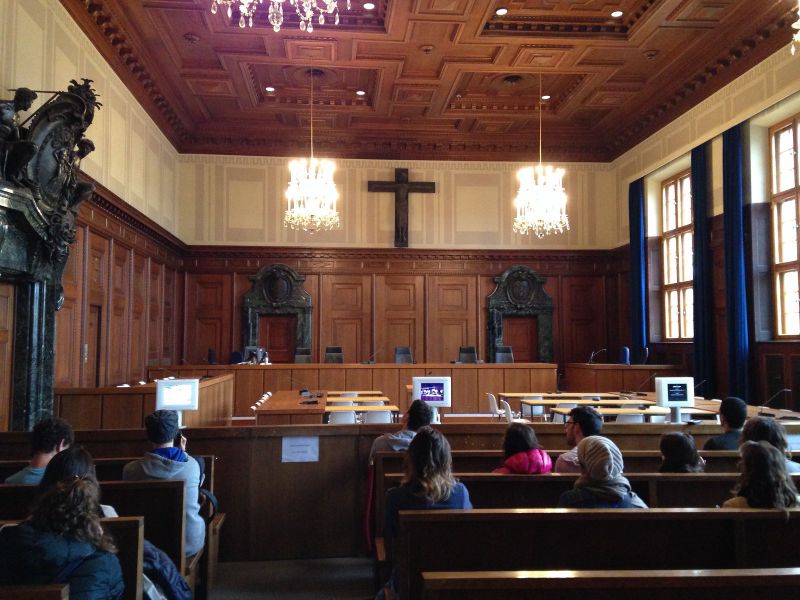
Nuremberg’s judges needed four languages heard as one, and translating each sentence in turn, language by language, would have made the trial run four times as long. So on 20 November 1945, everyone in the court put on a headset instead, and heard that day’s 24,000-word indictment live, each in their own language. What carried the sound to them was a system that had seen only limited experiments before.
more
A trial too urgent for the usual method
Officials had argued for months over what to do with the men the Allies now held. Britain wanted them shot as soon as they were caught and formally identified, while the United States and the Soviet Union pushed for a trial instead. The International Military Tribunal was finally set up on 8 August 1945, once the four powers had agreed which offences to prosecute. The Soviet Union insisted the charges cover only Axis aggression, since its own invasions of Poland and Finland would otherwise have belonged in the same dock.
Whispering used to be enough
Before the First World War, French served as the working language of diplomacy, so there was rarely anything to interpret between delegations. Once English joined French at the peace conferences that followed, delegates coped with whispered interpretation, someone murmuring a rendering straight into a colleague’s ear while the speaker carried on. A speech might otherwise be translated in advance and read out afterwards, or interpreted in full only once the speaker had finished. André Kaminker, who interpreted a 1934 Hitler speech for French radio, could render a ninety-minute speech without notes. His listeners still had to sit through the full speech first. The first dedicated school for interpreters did not open until 1941, in Geneva, four years before Nuremberg’s indictment was read.
A gadget first used at a labour conference, not a war-crimes trial
The technology already existed. In the 1920s, a businessman and an engineer trading as Filene-Findlay patented an audio system, and IBM built and sold it as the International Translator System. It had been used at the International Labour Conference in Geneva in 1927. Leon Dostert, a linguist who had served as Dwight D. Eisenhower’s personal interpreter, brought the system to the attention of the American judges organising the tribunal and took charge of its translation division. Working from a Pentagon office, he began recruiting interpreters, mostly for English and German, from 1 October 1945, seven weeks before the trial opened. France and the Soviet Union supplied their own language staff, and the United States shared its English speakers with Britain, while doing most of the recruiting, housing and paying itself.
The interpreter who went absent without leave to get there
Siegfried Ramler was fourteen and Austrian when he watched Wehrmacht troops enter Vienna from behind a drawn curtain in March 1938. The family lost their home soon after, and once Kristallnacht had passed, Ramler left on the Kindertransport for London, where he lived with an uncle near Hampstead Heath. By 1945 he had joined the US air force as a linguist working in Germany. When he heard about the trial of the Nazi leadership, he went absent without leave and hitched a ride to the Palace of Justice. Within days, with no training in interpretation, he was interpreting the pre-trial interrogation of Hans Frank, the former governor general of occupied Poland, later convicted of murdering three million Jews and Poles. Ramler remembered him as “interesting and impressive”, a man “overtaken by fanaticism” who nonetheless “knew he had done wrong”.
No pause to think, and no second attempt
Asked decades later how it felt to sit across from a man responsible for mass murder, Ramler said the feeling itself was not the issue. “We were there to interpret, not to judge,” he said. The work left little room to feel anything at all, he added: “I was 22, I just concentrated on the job.” That pressure caught out even practised interpreters. Virginia von Schon, a librarian working the English microphone, once reached a word so vulgar mid-sentence that she could not bring herself to say it, and simply stopped. Ramler took the microphone himself. “I took the microphone and used that word,” he said. “In fact I made it worse.”
A trial too long to read straight through
Even with interpreters working live, the trial ran for ten months, sitting on 210 separate days between 20 November 1945 and 1 October 1946. Its published transcript fills 42 volumes, and some call it the trial of six million words. Interpreters were meant to wait for a full unit of meaning before speaking it in another language, a lag of six to eight seconds when it worked as intended. Ramler stayed for all of it, from the first day to the last, when Sir Geoffrey Lawrence read out the sentences. Ten times he heard the words “Death by hanging”, in German Tode durch den Strang. That final session was never filmed, so as to preserve what dignity the defendants had left.