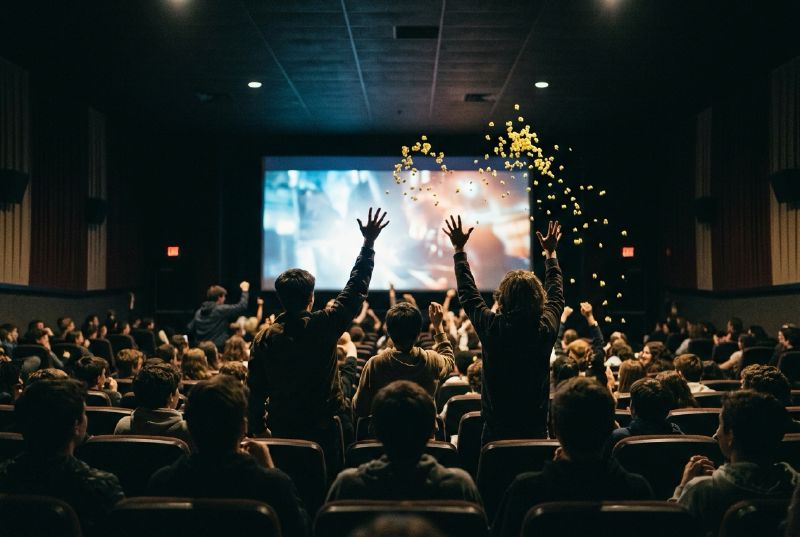
In April 2025, cinemagoers in Utah brought a live chicken to a screening of A Minecraft Movie. They had not come to watch quietly. Across the United States, teenagers climbed onto their friends’ shoulders, threw popcorn into the air, and filmed themselves cheering before the film had even started. At some screenings, the noise brought the police.
Before release, tracking had put the film’s opening weekend at around $65 million. By Saturday morning, insiders at the studio projected a $135 million domestic weekend, built off a Friday take of $58 million. The real three-day total, once every ticket was counted, was $163 million, including roughly $10 million from Thursday previews. That beat Barbie’s own opening weekend from 2023.
Worldwide, the film added a further $150.7 million from 75 other territories, for a $313.7 million global opening. It had cost $150 million to make. By the end of 2025 it was the highest-grossing release of the year in the United States, and the highest-grossing film of any kind at the UK and Irish box office, where it took £56.88 million.
A decade of directors who didn’t finish it
Warner Bros. had been trying to make this film since 2014, when Mojang founder Markus Persson first said the studio was in talks to adapt Minecraft. Shawn Levy, who went on to direct Deadpool & Wolverine, took the project on first. Rob McElhenney of It’s Always Sunny in Philadelphia followed in 2015. By 2019 it belonged to Peter Sollett, the director of Nick & Norah’s Infinite Playlist. None of them got it to a soundstage.
The trouble was the game itself. Minecraft has no set storyline. Players mine blocks and build whatever they choose. Mary Parent, chairman of worldwide production at Legendary Entertainment, said the title reflected that there was “no one story that drives the game.” Director Jared Hess put it more plainly: the film was “just one of a zillion stories.”
By 2022, Legendary had joined and Jason Momoa was in talks to play Garrett Garrison, a washed-up arcade owner. The rest of the cast was set between May 2023 and January 2024. Principal photography took place in New Zealand, and the finished visual effects were split across three studios: Sony Pictures Imageworks, Wētā FX and Digital Domain.
Microsoft, which owns Mojang, treated the film as an experiment. Phil Spencer, the head of Microsoft Gaming, said the company embraced “trial and error” in film and television. He said it had learned from both its Halo series, cancelled after two seasons, and Fallout.
The trailer fans hated, and the meal deals that followed
A first trailer arrived in September 2024, shown ahead of screenings of Beetlejuice Beetlejuice, and it landed badly. Fans disliked the look of the in-game sheep and said the effects looked unfinished. The reaction drew comparisons to the widely mocked first trailer for Sonic the Hedgehog in 2019. One Minecraft YouTuber, ElVitt0ri0, told the Guardian that any adaptation needed to avoid becoming, in the person’s words, a “corpo-vomited product.” Warner Bros.’ marketing co-heads, Dana Nussbaum and Christian Davin, changed course. A second trailer in February tested better with audiences.
By release, the studio had signed dozens of brand partners. McDonald’s built meal boxes around the film, Adidas produced a clothing line, Oreo made square cookies, and Doritos ran a cash-prize hunt in the UK for square-cut chips. Actors dressed as Jack Black’s character, Steve, walked through Times Square in New York as part of the push. Microsoft, which had bought Mojang for $2.5 billion in 2014, made keeping a PG tone an important requirement. The game itself has sold more than 300 million copies and generated over 1.3 trillion YouTube views.
A comedy director and a two-time video-game veteran
Warner Bros. handed the film to Jared Hess, the director of Napoleon Dynamite and Nacho Libre, an odd match on paper for the best-selling video game of all time. Napoleon Dynamite made $46.1 million worldwide in 2004. Nacho Libre made $99.3 million two years later. Hess had also made Gentlemen Broncos, which took just $114,000 in North America in 2009, and Masterminds, which made $29.7 million in 2015. Nothing in that record pointed to a film that could out-open Barbie.
Jack Black, who plays Steve, had already appeared in two other video-game adaptations, The Super Mario Bros. Movie and Borderlands, before this one. Momoa, as well as starring, was one of the film’s producers. The script passed through five credited writers, Chris Bowman, Hubbel Palmer, Neil Widener, Gavin James and Chris Galletta, working from a story credited to Allison Schroeder, Bowman and Palmer.
At the film’s London premiere in late March, neither lead sounded like someone bracing for a flop. Momoa told reporters he hoped fans would be “delighted,” and floated the idea of a sequel before the first film had even opened. Black, asked why the world needed a Minecraft film, argued that its message of creativity and cooperation mattered given how much “war and hatred” was in the news. Danielle Brooks, who plays the realtor Dawn, admitted on the same carpet that she was not herself a Minecraft player, though her five-year-old daughter was.
Earlier in 2025, the crime drama The Alto Knights had flopped with $9.5 million worldwide. Legendary had put up 25% of the $150 million production budget. The studio’s global distribution chief, Jeff Goldstein, later called Minecraft’s opening “lightning in a bottle.” Legendary’s Mary Parent won much of the credit for suggesting Hess as director.
Reviews that read like a warning
Critics were not kind. The film scored 48% on Rotten Tomatoes. Kevin Maher’s one-star review in the Times called it “garish, headache-inducing,” and “a lumpen splodge of commercial propaganda.” The Telegraph gave it two stars, saying the game’s charm was “nowhere to be found.” The Guardian also gave it one star, for its “cobbled-together feel.” The Observer’s review noted that the film’s villain, a wealth-hoarding piglin named Malgosha, doubles as an allegory for the studio bosses behind what the review called an “egregious IP cash-in.” The Hollywood Reporter’s verdict was a single word: “Mindnumbing.” Variety ranked it below Dungeons & Dragons: Honor Among Thieves, a film built from source material about fifty years old. Empire called it “more bust than block.” A student reviewer for Beloit College’s Round Table called it “deeply, wholly unoriginal,” despite a plot built around the value of creativity. Not every outlet was so harsh. The BFI called it a “fanciful block-buster” and its prologue a clever cross-generational gambit, but noted the decade of writers and directors it had taken to get there.
The audience that disagreed, loudly
None of it mattered at the till. On Letterboxd, the average rating for the film sat at a poor 2.8 out of 5. The single most common score users gave it, though, was a perfect 5. On Rotten Tomatoes’ own audience poll, the Popcornmeter, the film stood at 87%, against the critics’ 48%. Variety asked its own Gen Z staff writers what they made of it. One called it “classic dumb fun” carried by two “completely unhinged performances” from Black and Momoa. Another said it fell short of The Lego Movie, yet still found a charm in seeing familiar Minecraft moments reach a cinema screen.
CinemaScore gave it a B+, and under-18 audiences gave it a perfect A. Exit polling found the crowd disproportionately young and male: teenagers aged 13 to 17 made up 35% of opening-weekend audiences. The largest single group was 18 to 24, and men made up 65% to 67% of ticket buyers. The research firm PostTrak separately found that the 18-to-24 group alone accounted for 64% of the North American opening-weekend crowd. Steve Buck, chief strategy officer at the industry analyst EntTelligence, said the film had “overperformed all industry projections” and noted that about a quarter of the audience was under 13. Fathers turned out alongside their children.
What the audience did in the cinema became its own story. In one scene, a green zombie child rides a hen, and Black’s character shouts “Chicken jockey!” Fans in the crowd began shouting it back at the screen. Director Jared Hess said people kept sending him videos of teenagers hyping up entire auditoriums before the film even started. “It’s been way too fun,” he told Entertainment Weekly. The UK Cinema Association noted the “exceptional” crowd response. Once the reaction went viral, a cinema in Staffordshire still went on to ban under-18s from evening showings without an adult. A Guardian columnist argued it was time for “the grownups to lay down the law.” British comedian Sam Avery told the BBC that seeing the film with his sons was the most joyous cinema trip he had ever had.
Not every tribute in the film was chaos. Amid the noise, a crown-wearing pig makes a brief cameo, a nod to the Minecraft YouTuber Technoblade, who died of cancer at 23.
A sequel, A Minecraft Movie Squared, is due in cinemas in July 2027. Nothing about how critics received the first film changed how many tickets it sold. Warner Bros. now has to decide whether that was a one-off, or whether reviews just stopped being the thing that decides.