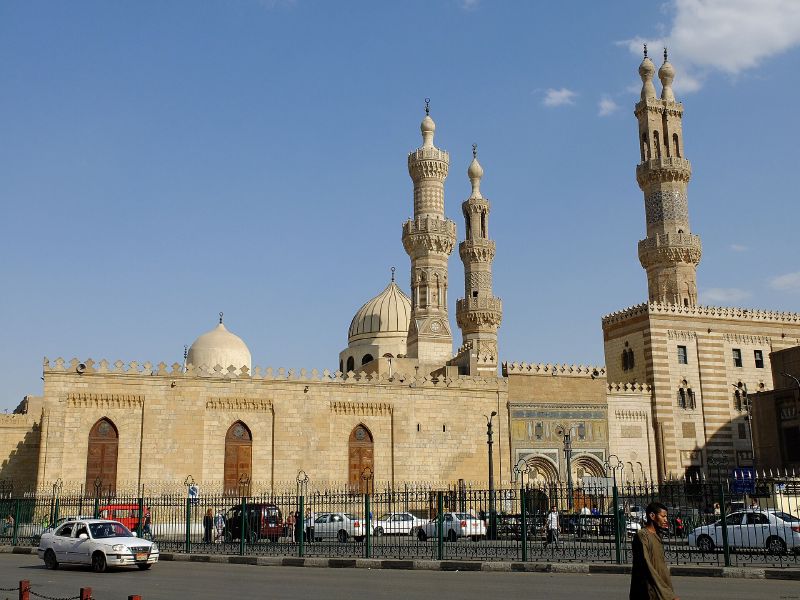
Jawhar al-Siqilli, the general who conquered Egypt for the Fatimid caliphate, laid the foundation of a mosque in his new city of al-Qahira in 970. Eighteen years later, that mosque held its first organised classes. Al-Azhar has kept that role as a seat of learning throughout Muslim history.
more
Who built it, and why
The Fatimids were Isma’ili Shi’a rulers who claimed descent from the Prophet Muhammad’s daughter, Fatima, through her marriage to Ali. Caliph al-Mu’izz li-Din Allah made Cairo his capital between 969 and 973, and the mosque he ordered built took its name from the title al-Zahra, “the luminous”, one of the honorifics linked to Fatima.
As the royal mosque of al-Qahira, it was reached from the Eastern Palace by passages only the caliph and his entourage used. The first Friday prayer was held there in 972, with the sermon read from its minbar. For its first years, Al-Azhar was what a congregational mosque was supposed to be: a place for the whole community to pray together, not a school.
The classroom that grew out of the prayer hall
That changed under Ya’qub ibn Killis, the vizier who served the Fatimid caliph al-Aziz. He formalised the imam’s role as supreme head of the community, and he was the first official to regularise teaching inside Cairo’s main mosque. By 988, the Fatimid state was paying 35 scholars to live nearby and teach Isma’ili doctrine to students at Al-Azhar. The Institute of Ismaili Studies describes the mosque as having “soon developed into a seat of learning” after its founding, a role it has kept throughout Muslim history.
The state’s backing became permanent in 1009, when Caliph al-Hakim endowed the mosque with a waqf, a charitable endowment made in perpetuity. Waqfs sustained most of Cairo’s great institutions until the nineteenth century.
A Shi’i school in a city that turned Sunni
Al-Azhar spent its first two centuries as the Fatimids’ flagship for Isma’ili Shi’i learning. Al-Azhar’s own history, as the Institute of Ismaili Studies records it, moved from being “the foremost center for Shi’i Isma’ili learning” to becoming, after the twelfth century, “a major Sunni educational institution.” The building survived the change of doctrine that built it.
What the building looked like, and why it kept changing
The original mosque was a hypostyle hall, with rows of arches carried on columns. A wide central aisle led to the mihrab, higher than the rest of the prayer hall. The other aisles ran parallel to the qibla wall. Al-Azhar’s builders reused marble columns with Corinthian capitals taken from older, pre-Islamic structures, and set a dome where the mosque’s main aisle met the wall facing Mecca.
Successive rulers kept adding to it. Caliph al-Amir carried out the first renovation in 1035, and Caliph al-Hafiz refurbished the mosque in 1129, adding four porticoes around the courtyard with the pointed, keel-shaped arches typical of Fatimid building. Fatimid mosques also favoured projecting portals, domes over the mihrab, and fine stucco decoration. Centuries later, Mamluk emirs competed with each other to add minarets and other embellishments, each trying to outdo the last patron’s contribution to the mosque’s standing.
From madrasa to modern university
In 1871, the reformer Jamal al-Din al-Afghani pushed Al-Azhar toward including Western sciences alongside its traditional curriculum. Legal reforms through the 19th and 20th centuries then reorganised the institution into the structure of a modern university, with faculties and degrees alongside its religious teaching.
The mosque Jawhar al-Siqilli founded for Friday prayers in 970 is still standing in Cairo, and people still study at the university that grew out of its prayer hall.