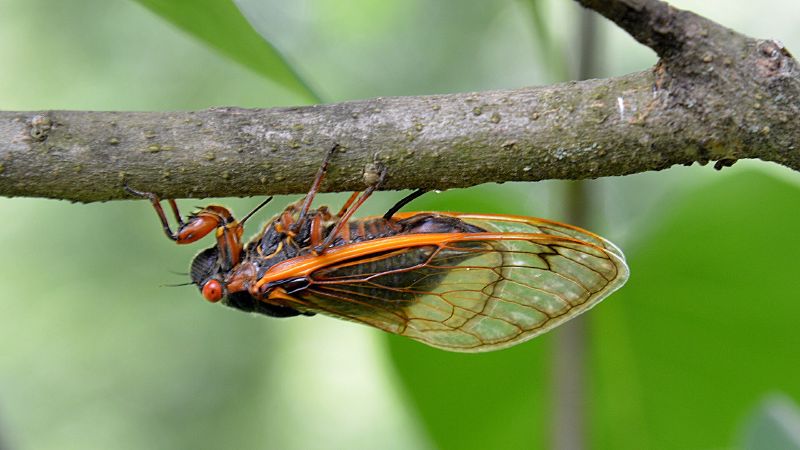
A 17-year cicada brood keeps two clocks. One counts years underground while the nymphs feed on tree roots. The other is a thermometer: in the year the count runs out, the nymphs wait until the soil reaches about 64 degrees Fahrenheit before they climb out. Why the insects keep to such long periods is still unclear.
more
Seventeen years on a diet of sap
A brood spends almost its whole life in the dark. Brood X nymphs, for example, drink xylem fluid drawn from tree roots and dig deeper as they grow, to reach bigger roots. Each nymph passes through five growth stages, called instars, before it surfaces. One account holds that the gap between the 13-year and 17-year cycles comes down to how long the second instar takes.
When the count is up, the nymphs dig to just below the surface and wait in chambers. Lou Sorkin, an entomologist at the American Museum of Natural History, said they usually come out at night, often after rain. Then they climb the first vertical thing they meet, whether a tree, a fence post or a person’s leg.
Why 13 and 17
Both numbers are prime, divisible only by one and themselves. North America has seven species of periodical cicada, and every one runs on one of those two cycles. WebMD puts three species on the 17-year cycle and four on the 13-year one.
Discover Wildlife sets out two theories. A prime cycle makes it harder for a predator with a two, three or four-year cycle to keep meeting the cicadas at its own peak. It also keeps the two cycles apart. A 13-year brood and a 17-year brood coincide only once in 221 years.
That last happened in 2024, when Brood XIII and Brood XIX surfaced together across the Midwest and the Southeast. The previous time was 1803, while Thomas Jefferson was president, and the next is due in 2245.
Safety in sheer numbers
Surfacing together is the point. Audubon describes cicadas as easy prey for birds, squirrels, foxes, fish and even ants, so a brood survives by swamping them. BBC Newsround reported that up to 1.5 million can emerge from a single acre.
The adults have little time. They live above ground for about four to six weeks, mate and die. Their eggs hatch in the twigs, and the young nymphs drop and burrow down to begin the count again.
When the clock slips
The count is not perfect. Some periodical cicadas surface in the wrong year, usually a few years early or late, and entomologists call them stragglers. John Cooley, a cicada researcher, has said these errors are a normal part of the life cycle. They often come in steps of one or four years.
One brood has kept time since colonial days. Gene Kritsky of Mount St. Joseph University told National Geographic that pilgrims recorded Brood XIV in the Plymouth colony in 1634. It still emerges in Plymouth today.