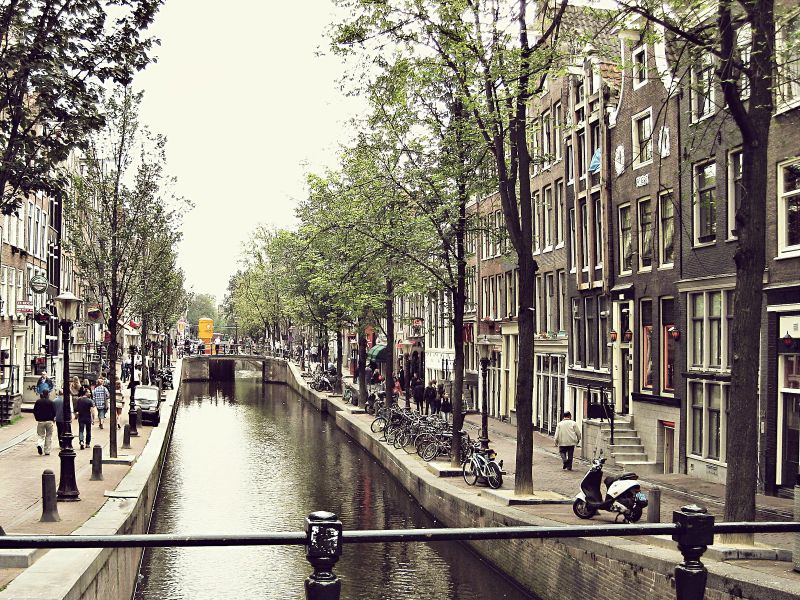
The first bike-share was a stunt. On a summer’s day in 1965, members of Provo, a Dutch anarchist group, painted a handful of used bikes white and left them unlocked in central Amsterdam for anyone to ride. They called it the Witte Fietsenplan, the white bicycle plan. The police soon removed the bikes. What turned the gesture into a working idea was one of its authors, who kept pushing it.
more
That man was Luud Schimmelpennink, an industrial engineer. The BBC puts the first batch at about ten old bicycles, spread across different points in the city. The Guardian calls it the first urban bike-sharing concept in history.
A protest against the car
Provo saw the white bike as its reply to air pollution and to consumerism. Its pamphlet contrasted the plain white bike with what it called the filth of the authoritarian car.
Sara Stolk-Duijs joined Provo as a teenager. She told the Guardian that traffic was a real problem in Amsterdam at the time. In her account, the city could not cope, the air was dirty and children could no longer play safely in the street. She later rode to her own wedding in Zaandam on a white bike, which drew plenty of press.
Schimmelpennink drew on an older precedent. He told the Guardian he was thinking of 17th-century Amsterdam. The city had doubled in size, and carriages had choked its streets. The council answered with squares on the edge of town, where people left their carriages and walked on. Provo wanted drivers to do the same thing, and ride a white bike for the rest of the trip.
Why did the first scheme fail?
Schimmelpennink himself called that first plan symbolic. “We painted a few bikes white, that was all,” he said.
The police were hostile to Provo, and took the free bikes off the streets quickly. The BBC says the scheme did not last, but that it had a large influence and passed into popular culture.
From stunt to council plan
Two years later Schimmelpennink won a seat on Amsterdam’s city council. He used it to put forward a far bigger version.
His proposal was for the city to spread 10,000 white bikes across Amsterdam, free for everyone. He had done the sums. By his figures, a white bike would cost the city about 10% of its public transport subsidy per person per kilometre.
The council turned it down without a single vote in favour. Schimmelpennink recalled their verdict: the bicycle belonged to the past, and the future was the car.
The Witkar
He switched to cars. He designed a shared scheme for small electric cars, called the Witkar. The politician Ed van Thijn backed the project. It opened in 1974 with one station and four cars.
Users joined as members and paid a small charge per mile. A computer ran the system, primitive but well ahead of its day, the Guardian says. Early on, police cars followed the witkarren to watch for trouble. The team parked the cars in a church overnight for fear of theft.
Schimmelpennink reckoned the scheme needed at least 25 stations to succeed. The money for that never came, though the cars stayed on the streets for ten years. The BBC counts the Witkar as an early computerised car-sharing scheme.
Where did the idea go next?
Around the world, eventually. Hundreds of cities now run bike-sharing systems, the Guardian reported in 2016. Schimmelpennink went on to advise on the kind of schemes seen in cities today, according to the BBC. He told the BBC’s Janet Ball his story in 2019.
The odd part is his home town. The Guardian’s piece asks why Amsterdam, a city in love with the bicycle, never took up his invention. The first bike-share began in Amsterdam, and Amsterdam is where it never caught on.