Andrew Wiles proved Fermat’s Last Theorem by not attacking it head on. He proved a piece of a much larger conjecture linking two distant areas of mathematics, and the theorem followed from that. Getting there took him seven years of secret work, and then one more year to repair a flaw a reviewer found.
The claim in the margin
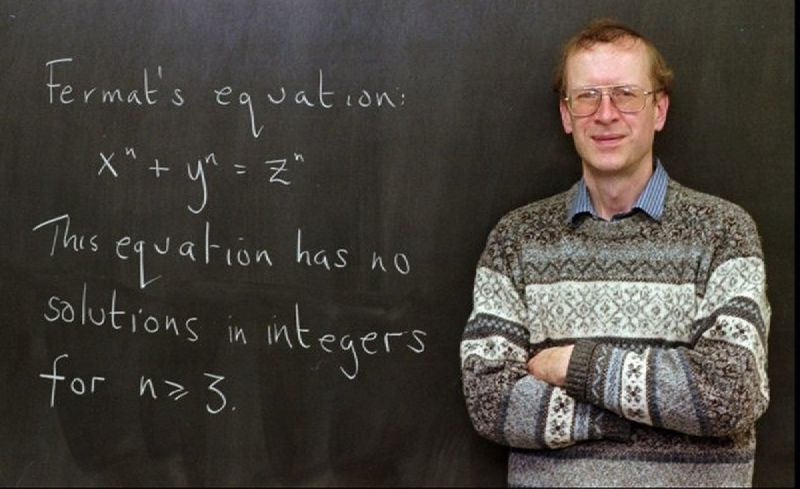
The theorem says that the equation x to the n, plus y to the n, equals z to the n has no positive whole-number solutions once n is bigger than 2. Pierre de Fermat wrote it in 1637 in the margin of his copy of Diophantus’s Arithmetica, adding that the margin was too narrow for his marvellous proof.
Readers confirmed every other note Fermat left in those margins within a few years. This one held out, which is why it became the “last” theorem. Fermat himself proved the case n equals 4.
The route Wiles took
Wiles, then a professor at Princeton, worked alone in the attic of his home. His proof built a bridge between equations called elliptic curves and objects called automorphic forms, which Robert Langlands had conjectured should match up. Wiles established that bridge only between two small plots on either side, Quanta Magazine explains, but that was enough.
He announced the result in June 1993, in a lecture series at a conference in Cambridge, England. The story reached the front page of The New York Times the next day.
The crack
The 200-page proof went to the journal Inventiones Mathematicae, whose editor split it among six reviewers. One of them, Nick Katz of Princeton, checked his section for two months with Luc Illusie. In late August Katz found a step that Wiles could not satisfactorily explain, and the hole grew as Wiles probed it.
Wiles spent about another year on the problem before fixing it. He had help: Quanta credits Richard Taylor with assisting on the final proof.
Why the episode still matters
Mathematicians cite the flaw as a warning. Andrew Granville of the University of Montreal told Live Science that famous papers have been wrong over small linguistic issues, and Live Science calls Wiles’s proof perhaps the best-known example. That worry drives the push to check proofs in computer languages such as Lean.
The proof also kept growing after it was done. Toby Gee of Imperial College London called it one of the best things in 20th-century mathematics, and still only a tiny corner of the larger bridge. In 2020 two papers by more than a dozen mathematicians extended that bridge, which may one day prove Fermat’s theorem for number systems beyond the whole numbers.