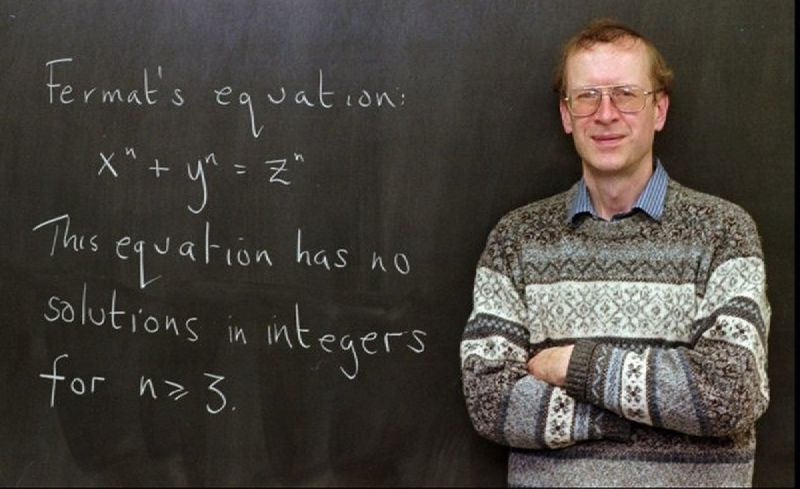
Andrew Wiles proved Fermat’s Last Theorem by working almost entirely alone, in secret, before announcing a proof at a mathematics conference in Cambridge, England, on 23 June 1993. Fermat’s Last Theorem says no positive whole numbers x, y and z satisfy xⁿ + yⁿ = zⁿ once the exponent n rises above 2. Pierre de Fermat scribbled the claim into a book’s margin in 1637, adding that he had found a “marvellous proof” too large for the space available.
more
Why it took 358 years
Mathematicians spent the years after 1637 chasing the proof one exponent at a time rather than all at once. Fermat himself had settled the case where n equals 4. Euler proved the case for 3 between 1753 and 1770, though Legendre had to patch a gap in the argument. Sophie Germain showed in 1820 that a class of prime exponents ruled out solutions under certain conditions, and Legendre and Dirichlet proved the case for 5 in 1825. Gabriel Lamé proved the case for 7 in 1838, and made instructive errors in further attempts, at a time of many developments in algebraic number theory. None of it reached every exponent at once.
The shortcut through elliptic curves
Wiles’s route to a full proof ran through a separate claim, the Taniyama-Shimura conjecture, about a class of curves called elliptic curves. Ken Ribet had shown in 1986 that if that conjecture held, Fermat’s Last Theorem followed as a consequence. Wiles set out to prove enough of the conjecture to force that conclusion, working in secrecy so that the attention a public attempt on Fermat would invite could not slow him down.
He announced the result during a series of lectures at the Isaac Newton Institute. Eyewitnesses called the atmosphere in the room electric. Word reached mathematicians worldwide by email within hours, and newspapers reported the achievement across several countries.
The gap, and the year it took to close
The announcement did not settle the matter. Reviewers checking the argument found a gap, and Wiles spent about another year repairing it with help from Richard Taylor. The completed proof filled two papers making up the May 1995 issue of the Annals of Mathematics, one of them written jointly with Taylor.
The Fields Medal has an age limit Wiles had already passed by 1995, so in 1998 the International Mathematical Union gave him a silver plaque instead, and he was knighted two years later. In 2016, the Abel Prize went to him for solving what the award announcement called a three-century-old problem in number theory. The BBC’s Horizon strand broadcast a documentary on the proof, titled “Fermat’s Last Theorem”, in January 1996. Simon Singh’s book on the same story, Fermat’s Enigma, became a bestseller in Britain before its American release the following year.