Most Antarctic research stations make their electricity from a mix of sources, and diesel fills the gaps. Nature reported in 2006 that stations typically have some wind and solar power but rely on diesel generators for part of their energy. They lean on them most in winter, when there is little sun.
The interesting cases are the bases that try to do without, or with much less.
The station built to run on wind and sun
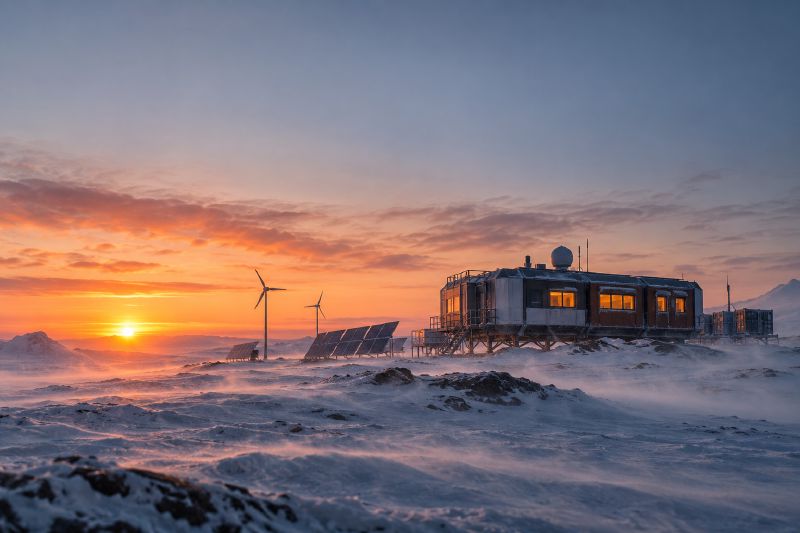
Belgium’s Princess Elisabeth station was planned as the first Antarctic base to run on solar and wind power alone. Nature put its cost at €6.4 million when the Belgian government committed to it in 2006.
The design relied on being small. Project manager Johan Berte said the building would be about a quarter the size of most polar stations, house 12 people as a rule, and need about 30 kilowatts at peak.
In summer, almost all its power was to come from solar panels built into the roof and walls. For winter use, Berte said up to ten small wind turbines of 6 kilowatts each could harvest the strong winter winds and supply power through the dark months. An emergency generator would still be switched on now and then for safety.
By 2013 the Guardian described Princess Elisabeth as the first zero-emission station, powered by wind and sun and built from super-insulated wooden panels.
Why bigger bases find it harder
Size changes the sums. Karl Tuplin, then project manager for Britain’s Halley VI, told Nature the Belgian approach was good but hard to scale up. Halley VI was designed for 52 people, and its target was a 15% cut in energy use rather than full self-sufficiency, mainly through efficiency.
At the other extreme, the Guardian reported that the American McMurdo base may have the largest carbon footprint of any building on Earth. It described India’s Bharathi station as sharing Princess Elisabeth’s green credentials, and South Korea’s Jang Bogo station as clad in solar cells.
A jet engine in a box
When Halley had to run without people, the British Antarctic Survey tried something else. Ice instability forced staff out over winter, and the BBC reported that a micro-turbine spinning at 70,000 rpm around the clock was generating a constant 9 kilowatts.
That supply let the survey run about 80% of Halley’s normal experiments with nobody on site, sending data home by satellite. Among them was the Dobson instrument that measures the ozone layer, which had sat idle through two unstaffed winters.
Thomas Barningham, who led the automation project, told the BBC that deep-field experiments are usually limited to solar panels, batteries or a small wind turbine. A self-running turbine that lasts nine months, he said, would allow more power-hungry science far from any base.