The Apollo-Soyuz docking happened because two rivals had stopped racing. By the 1970s the United States and the Soviet Union faced other enemies and tighter space budgets, and both spoke openly of working together. On July 17, 1975, an American Apollo and a Soviet Soyuz locked together in orbit.
It was the first time spacecraft from two countries met, docked and parted in space.
From a moon race to a handshake
The rivalry had been sharp. John F. Kennedy started the race to the Moon in 1961 to beat the Soviets at something. Over the following years the two sparred over communism and nuclear arms, but relations slowly improved.
Crew member Vance Brand recalled American astronauts and Soviet cosmonauts meeting at a Paris Air Show a few years earlier, and enjoying it. Behind the scenes, NASA, the State Department and the Russian Academy of Sciences worked towards a joint flight. The mission’s name became official on June 30, 1972, and it took five years to prepare.
Brand admitted the suspicion at first. The Americans thought the Soviets aggressive, he said, and the Soviets probably thought the Americans monsters. That passed quickly once they met people in the same line of work.
How the crews learned to talk
The Americans spent months learning Russian and flying back and forth to study the Soyuz. The Soviets learned English and visited NASA.
Tom Stafford, the Apollo commander, found a trick. In training he offered to speak Russian to the Soviet backup commander, Anatoliy Filipchenko, if Filipchenko would answer in English, and it worked well. In orbit the crews kept the rule: the Americans spoke Russian and the Soviets spoke English.
Deke Slayton believed the Americans’ rooms in the Soviet Union were bugged. As a test, the crew complained aloud about having no pool table, and one appeared the next day.
The flight
Soyuz 19 launched from the Baikonur Cosmodrome on July 15, 1975, carrying Alexei Leonov and Valeriy Kubasov. Apollo followed from Kennedy Space Center the same afternoon, with Stafford, Slayton and Brand aboard.
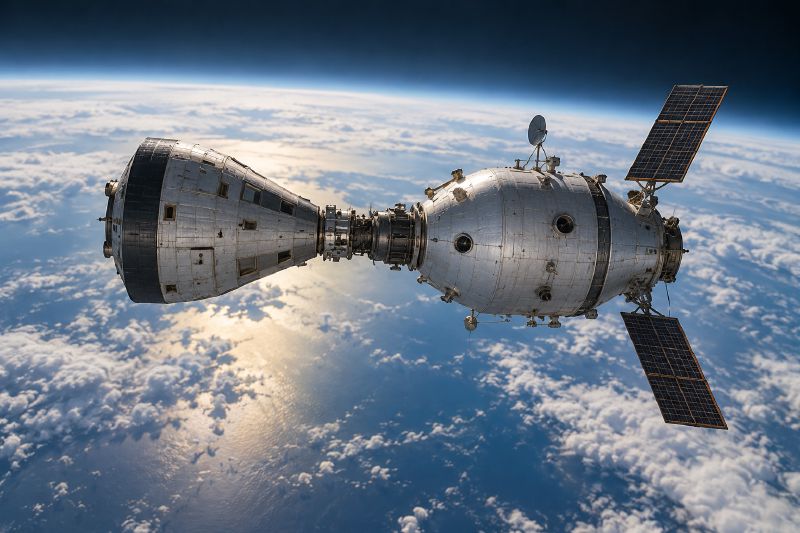
The two craft joined using an “androgynous” system of petal-shaped plates. Apollo carried a docking module built for the mission, an airlock that raised or lowered the pressure as crews passed between craft. Stafford opened the hatch, and he and Leonov shook hands.
They stayed docked for about 47 hours, with four crew transfers and joint experiments. The science included ultraviolet astronomy and an artificial solar eclipse to image the Sun’s corona.
What came after
The mission was designed partly to open the way for international space rescue. It also laid the groundwork for the Shuttle-Mir programme of the 1990s and the International Space Station.
It was the last time US astronauts flew until the first Space Shuttle launch on April 12, 1981. Americans and Russians did not fly together again until 1994.
Stafford and Leonov stayed close long after the flight. Leonov, Stafford said, had become like a brother.