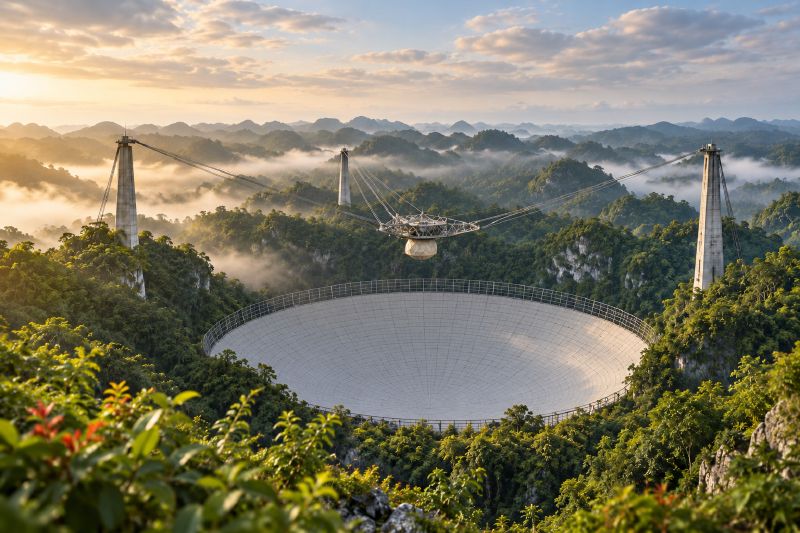
The Arecibo telescope began as a radar for studying the upper atmosphere, paid for by the Pentagon. Cornell University engineer William Gordon conceived it to probe the ionosphere, and the US military’s Advanced Research Projects Agency (ARPA) funded it. ARPA hoped the instrument might help track nuclear missile launches, Astronomy magazine reports.
When it opened in 1963, it was called the Arecibo Ionosphere Observatory. Astronomy came later, almost by accident.
What the military wanted
ARPA’s idea was that an incoming nuclear missile might leave a wake in the ionosphere that a big enough radar could spot. Donald Campbell, a former director of the observatory, told Astronomy that even ARPA realised early, while the dish was still being built, that this was unlikely to work. “As it wasn’t, by the way,” he added.
The ionosphere mattered for another reason. Its quirks affected long-distance radio communication, which was of great interest to the military, the SETI Institute notes. Space.com adds that the project also drew funding from the Office of Naval Research.
Gordon himself was clear about the priorities. “Honestly, the observatory was built to study the upper atmosphere,” he said in a 1994 oral history. Radar and radio astronomy, in his words, were “fringe benefits”.
Why Puerto Rico, and why a sinkhole
The planners wanted a site near the equator, so the planets would pass more or less overhead. Hawaii’s big island lay further south, but the Cornell team judged it too far from Ithaca. They chose Puerto Rico.
The dish needed a hole to sit in. Its 1,000-foot reflector of perforated aluminium panels was laid into a natural sinkhole in the karst of north-west Puerto Rico. Gordon is said to have found the spot by sliding a nickel around a topographic map until it fitted a natural hollow.
Gordon recalled that “eminent authorities” told the team in the late 1950s that it could not be built. It was dedicated in 1963 as the world’s largest radio telescope.
How astronomers took over
Radio astronomers wanted in from the start. In 1959 Cornell’s dean of engineering, Dale Corson, hired the British astrophysicist Thomas Gold from Harvard to run an astronomy programme that would include Arecibo. Gordon resented it, and the two men had different visions for the dish.
Then came pulsars. Jocelyn Bell Burnell found them in 1967. Campbell explained why Arecibo suited them so well. Pulsar signals resemble radar pulses, and the dish had been built around radar. “So everybody converted over to doing pulsars,” he said.
ARPA’s interest faded, and in 1969 the National Science Foundation (NSF) took ownership. It renamed the site the National Astronomy and Ionosphere Center and kept Cornell on to run it.
What the converted radar found
In 1992 the Polish astronomer Aleksander Wolszczan used Arecibo to find the first planet around another star, according to the SETI Institute. The BBC notes that the telescope served radio astronomers for 57 years.
It ended badly. A cable holding the 900-ton instrument platform failed on August 10, 2020. More cables gave way, and on December 1, 2020, the platform fell onto the dish. A National Academies committee later concluded that engineers had missed warning signs.