Artemis II lifted off on 1 April 2026 and carried four people farther from Earth than anyone had travelled before. It splashed down in the Pacific off San Diego on 10 April, closing the first crewed trip toward the Moon since the Apollo programme ended in 1972.
more
It was also the first time astronauts rode NASA’s Space Launch System rocket and sat inside an Orion capsule. Artemis I had sent Orion around the Moon empty in late 2022, so this flight was the test with people aboard.
Who was on board
NASA named the crew on 3 April 2023: three of its own astronauts and one from the Canadian Space Agency. Reid Wiseman commanded, Victor Glover piloted, and Christina Koch and Jeremy Hansen flew as mission specialists.
Each of them set a mark. Glover became the first Black astronaut to fly around the Moon, and Koch the first woman to leave low Earth orbit. Hansen, a Royal Canadian Air Force fighter pilot on his first spaceflight, became the first non-American to reach the Moon’s vicinity. Wiseman had flown once before, on a 165-day stay aboard the International Space Station in 2014.
Why the launch slipped from February
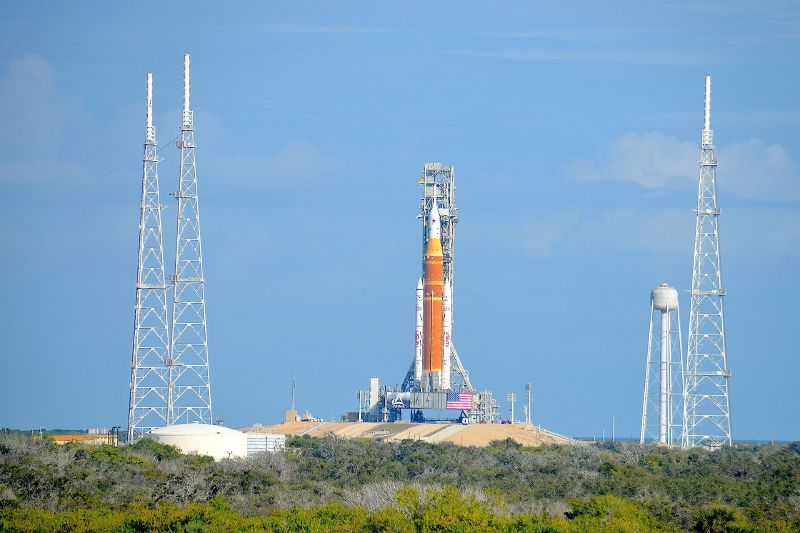
NASA had aimed for a launch no earlier than February 2026 from Pad 39B at Kennedy Space Center. A fuelling rehearsal that began on 31 January found liquid hydrogen leaking, and the team repaired it at the pad. A second rehearsal from 19 to 21 February went well. Then engineers found a break in the helium flow that pressurises the upper stage’s tanks.
That fault could not be fixed at the pad. The rocket went back to the Vehicle Assembly Building on 25 February and returned to 39B on 20 March, a 6.4 kilometre crawl that took about 12 hours.
How close they came to the Moon
Orion spent its first day in Earth orbit while the crew and mission control checked its systems, and Glover flew the capsule by hand. The burn that sent the crew toward the Moon came on 2 April, at 39,472 kilometres an hour. On 6 April the spacecraft passed 6,545 kilometres from the lunar surface. The Moon then blocked radio contact with Earth for about 40 minutes.
At the far point the crew was 406,771 kilometres from Earth. That beat the record Apollo 13 had held since 1970. Eleven parachutes slowed the capsule to about 27 kilometres an hour before it met the water.
What the flight was meant to prove
Artemis II never landed and never went into lunar orbit. Its job was to check Orion, the rocket and mission operations with a crew aboard, ahead of later landings. NASA frames the flight as a step toward a lasting return to the Moon and, later, crews on Mars.
The landing itself has moved. NASA decided in 2026 that Artemis III would test a lunar lander in Earth orbit, leaving the first touchdown to Artemis IV in 2028.