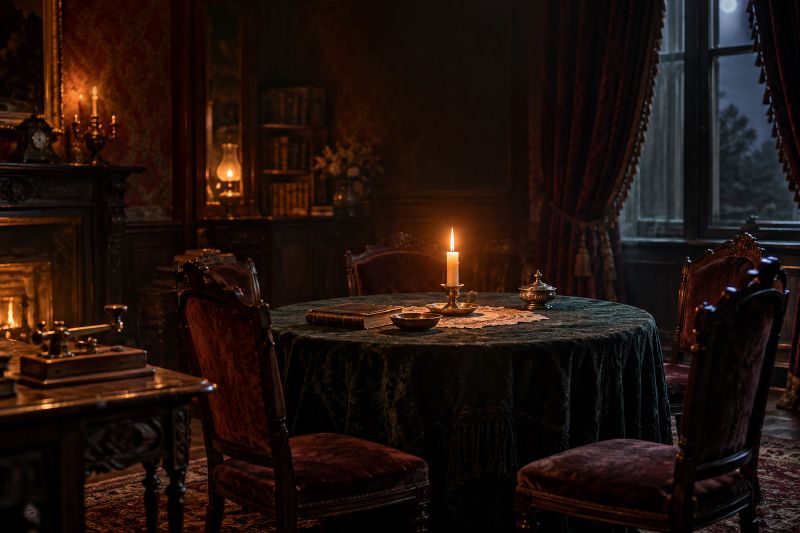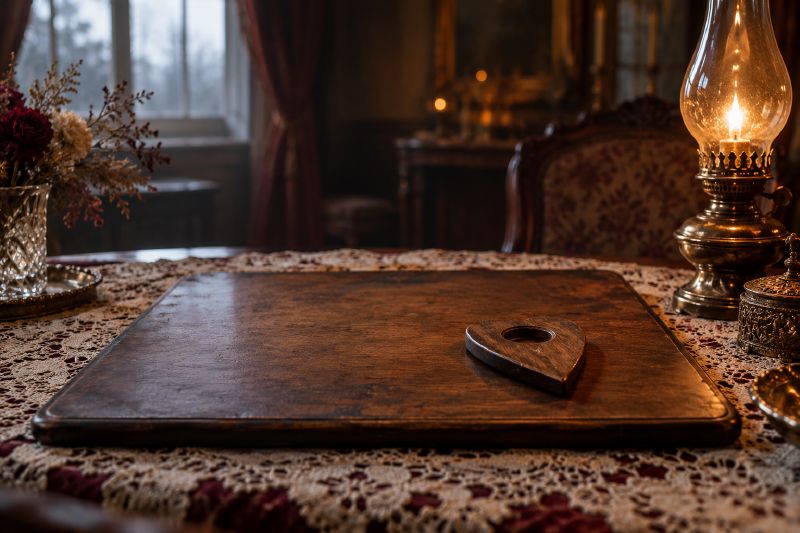
The Ouija board began as a toy. The Kennard Novelty Company of Baltimore introduced it in 1890 as a “wonderful talking board”, and families played it in the parlour.
The board was plain cardboard. It carried the alphabet, some numbers, and three words: “yes”, “no”, and “goodbye”. Players rested their fingers on a triangular pointer, which seemed to move by itself and spell out answers.
Where the idea came from
Talking boards grew out of Modern Spiritualism, which took hold in the 1840s. Smithsonian Magazine dates the American movement to 1848, when the sisters Kate and Maggie Fox said spirits rapped on walls to answer them.
Spiritualists found the old methods slow. Calling out the alphabet and waiting for a knock bored people, says the historian Brandon Hodge, at a time when the telegraph already carried messages across great distances.
Grief helped the fashion along. After the US Civil War, most families had lost someone, and Robert Murch of the Talking Board Historical Society says talking to the dead was a normal way to cope.
The men who founded the Kennard Novelty Company in Baltimore were chiefly after customers’ money, Smithsonian Magazine says. Early advertisements called it “Ouija, or, the Wonderful Talking Board”, and one New York newspaper advertisement put the price at $1.50.
How the board turned dark
For a while the board stayed cheerful. In the 1920s it became a date game, and Norman Rockwell put a couple with a board on their knees on a 1920 cover of The Saturday Evening Post.
In 1967 Ouija outsold Monopoly, the only game to do so, and over two million boards sold that year.
The change came with the late 1960s and the Manson murders, which fed the board’s darker image. Then The Exorcist arrived in 1973. A child plays alone with a board in a brief scene and later becomes possessed.
John Kozik, owner of the Salem Witch Board Museum, says it was the first film to suggest evil could come through the board that way. Later horror films, such as Witchboard, helped set many myths that persist.
What moves the pointer
Studies point to the ideomotor phenomenon, a psychological effect in which people move objects without knowing it.
That has not ended the fear. Kozik says people still send him boards they want to be rid of, even when they accept the science.