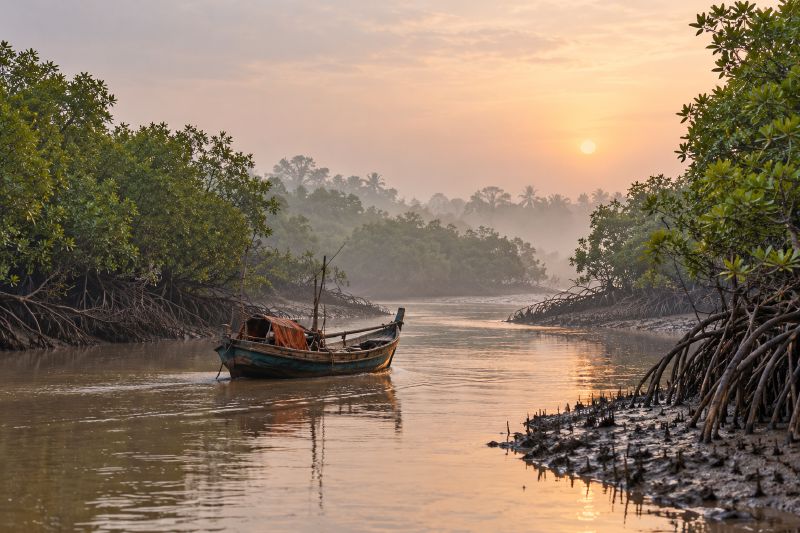
The Sundarbans stands between millions of people in Bangladesh and the sea. The International Union for Conservation of Nature (IUCN) says the forest protects them from cyclones, storm surges and other climate hazards. That shield is now under strain.
Rising seas are swallowing parts of the forest, and saltier water is harming its plants and marine life, National Geographic reported.
How big the forest is
No mangrove forest on Earth is bigger, and no river delta is bigger than the one it grows on. The BBC put it at six times the size of Greater London.
UNESCO gives the whole area as 10,000 square kilometres, with 60% in Bangladesh and the rest in India. The Ganges, Brahmaputra and Meghna rivers built the land from their sediment, and the tides shaped it. The result is a maze of islands cut by brackish channels.
Who lives there
It is the only mangrove forest in the world where tigers live. Its Bengal tigers are the only ones adapted to mangroves. Other residents include Irrawaddy dolphins, estuarine crocodiles and the river terrapin, a critically endangered turtle found nowhere else.
People depend on it too. Nearly half a million make a living there, catching fish and crabs or gathering honey. The work is dangerous. Officially about 50 people a year are killed by tigers, the BBC reported, though the unofficial figure may be nearer 150.
Many locals have long worshipped Bonbibi, the lady of the forest. In one telling she struck a bargain with a tiger spirit that he would spare anyone who prayed to her. Some still pray to her before going in.
Fewer tigers, more pressure
The tiger counts have fallen. A 2004 census estimated around 440 tigers in the Sundarbans. Later surveys found around 106 on the Bangladeshi side, according to National Geographic.
Land loss is pushing people deeper into the forest. They clear trees for farms, and some poach.
A five-year plan
In May 2026 the Bangladesh Forest Department and IUCN Bangladesh launched a five-year project called CRIS, with French development funding. It targets climate change, salt intrusion, damaged habitat and overuse of the forest. The work includes climate-risk assessments, hydrological studies, wildlife surveys and restoration led by local communities.