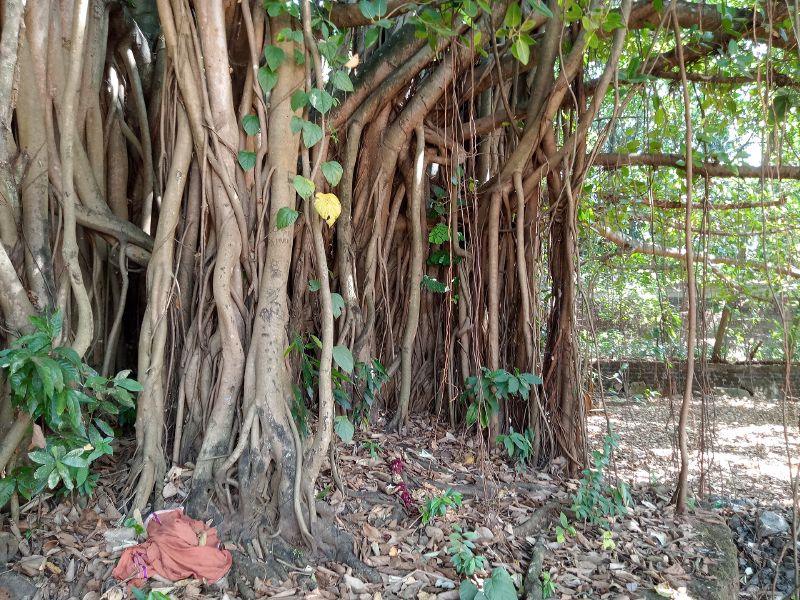
A banyan grows roots from its branches, and lets them hang until they touch the ground. Once anchored in the soil, those roots thicken into pillars that look and work like extra trunks. That is how a banyan spreads sideways.
more
It starts life on another tree
The Indian banyan, Ficus benghalensis, belongs to the mulberry family and is native to the Indian subcontinent. It often begins as an epiphyte, a plant that sprouts in the branches of a host tree. From there it sends vine-like roots downwards, which shade the host as they wind towards the forest floor.
When those roots reach the earth they spread underground and take water and nutrients from nearby plants. The banyan puts those resources into thickening the roots into trunk-like columns, and it keeps spreading as far as the ground around it allows.
What tells a branch to grow a root
A genome study published in the journal Cell in 2020 looked for the answer in a related banyan fig, Ficus microcarpa. Ray Ming, a plant biologist at the University of Illinois, led it with Jin Chen of the Chinese Academy of Sciences.
They compared it with Ficus hispida, a fig that grows no aerial roots. The banyan’s genome held more duplicated segments, making up about 27% of it, according to Ming. Those copies added genes for making and moving auxins, the hormones that drive plant growth.
Ming said auxin levels in the aerial roots ran five times higher than in the leaves of fig trees with or without them. The team concluded the extra auxin appears to trigger the roots. The duplicated stretches also carry genes for a light receptor that speeds up auxin production.
How far one tree can go
Thimmamma Marrimanu, in Andhra Pradesh, holds the Guinness World Records title for the largest single tree canopy. It has more than 4,000 roots in its canopy and spreads over five acres. The local forestry department argues it now covers eight acres and is 660 years old.
The tree has an entire temple at its centre. Cyclones and droughts have knocked whole clumps of its roots sideways, yet it is still expanding.
A smaller example stands in Lahaina, on Maui, where a sapling eight feet tall shipped from India was planted in front of the courthouse. The Smithsonian put its age at 150 years in 2023. By 2023 it was 60 feet tall, with more than 46 trunks over two-thirds of an acre. When wildfire swept the town that August, county officials wrote that if the roots were healthy it would likely grow back.