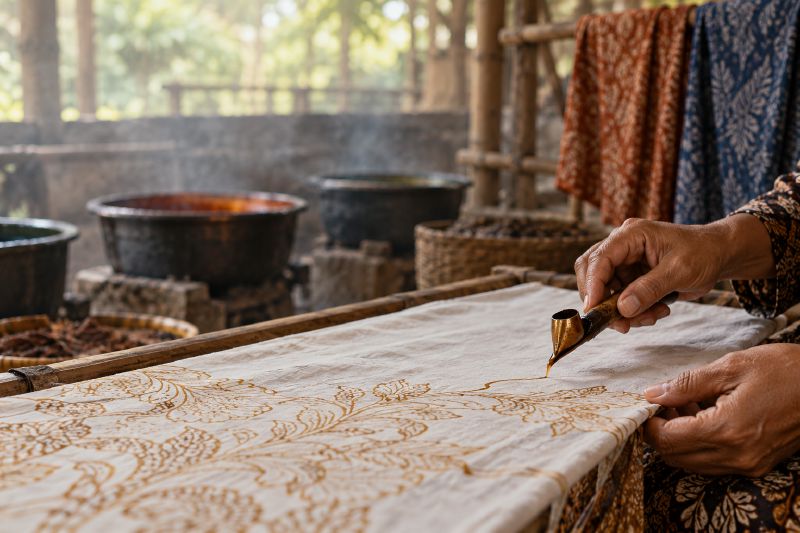
Wax stops dye by getting there first. Batik is a resist technique: the artisan lays hot wax on the cloth, and wherever the wax sits, the dye cannot reach the fibres. Soak the cloth, and only the bare areas take the colour. Remove the wax, and the protected areas show through in the colour they had before.
UNESCO describes Indonesian batik as hand-dyed cotton and silk on which craftspeople draw designs in dots and lines of hot wax. The wax resists vegetable and other dyes.
Why the wax has to be hot
Temperature decides whether the barrier holds. BBC Bitesize’s guide for art students warns that a wax line you cannot see on the fabric means the wax was not hot enough. In that case the dye will bleed under the line.
The traditional tool is the tjanting, a wooden handle with a small metal spoon that holds liquid wax. The guide also describes stamping wax on with metal or wooden printing blocks instead of drawing it.
Building colour in layers
One colour is simple. Several take patience, because each layer of wax protects everything already dyed.
The layering method in the Bitesize guide runs like this:
- Draw or print the first wax design.
- Dye the cloth its lightest colour, then rinse and dry it.
- Add more wax over the areas that should keep that colour.
- Dye the next colour, and repeat.
- Remove all the wax at the end.
UNESCO describes a related cycle in Indonesian practice. The artisan soaks the cloth in one colour, takes off the wax with boiling water, and repeats for each further colour.
Getting the wax out is the last step. Boiling the cloth melts the wax so it floats to the surface. Students can also iron the cloth between sheets of newsprint, which soaks up the melted wax.
More than a technique
In Indonesia, batik carries meaning from birth to death. Infants travel in batik slings with symbols meant to bring luck, and the dead are wrapped in funerary batik. UNESCO added Indonesian batik to its Representative List of the Intangible Cultural Heritage of Humanity in 2009.
Its patterns borrow widely. UNESCO lists Arabic calligraphy, European bouquets, Chinese phoenixes, Japanese cherry blossoms and Indian or Persian peacocks among the influences. The chemistry behind every one of them is the same patch of wax.