Most people picture the panopticon as a building where a guard watches every prisoner at every moment. Bentham’s design aimed at something cheaper. Prisoners would only ever know that they might be watched, and that possibility would do the guard’s work for him.
more
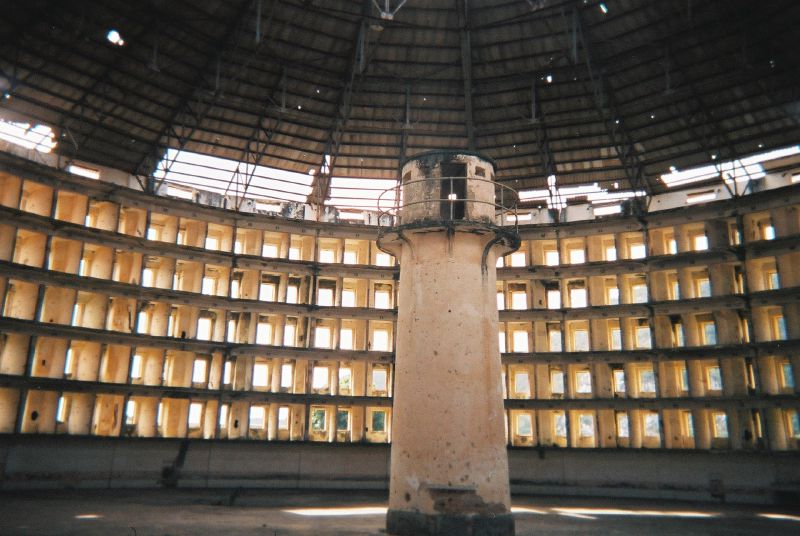
The layout puts a tower in the middle of a ring of cells. Light lets the watchman see into every cell, while the people inside the cells cannot see him. So they have to assume that someone is always looking.
Why one watchman was never the plan
Philip Steadman, a professor of architecture at the Bartlett School at UCL, told the BBC that Bentham started from the idea of a single all-seeing eye on every prisoner, day and night. That was not really workable. The idea shifted to prisoners who had to assume they might be under observation at any time.
The payoff Bentham wanted was economic as well as moral. The BBC reports that the state would get a “machine to grind rogues honest” at minimal cost, and a model prison to show the world.
A brother’s factory in Russia
The arrangement began with Bentham’s brother, Samuel, according to Philip Schofield, who directs the Bentham Project at UCL. Samuel ran an estate at Krichev in Russia with a fairly unskilled workforce. He sat at a central desk with his workers in a circle round him.
Jeremy visited in the late 1780s and saw uses well beyond one factory. He thought the plan could serve prisons, schools and hospitals too.
Bentham won funding from the prime minister, William Pitt the Younger, for a national penitentiary on the plan. A run of problems sank it. The BBC puts the failure down to practical and political opposition. Bentham never saw a panopticon built while he lived.
What Britain built instead
Britain waited until 1842 for its model prison, Pentonville. Its cells sat along galleries radiating from a hub. The chief warder at the centre had no view into the cells, only of the warders patrolling them. The closest thing to a true panopticon prison came in the 1920s, the Presidio Modelo in Cuba, now abandoned.
The watching that does itself
Michel Foucault took up the design in Discipline and Punish in 1975. He described its aim as a power so perfect that it would rarely need to be used, with surveillance “permanent in its effects”. The inmate, in his words, “is seen, but he does not see”.
Schofield sums the idea up plainly: “The principle is central inspection.” He argues a CCTV control room does the same job without any round building at all. That leaves the question the BBC raised about Britain’s planned Titan jails, whose plans called for “optimal sight lines” to save on staff.