European diplomats gathered in Berlin in 1884 to agree how Europe would take Africa, and no African leader was in the room. The conference did not draw the modern map. It wrote the rules that governed the race to claim it.
more
A map with white spaces
German Chancellor Otto von Bismarck hosted the talks at his official residence, the Reich Chancellery. A map five metres tall hung on the wall. It showed Africa with a few rivers, lakes and place names, and many blank patches.
The talks ran from 15 November 1884 until 26 February 1885. Al Jazeera counts delegates from 14 countries. Deutsche Welle describes 13 European states, the United States and the Ottoman Empire. A request from the Sultan of Zanzibar to attend was dismissed.
Why the powers met
Rivalry brought them there. Britain’s occupation of Egypt in 1882 had opened a rift with France. French officials wrote to Bismarck worried about British gains, and Germany feared clashes with Britain over Cameroon.
Al Jazeera says the aim was to avoid open war between the rivals by agreeing common terms. Four of the delegations, France, Germany, Britain and Portugal, already held the most territory.
What the General Act decided
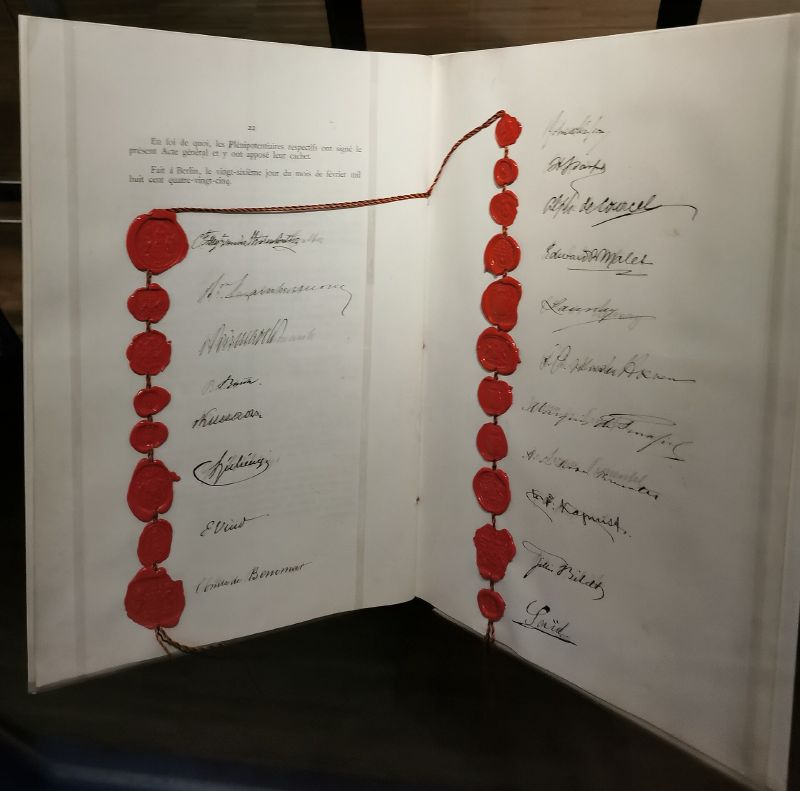
The powers signed a General Act of 38 clauses. It opened free trade on the Congo and Niger river basins. It also recognised King Leopold II’s International Congo Society.
The Act set one rule that shaped the scramble. Planting a flag on newly claimed land was not enough to own it. A power had to establish an administration there, which the Act called “effective occupation”.
The United States did not sign the treaty, because domestic politics had turned anti-imperialist.
What it left undone
The conference did not fix the borders. Al Jazeera says many of today’s boundaries came from bilateral deals afterwards and from the settlement after World War I.
Deutsche Welle describes the result in practice. Within a few years, every state in present-day Africa except Ethiopia and Liberia had been parcelled out. Surveyors used lines of latitude and longitude, rivers and mountain ranges as borders, and sometimes a ruler on a map.
The argument about the damage
Historians disagree about how much the lines matter. Olyaemi Akinwumi of Nasarawa State University in Nigeria says many African Studies scholars see the 1884-85 conference as the foundation of present-day crises.
Michael Pesek of the University of Erfurt says historians now give less weight to the arbitrary borders as a root cause of conflict. He argues the borders often existed only on paper for people on the ground.
In 2010, on the conference’s 125th anniversary, representatives from several African states met in Berlin. They called for reparations and described the division of the continent as a crime against humanity.