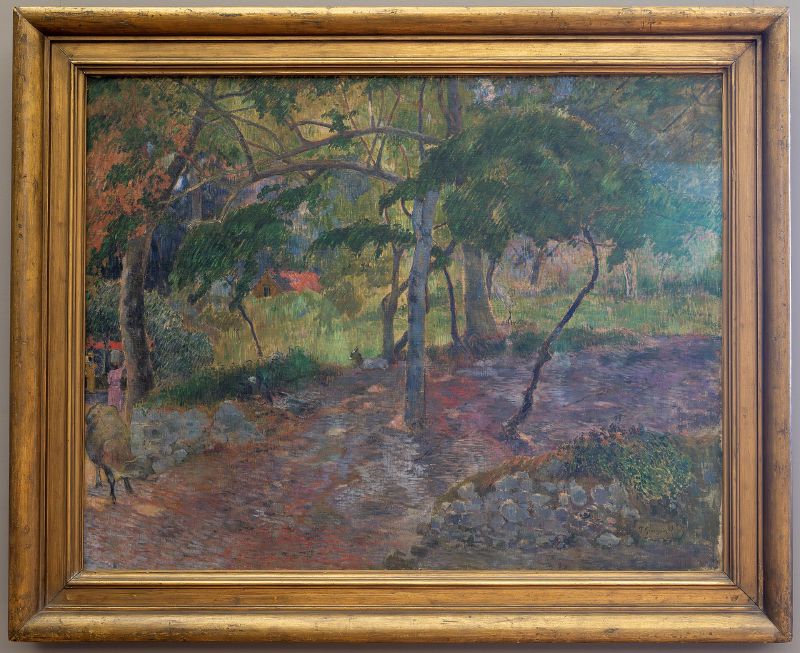
Bernard Williams dramatised moral luck with a thought experiment about a painter. In his 1976 essay “Moral Luck”, he took Paul Gauguin’s move from Paris to Tahiti and asked whether the art that came of it could justify abandoning a wife and children. His answer was that Gauguin’s eventual success counted as a kind of moral luck: the achievement justified a choice many would call morally indefensible.
more
A Gauguin built for the argument
Williams said openly that his Gauguin need not match the real French artist in every detail. The figure was a prop. Williams assumed, for the sake of the argument, that the gamble paid off and the paintings were a true expression of Gauguin’s gift.
The choice he set up was stark. Leaving meant giving up the family, and staying meant giving up the art.
Two ways to fail
The essay’s sharpest move was to split failure in two. In the first case, something outside Gauguin goes wrong. His ship goes down, or bad shrimp kills him on the voyage. He would then have been unlucky, but not wrong about his talent.
In the second case he reaches Tahiti safely and produces nothing worth having. There, the Aeon essay on Williams argues, the decision would have been mistaken at its root, because the obstacle was Gauguin himself. Whether the choice was justified depends on something he could not know when he made it.
Williams also gave a name to what drove the gamble. He called an aim that gives a person a reason to go on living a “ground project”, and Gauguin’s art was his.
What the idea claims
Williams did not work alone. Arianne Shahvisi, writing in the London Review of Books, credits Thomas Nagel and Williams together with naming moral luck in the 1970s. She states the idea as the view that some, and perhaps all, right and wrong action is a matter of chance. In her account, the chance can come from circumstances a person did not control, or from a character and upbringing they did not choose.
Her example is blunt. More than half a million Germans emigrated to the United States in the twenty years before the Third Reich, mostly for economic reasons. Shahvisi argues they were not better people than those who stayed. They were spared a test that many who stayed failed. Seeing that, she writes, breeds empathy and humility, but it also unsettles the ideas of blame people use to make sense of evil.
The gap in the original
The essay has critics on its own terms. Williams said little about the harm Gauguin did, the Aeon essay notes, and nothing about the Polynesian people who became subjects of his best-known paintings. The American philosopher Susan Wolf, an admirer of Williams, has questioned why the painter’s ambition had to take him away from his family at all.
That is the question Mette Gauguin might have asked. If her husband’s life had meaning, why were she and the children not part of it?