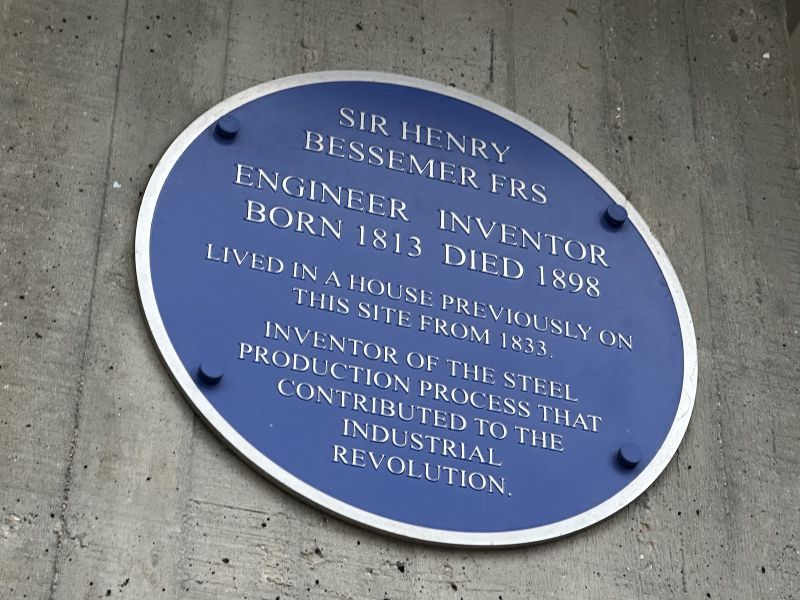
Henry Bessemer patented a new way to make steel on October 17, 1855, and it cut the time to produce a batch by a factor of ten. Before it, steel could only be made in small batches, using large amounts of costly fuel.
more
What the process actually did
Bessemer built his process around a discovery he made in 1856, while studying what happened when air was blown across a mass of molten iron. He found that a blast of compressed air, forced through the molten metal, burned out excess carbon and other impurities. The result was a form of steel that was lighter and easier to shape than traditionally made metals, and it could be made at ten times the speed of older methods.
At a working converter, the sequence was dramatic to watch. Molten iron at extreme temperature was poured into a pear-shaped vessel, a blast of air was forced through holes in its base, and the vessel was tipped upright. A cascade of sparks and a long blue flame shot from the top as the reaction burned off carbon. A steelmaker judged the flame’s shape, length and colour to decide the exact moment the steel was ready, and a badly timed call impaired the quality of the steel.
Why iron alone was not enough
Bessemer was not working on steel for its own sake. He had been trying to solve a problem for the British navy after the Crimean War: cast-iron cannons kept exploding under the pressure of the new rifle-style guns that fired spinning shells, killing crew nearby. Steel was the obvious replacement, but before Bessemer’s process it could only be produced in small batches, using large amounts of costly fuel to burn off impurities.
The new process was not trouble-free at first. When other foundries tried to copy it, they failed. Bessemer eventually traced the failures to phosphorus. His own experiments had used iron free of the element, while foundries elsewhere in England relied on ore with much higher phosphorus content, which the process could not handle. He turned that setback into an advantage. He opened his own foundry in northern England, where the local ore held little phosphorus. Other metallurgists later learned to deal with phosphorus.
What it built
Once the phosphorus problem was solved, Bessemer’s method took off in England and, under licence, in the United States. Cheap, high-quality steel let engineers envision transcontinental railroads, tall office towers, long bridges and mass-produced cars.
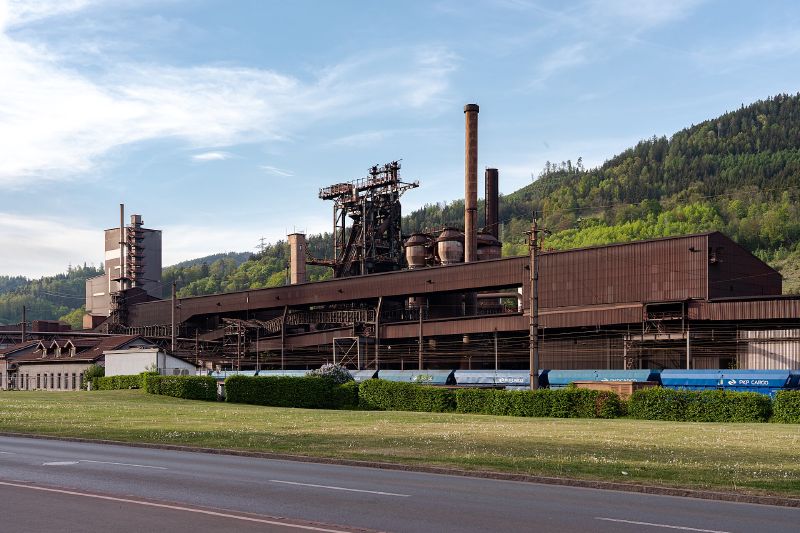
In Workington, in Cumbria, a Bessemer plant began producing steel in June 1877, and by 1885 close to a fifth of all the steel made in the UK came from West Cumbria. Trains across the world ran on rails rolled at the town’s Moss Bay Steelworks. The Workington converters made their last steel in 1974, and the sole surviving Bessemer converter from the site now stands at the Kelham Island Museum in Sheffield.