Most astronomers say a supermassive black hole called Sagittarius A* sits at the centre of the Milky Way. It holds about 4.3 million times the mass of the Sun, and astronomers worked that out by watching nearby stars race around it.
more
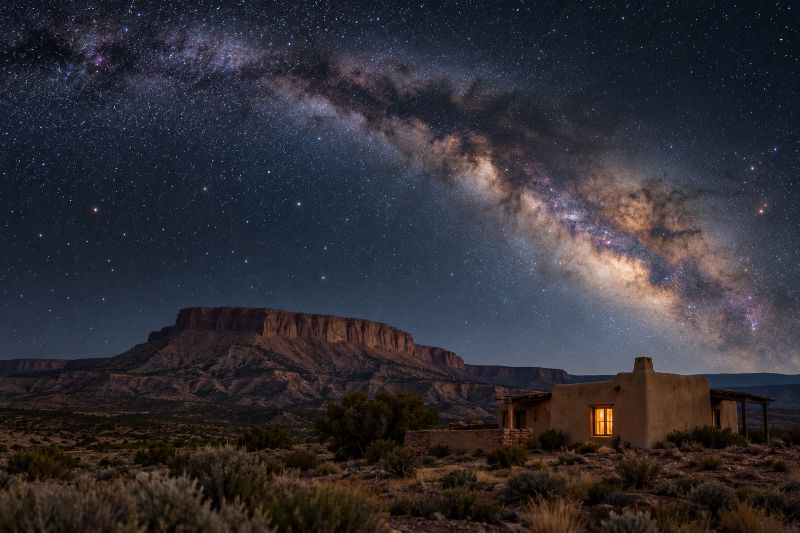
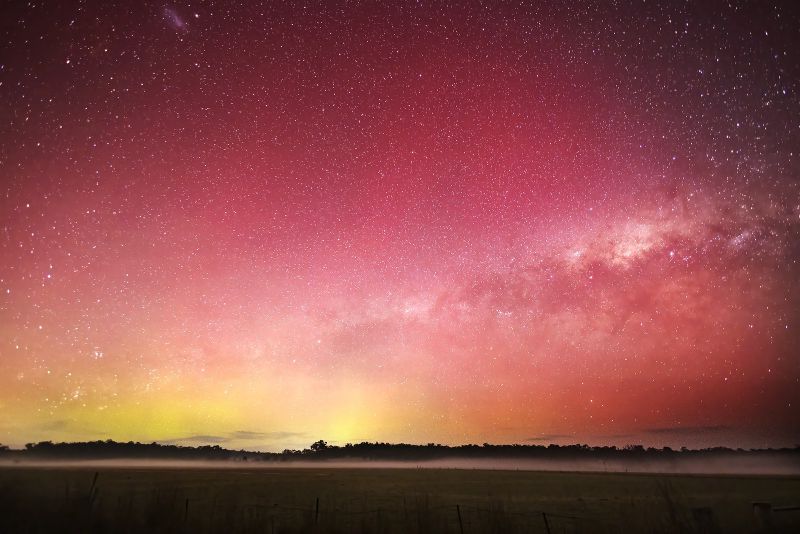
You can point to the place on a summer night. The galactic centre lies in the constellation Sagittarius, next to the teapot’s spout. You will not see it. Dust along that stretch of the Milky Way blocks the view in visible light.
How astronomers found the centre
In 1918, Harlow Shapley studied the motion of globular clusters and concluded that the centre of the galaxy lay towards Sagittarius. Later work put it about 26,000 light years away.
The dust left astronomers waiting. Radio astronomers picked up signals from the region in the 1950s, and infrared telescopes on Hawaiian volcanoes began to see through the dust in the 1990s. A powerful radio source, now called Sagittarius A, was found in 1960. In the mid-1940s, Walter Baade found a patch near the star Gamma Sagittarii where the dust thinned, and it let him see stars of the central bulge.
Why a black hole
The evidence is the stars. Valentina Crespi of the Institute of Astrophysics La Plata in Argentina says the orbits of the so-called S-stars show a very massive, compact object at the centre. From their orbital times and distances, astronomers calculated a mass of about four million Suns.
That mass sits in a space smaller than a third of the Solar System, so the stars survive without being consumed. The only explanation that fitted was a supermassive black hole.
In 1971, Donald Lynden-Bell and Martin Rees at Cambridge had already proposed that the galactic centre held one. The 2020 Nobel Prize in Physics went to Reinhard Genzel and Andrea Ghez for tracking those stars over decades. In May 2022, the Event Horizon Telescope released the first direct image of Sagittarius A*, a glowing ring around a dark shadow. ScienceABC notes that its event horizon would fit inside the orbit of Mercury, so it is small for a supermassive black hole.
What if it is dark matter
The question comes from a separate puzzle. Stars far out in the galaxy move so fast that they should escape, and astronomers usually blame dark matter for the extra gravity.
BBC Sky at Night Magazine reported a challenge on 2026-06-22. A team led by Crespi and Carlos Argüelles asked whether Sagittarius A* might be a form of dark matter instead of a black hole.
Their idea rests on “fermionic” dark matter. Argüelles says you do not need to put a black hole at the centre, because everything is part of the same substance. The magazine presents this as new research that questions the standard picture, not as a settled result.
The crowded view from Euclid
The black hole is not alone. On 23 March 2025, the European Space Agency’s Euclid telescope spent about 26 hours imaging the galactic bulge, the bright inner region of the galaxy. The mosaic holds more than 60 million stars and is the largest and most detailed visible-light photo of the area.
Astronomers want it for planet hunting. A technique called microlensing relies on one star passing in front of another, and it needs a field as crowded as this one. Jean-Philippe Beaulieu says almost 300 exoplanets have been found this way in twenty years, and the image includes 51 known planetary systems. Each pointing of the camera spans an area 270 times larger than the field of the Hubble Space Telescope.
It also gives future surveys a head start. Natalia Rektsini says anyone who later detects a microlensing event in that region can use the Euclid data as a reference from before the stars overlapped.