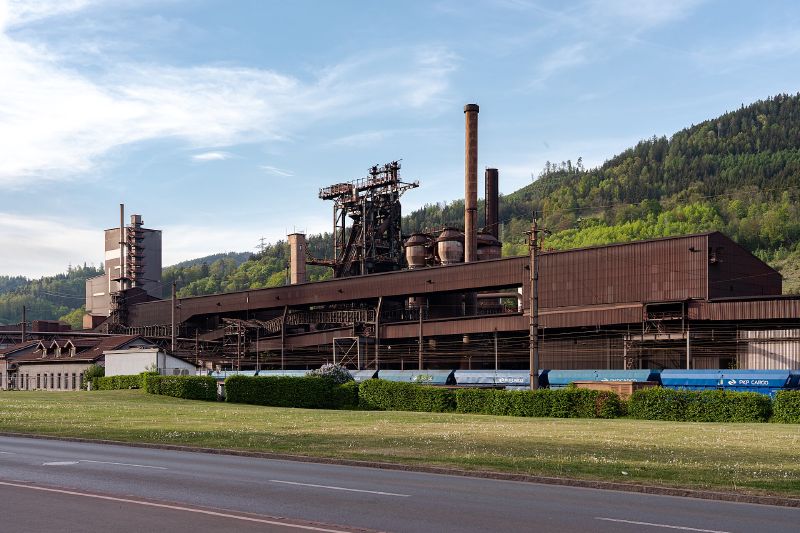
A blast furnace never makes steel on its own. What comes out of its base is pig iron, and pig iron carries so much carbon, 4 to 5% by weight, that it stays hard and brittle rather than useful for building anything. Turning that pig iron into steel takes a second step, one that strips most of that carbon back out.
The chemistry that does the first job has barely changed. A blast furnace strips oxygen from iron ore using carbon monoxide gas, made by burning coke, a fuel baked from coal. The National Institute of Standards and Technology notes that the reactions involved are close to the ones ancient furnaces ran around 1000 BCE.
What goes into a blast furnace, and what comes out of it
Three materials go in at the top: iron ore, coke, and limestone. Huge quantities of air blast in at the bottom. That combustion produces carbon monoxide, and carbon monoxide is what actually pulls the oxygen out of the ore. Haematite, a common iron ore mineral, is mostly iron(III) oxide, and carbon monoxide reduces it directly: three molecules of carbon monoxide react with one of iron oxide, leaving metallic iron and carbon dioxide behind.
Limestone does a separate job. Heat breaks it down into calcium oxide, which then reacts with the silica and other impurities riding along in the ore to form a molten layer called slag. Because slag is lighter than the iron, it separates on its own, rising to the top where it can be run off before the iron ever cools. Skip the limestone, and those impurities stay in the metal.
Not all ore reaches the furnace ready to use. Raw ore typically runs only 30 to 40% iron, mixed with sand and clay, so mills crush it fine and pull the iron-rich grains away with magnetic separators first. Haematite is not magnetic on its own. Refiners sometimes heat it with a little coal at around 800°C to convert it to magnetite. A magnetic separator can then pull that free, raising the iron content to 60% or higher before it ever reaches the furnace. The iron that finally collects at the bottom is tapped off separately from the slag, at intervals, through openings near the base, and cooled into pig iron.
The invention that made blast furnaces practical
For most of the technology’s history, the blast came cold, and keeping the furnace hot enough to react took a great deal of charcoal. That changed with the hot blast: heating the incoming air first, using the furnace’s own waste gases, before it ever reaches the tuyeres, the nozzles that fire it into the furnace. Hotter air needs less fuel to reach the same reducing temperature.
The earliest hot-blast furnace still standing in the United States sits on Nassawango Creek in Maryland. There, the ironmaker Thomas Spence installed the stove around 1835, less than a decade after the process was first used in Scotland. Under Spence, the furnace turned out about 700 tons of pig iron a year, smelting bog ore, until poor markets and a shortage of labour closed it down in 1847.
How pig iron becomes steel
Pig iron has to be reworked before it is any good. One route melts the pig iron, mixes it with slag, and hammers it to drive carbon out, down to around 0.3%. What is left is wrought iron: malleable, bendable, and easy to weld once it is hot. Steel asks for something similar but more exact, cutting the carbon back to well under 2% under closer control, and the open hearth furnace is one way to reach it.
A modern mill sends the hot metal from its blast furnace straight into a basic oxygen furnace instead, mixed with roughly 30% scrap steel. A water-cooled lance blows high-purity oxygen into the melt. The oxygen combines with the dissolved carbon and bubbles off as carbon monoxide gas, and it strips out the leftover silicon, manganese, and phosphorus at the same time.
Why the same design has lasted, and where it might not
The blast furnace route has outlasted plenty of attempts to replace it. NIST is now working on one: direct reduction, which strips oxygen from ore using pure hydrogen or reformed natural gas instead of coke-derived carbon monoxide. Run on pure hydrogen, the only byproduct is water vapour, rather than the carbon dioxide a blast furnace releases. The catch is ore quality. Direct reduction needs high-grade ore, and in the United States, much of that has already been mined out, leaving lower-grade ore with more impurities that can weaken the steel it eventually makes.
Steel’s supply problem is not only in the ground. It is also in the scrap yard. Steel is one of the most recycled materials there is, but rising demand is depleting the cleanest scrap. That pushes mills toward lower-quality material, which carries its own impurities into the next batch of steel.