For twelve years, Tonda Ros ran a website called Mythic Spoiler, a page that posted card images for Magic: The Gathering players. For eight of those years, the banner ads on that site were paying for something else: a video game. All of the site’s ad revenue, Ros wrote on the site once the game was out, had gone into “making Blue Prince” for that time.
What that ad revenue funded became one of 2025’s first indie breakouts. Almost 150,000 people had played it, according to the games analyst Rhys Elliott, and its concurrent players on Steam peaked above 15,000. More than a quarter of Steam players had already logged between 20 and 50 hours only eight days after launch. Ros never pitched Blue Prince to publishers before it was fully playable. GamesIndustry.biz introduced him, at launch, as a “first-time developer.”
The numbers behind a quiet launch
Steam reviews for Blue Prince held a “very positive” rating across more than 2,500 write-ups, and almost 20% of players reached the hidden 46th room the whole game is built around finding. Elliott found that 57% of Blue Prince players had also played Balatro, a card game with roguelike elements. Console sales told a smaller story. Elliott described PlayStation and Xbox sales as “very low,” which he suspects stems from Blue Prince being available on Game Pass and PlayStation Plus.
By the end of 2025, Blue Prince had won Best Indie Game at the Golden Joystick Awards and picked up nominations for Game of the Year and Best Storytelling there too. The Game Awards nominated it for Best Independent Game and Best Debut Indie Game. It left Blue Prince off the main Game of the Year shortlist, though, an absence Polygon’s reporter called puzzling given the year the game had. The reporter pointed to one likely reason. Blue Prince’s puzzles run on English-language wordplay, and the game appeared only in English. In the reporter’s view, that hurt its chances with a global nominating body. Ros said localisation is “largely considered near impossible.” He likened the work to “creating a second game.” He said he was fine losing out to Hades 2 and Silksong, because at least indie games were represented.
Polygon’s staff agreed that Blue Prince was the best game of 2025. Eurogamer named Blue Prince its Game of the Year outright, calling it “daringly simple and dizzyingly, migrainiously complex.” By July 2026, the game had a competitive scene. Dogubomb, Ros’s own studio, ran a Blue Prince tournament with a $20,000 prize pool, building on a bingo-style speedrun race two players had staged at Summer Games Done Quick the year before. Two qualifiers fed four players into a field with eight invitees. Prizes included keys that unlocked doors on the live stream, hiding items such as the soundtrack on vinyl.
A notebook idea and a card game forest
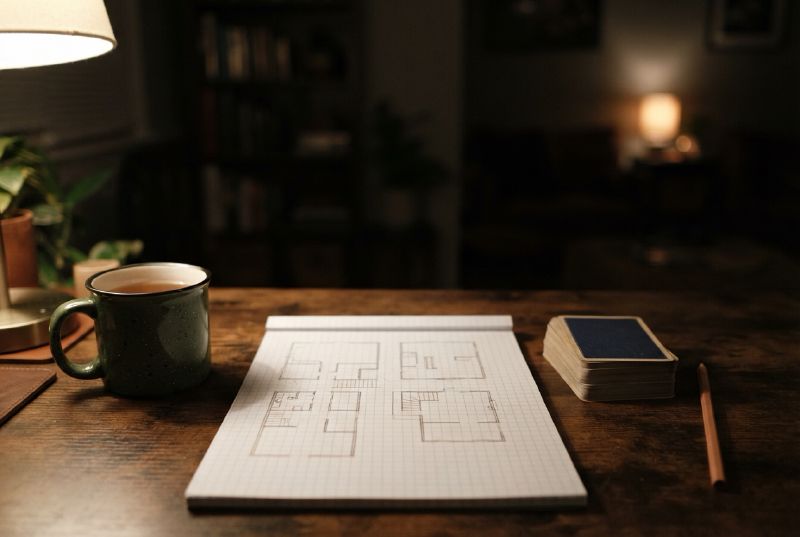
Ros first sketched Blue Prince around 2016, as a board game concept scrawled across only a few pages of a notebook. The idea combined the architectural sense of “drafting” a blueprint with the mechanical sense of drafting a card. A player would choose one room from a small, changing hand and add it to a house.
He built the mechanics from tabletop games rather than video game convention. Ros told GamesIndustry.biz he had never played a roguelite before making one himself, so the drafting and resetting came from card and board games instead. He named tile-placement games such as Carcassonne, Saboteur and Labyrinth as influences, alongside Seafarers of Catan, which he calls his personal favourite.
The specific idea of opening a door onto an unknown room traces to a single memory, he has said: replaying the Snowfly Forest inside the PlayStation game Vagrant Story. He compares that maze to the navigational puzzles in the original Legend of Zelda.
He built the first working version in Unity, an engine he had only just downloaded. Early rooms were filled with furniture taken from the engine’s own asset store, rather than modelled from scratch.
Ros spent over a decade as a film cinematographer before this, and he says that shaped how he lights the rooms. The core idea of opening a door and choosing one of three rooms never changed after the first week. The room prefabs he made that week are the same ones in the final build.
Testing it was its own problem. So much of the mansion is randomised that conventional quality assurance could not cover it, so Ros began recruiting outside playtesters in 2020, four years before release. Rather than run surveys, he watched more than 2,000 hours of their recorded sessions and revised the design from what he saw.
Eight years, alone, on advertising money
Ros worked on Blue Prince for more than eight years. His studio, Dogubomb, is based in Hollywood, California. For eight years, all the ad revenue from Mythic Spoiler went into the game. He had built that site twelve years earlier as what he calls “a passion project.” Once the game shipped, he thanked the Magic community on Reddit for years of ads they had tolerated without knowing what they were funding.
He never sent an unfinished build to a publisher. Only once Blue Prince was fully playable did he approach publishers, by email, with what he called “attractive key art” attached. He told GamesIndustry.biz that the finished game made his case for him, and made it better than he could himself. Raw Fury signed the game.
Ros calls the way the project came together lucky rather than planned. Separate ideas from earlier, abandoned projects happened to fit together, he has said, in ways he doubts he could plan out on purpose a second time.
A day inside Mt Holly
The premise is a will. Simon inherits the Mt Holly estate from his great uncle, on one condition: he has to find a 46th room inside a mansion that officially has only 45. The mansion sits on a grid nine rows deep and five wide. Only two rooms stay fixed from day to day: the entrance hall where each attempt begins, and the antechamber at the far end.
Every other room appears only once a player opens a door onto it, at which point the game deals a choice of three possible rooms. Whichever one the player picks becomes fixed for the rest of that day. Each day runs on a budget of 50 steps, spent one at a time on every doorway crossed. Run out, and the mansion resets overnight: the layout is shuffled and anything carried vanishes by morning.
Some rooms take coins as you pass, such as the chapel, while the pantry always holds a stack of them. The gymnasium wears you out each time you enter.
Rooms are colour-coded by function. Purple bedrooms often return steps when entered, yellow rooms sell items to players who have saved coins, and red rooms carry a cost or a hazard. The further a player pushes from the entrance hall, the more likely a room is to be rare rather than ordinary. Most rooms can only be drafted once in a single run.
Three resources keep the whole system moving: coins to buy from certain rooms, keys to open locked doors, and gems to draft the rarer room types. Tools turn up along the way, such as a magnifying glass for reading documents closely or a metal detector for locating hidden coins and keys. Rock Paper Shotgun’s reviewer spotted a tipped-over candlestick and still could not tell whether it was a hint. Players find notes written by different hands, and scribble down hints for future runs.
Underneath the daily puzzle sits a longer story: an inheritance, a missing children’s book author, and threads of blackmail and family politics reaching back generations.
Why did it land when it did?
Blue Prince arrived resistant to a single description. PC Gamer’s review ran through seven genres it borrows from, from board game to deckbuilder to exploration game, all inside one mansion.
Critics praised it. IGN called it an “all-time puzzle great”, and Rock Paper Shotgun described Mt Holly as a “restless, eldritch manor”.
Ros thinks puzzle games carry a stigma that keeps people from trying them, and told GamesIndustry.biz he wished more players would step outside their comfort zone and try well-regarded titles in the genre. He also called this “the golden age of indies”, and said people who play only big-budget games are missing out. The sheer volume of guides, wikis and forum arguments it produced is unusually large for a puzzle game, GamesIndustry.biz noted at the time.
Near the end of 2025, Ros still described himself as living in “the Blue Prince era.” He had also been working on a Mac port and on merchandise with iam8bit. He was close to finishing a final update, adding a colour-assist mode, remappable controls, a minigame called Dirigiblocks, and a cat somewhere inside the mansion. He expected to be about another year from moving on to whatever comes next.