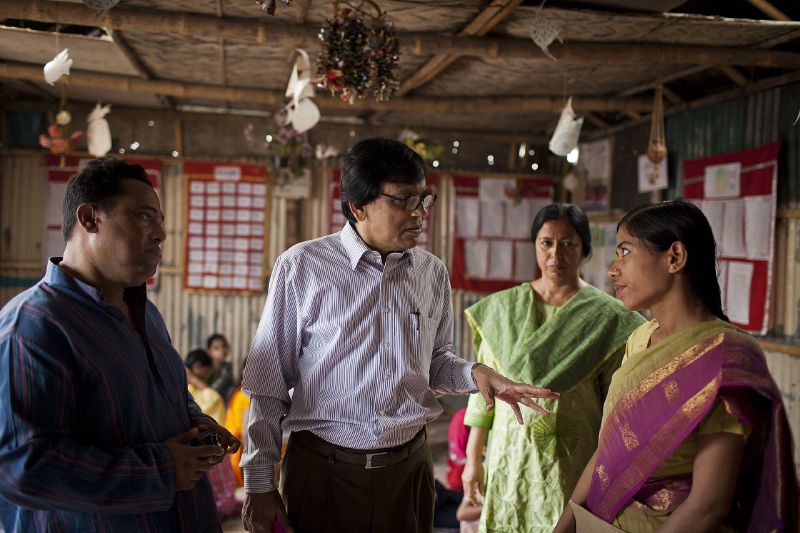
A BRAC school is a non-formal primary school with one teacher and one classroom. The Bangladesh Rural Advancement Committee, or BRAC, pioneered the model. The government later copied it in a project called Reaching Out-of-School Children, or ROSC. Research on where each type sits finds that they reach different poor places.
more
A 2016 study by the economist M. Niaz Asadullah, in the Australian Economic Review, asked whether these pro-poor schools reach the poor. Its title put the question plainly: “Do pro-poor schools reach out to the poor?” It used school census data to map where BRAC placed its one-room schools against where ROSC placed its own. Both programmes have a statistically significant presence in poor sub-districts. The study compared sub-districts within the same district, so the contrast is local rather than national. Where they diverge is which poor places they pick.
What BRAC avoids
BRAC’s schools steer clear of pockets that lack public infrastructure, and of areas with high female illiteracy. That is a specific pattern rather than a general tilt towards “the poor”.
ROSC schools run the other way. They have a greater presence in areas with poor access to cities and roads. They also do better at reaching areas that government schools underserve. For BRAC schools, and for state-recognised madrasas, the study found the opposite.
That does not mean BRAC schools serve better-off children. Both programmes still show up in poor sub-districts. It means that within the pool of poor areas, BRAC and the government scheme are not fishing in the same pond.
What BRAC does elsewhere
The location study covers where BRAC decides to build. It says nothing about how well the children learn once they are inside. BRAC has also built where a fixed school cannot stand. It has set up 670 floating schools on boats. One sits near Brahmanbaria, 100km east of Dhaka, where flooding turns a pupil’s village into an island for six months of the year.
A 10-year-old pupil named Runa gets a lift there in a small wooden fishing boat. She told the Guardian she saw dolphins on her way to school. Her class has 28 pupils in all. Their boat is painted pink and blue, with paper flowers on show and a national flag flying. On the day the Guardian visited, her lesson was on Bangladesh’s liberation war. Runa said her village used to be dry, but now there is more water and it is getting smaller.
Her teacher, Runa Akter, stressed that teaching standards are high in BRAC’s informal schools. To teach at the madrassa, she said, she would have had to study for longer and sit government exams.
The Guardian set the boats against a wider problem. Some 48 million Bangladeshis are poor by the official measure, and 70% of those live in the countryside. In rural Bangladesh, people often struggle to reach services such as education and healthcare, and climate change has made that worse.
The same gap in other services
Schools are not the only service that has to reach out. The Ishwaripur community clinic, in the coastal district of Satkhira, serves 6,000 people. It runs without electricity and on meagre government funding. Volunteers lobbied for basic kit such as surgical scissors, and a doctor now visits twice a month.
Further south, falling fish stocks are pushing down wages on the coast. Many men leave for months at a time to work in brick factories. Others move for good. The Guardian reports that no city in the world grows faster than Dhaka, where 3.4 million people live in slums.
Those pressures shape the villages that both BRAC and ROSC set out to serve. The study shows that each programme picks a different slice of them.