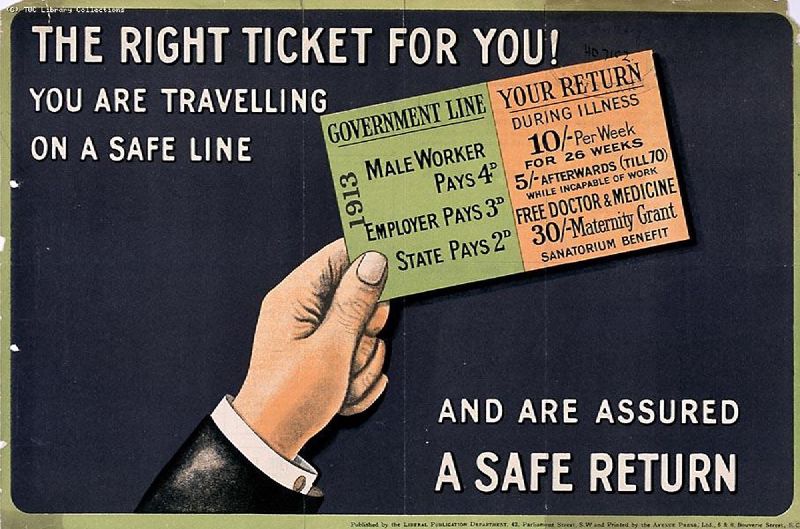
The National Insurance Act 1911 made British wage-earners pay into a national fund that covered them when they fell ill. A second scheme covered unemployment in some trades. The Liberal government of Prime Minister H. H. Asquith passed it.
more
Before the Act, a free National Health Service did not exist, and poor people usually could not afford medical care.
Who paid
Every wage-earner aged 16 to 70 paid 4d a week. Employers added 3d and the state added 2d. That made 9d a week for each insured worker. The state shared the cost with the people who used the scheme.
The health part was compulsory for workers earning under £160 a year. Nobody could opt out, and many people objected to the payments.
What a worker got
Britannica describes the health scheme as running through approved societies. The societies collected the contributions and passed them to the National Insurance Fund. A worker could choose which society to pay into.
Benefits came in four forms:
- Sickness pay of 10 shillings a week for men and 7 shillings and 6 pence for women, for up to 26 weeks.
- Free medical treatment.
- A maternity benefit of 30 shillings.
- An unemployment payment, known as the dole, for up to 15 weeks.
Sickness benefit stopped after 26 weeks away from work. After that the Poor Law had to provide for the worker.
Where it fell short
The scheme gave nothing to a worker’s family. The unemployment half was narrow too. It applied only to industries where work was irregular or cyclical, and workers there could claim 7 shillings a week for up to 15 weeks in a financial year.
Britannica notes that the state ran the unemployment insurance directly, without societies in between. It says the Act laid foundations for the modern welfare state in Britain.