Two wooden posts on a hillside at Bulford, three miles from Stonehenge, may have formed the earliest known solar alignment on the Stonehenge landscape. They lined up with the spot where the midsummer sun broke the horizon.
more
Later Neolithic builders caught the solstice sun with passages and standing stones.
What the Bulford posts show
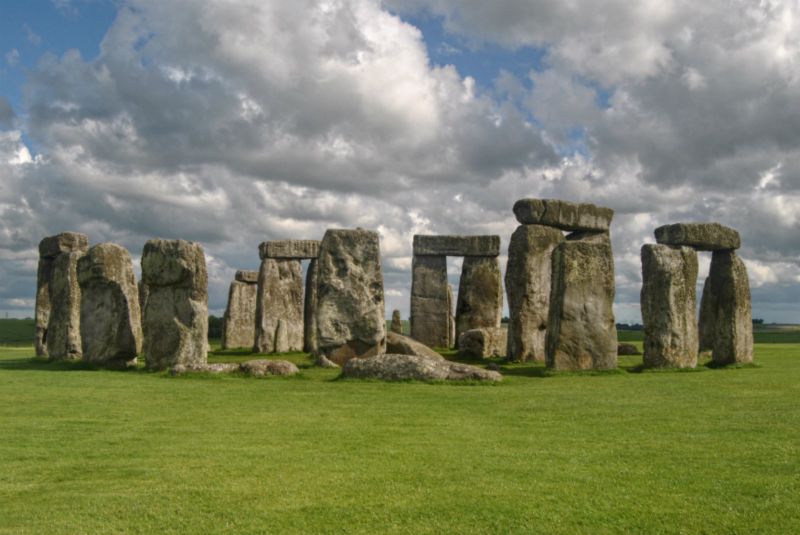
Wessex Archaeology found the remains of two wooden posts sunk 120 metres apart on a hillside above the modern village of Bulford, radiocarbon dated to around 2950BC. That is roughly 500 years before Stonehenge’s huge trilithon stones were placed to line up with the midsummer and midwinter sun.
Archaeologist Phil Harding almost missed it. The postholes looked, at first, like two of dozens of pits on the site. It was only when he drew a pencil line between the pair on a site plan that he saw it ran close to true solstice alignment. The line sat some 50 degrees off true north, he realised, close to where the midsummer sun comes up.
The posts themselves stood in pits about three feet across and 30 inches deep, holes deep enough to hold timber beams standing 12 to 14 feet tall, according to Harding’s team. Charcoal recovered from the base of one posthole came from ash, a tree that grows tall and straight on the chalk plains around Salisbury. Skyscape archaeologist Fabio Silva ran a digital reconstruction of the night sky over Wiltshire in 3000BC and found the posts would have formed an accurate sightline onto the midsummer sunrise.
The alignment was not exact. It sat about a degree off true, a gap the team puts down to the width of the posts themselves, which may have measured up to 20 inches across. A gap that size barely matters for a ritual sightline. A “rough orientation” is likely sufficient for the ritual the site was built for, said A. César González-García, an archaeoastronomer at Spain’s National Research Council who had no role in the dig.
Not every archaeologist is convinced two postholes prove a deliberate alignment. “Two postholes don’t make a particularly convincing alignment,” said Jim Leary of the University of York, though he added that a solstice-aligned monument “wouldn’t be out of place for this period.”
From posts to passages and standing stones
At Newgrange in Ireland, a passage was cut to admit the midwinter sunrise along its length. At Maeshowe in Orkney, a chambered tomb built around 2800BC has a 10 metre entry corridor oriented south-west, and for three weeks either side of the winter solstice the setting sun sends light straight down it to the tomb’s rear wall. The standing stones at Callanish in the Outer Hebrides create a comparable solar sightline, and Stonehenge’s tallest trilithon once framed the setting midwinter sun.
In Brittany, the passage tomb La Roche aux Fées was built from 41 megalithic blocks, some over 40 tonnes, around 2750BC, and it too catches the winter solstice sunrise.
What the alignment was for
Archaeologists disagree on how precise Neolithic solar architecture was meant to be. One theory once held that Stonehenge’s 30 sarsen stones represented the days of a month and its five trilithons the remaining days of the year, making the monument a working solar calendar. Mathematician Giulio Magli and astronomer Juan Antonio Belmonte challenged that reading, arguing the stone circle was not built accurately enough to track twelve months, even though it clearly relates to the solstices. Magli’s view is that the winter solstice alignment served a religious purpose, at a site used for burials across hundreds of years.
Matt Leivers of Wessex Archaeology reads the Bulford find the same way. Nobody now knows what the sun meant to the people who built it, or whether they saw it as a deity, he said, but the sheer effort spent tracking its movement marks this out as major religion, written into the ground. He thinks it is unlikely the people marking the solstice at Bulford were unaware of those doing the same three miles away, and possible they were the same people. He would not be surprised if Bulford proved to be a campsite of the builders of Stonehenge’s first phase.
Modern artists have taken up the idea. Land artist Nancy Holt made Sun Tunnels between 1973 and 1976, with help from engineers and astronomers. Its four 22-tonne concrete tubes sit in Utah’s Great Basin Desert, and each one frames the sun rising or setting on the solstices.