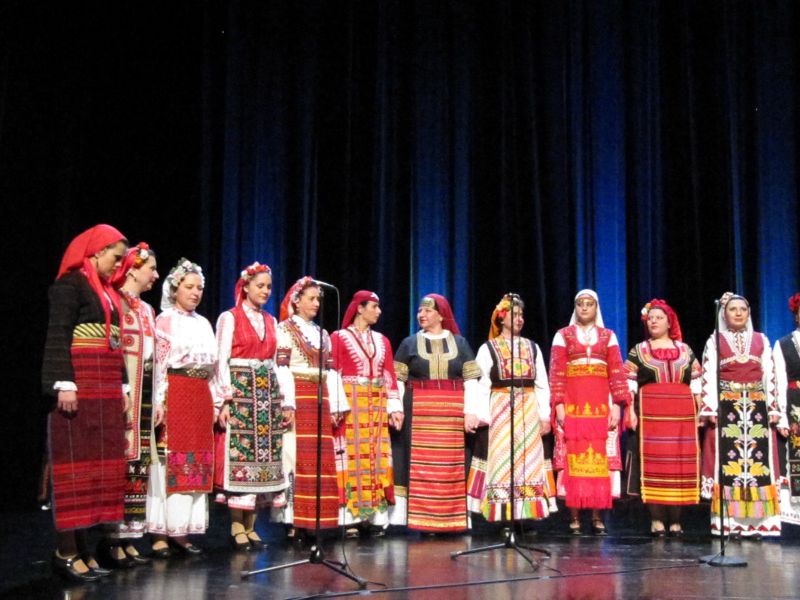
Bulgaria’s state women’s choir gets its sound from what its oldest singer, Elena Bozhkova, calls “open-throat singing”. She told the Guardian it is not painful if studied from childhood. Without the technique, she warned, a singer can damage the vocal cords.
more
The open throat sits on top of other devices. Bozhkova lists quarter tones, drones and unexpected rhythms as parts of the same style.
What the singers call their own sound
Village women had their own words for it. Pitchfork reports that they described their singing with “izvika”, meaning to cry out. They also called their tone “buchi”. Bulgarians use that word for the lowing of a cow.
The buchi drone holds the music together.
Pitchfork names the relation between melody and drone as the most basic feature of Bulgarian village song. The harmony rests mostly on unisons, major seconds and minor thirds. Notes that close together grind against each other, and the singers sat closely together to sing them.
A tradition younger than it sounds
The records sold the music as a thousand-year-old folk art. A 2005 BBC Radio 3 feature, presented by the singer Dessislava Stefanova, argued that the choral form began only in the early Soviet era. Its songs came from a rural society that had barely changed for centuries before the Second World War.
The composer Filip Kutev formed the ensemble in 1951, according to Pitchfork. The Guardian dates the choir’s founding to 1952. Kutev took single-line village tunes and set them in several parts. He kept the throaty folk tone while borrowing harmony from Western choirs.
The state paid for it. Bozhkova joined in 1972 and drew a wage as a state employee. The Guardian reports that the government wanted a modern music built on folk styles, and one that kept out anti-socialist influence.
How the West heard it
The Swiss musicologist Marcel Cellier recorded the choir for a 1975 album called Le Mystère des Voix Bulgares. It sold poorly at first. Peter Murphy of Bauhaus later persuaded the label 4AD to reissue it. The 4AD version came out in 1986, and Nonesuch released it in the US in 1987. A second volume went on to win a Grammy.
The technique proved hard to copy. Lisa Gerrard of Dead Can Dance tried to sing in the Bulgarian style in the 1980s. She told the Guardian that it “nearly destroyed my voice” because she had no proper teacher. More than 30 years later, she was recording and touring with the choir itself.