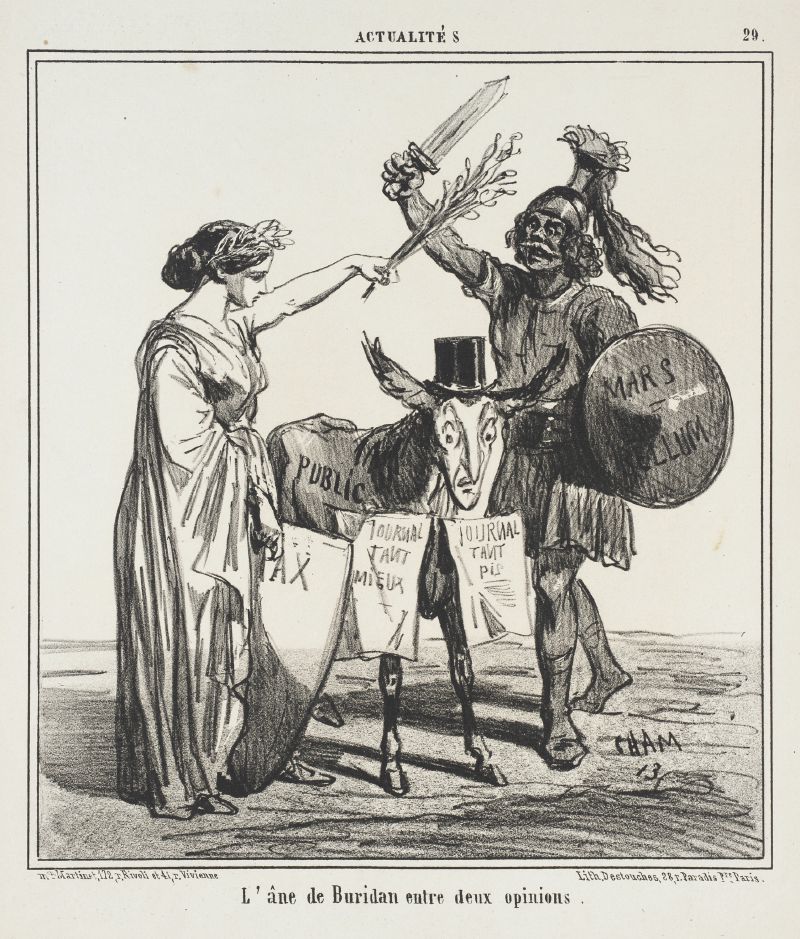
A donkey stands exactly halfway between two piles of hay, equally large and equally tempting. It has no reason to prefer either, so it never chooses, and it starves. That is Buridan’s ass, named after the philosopher John Buridan, who lived from 1300 to 1358. The story asks whether a choice needs a reason, and what happens when there is none.
more
The principle the donkey tests
The philosopher Michael Hauskeller, writing in Philosophy Now, starts somewhere more ordinary. You open a menu and find your two favourite dishes, asparagus and spinach tart. You like both equally, yet you pick one.
Either nothing caused that choice, he writes, or something did and you do not know what it was. Most people find the second answer easier to believe. It fits the Principle of Sufficient Reason, which Hauskeller also calls Leibniz’s Law: nothing happens without a reason.
Treat reasons as weights on a pair of scales, and a decision is whichever pan is heavier. Now load both pans equally. On that mechanical picture no rational decision is left to make, and the donkey is stuck. Hauskeller notes that the tale is usually read as an argument against free will.
Older than Buridan
The image predates the man it is named after. Aristotle described a person equally hungry and thirsty, held still between food and drink. The Persian philosopher Al-Ghazali used two identical dates. He argued that a person given one to pick would take one without any reason, and that this showed a will able to act on its own.
The donkey itself never appears in Buridan’s surviving manuscripts, according to Philosopedia. It holds that his critics probably invented it to mock his views on choice.
A paradox about hard decisions
The puzzle has a modern relative. In The Guardian, Oliver Burkeman described Fredkin’s paradox, named after the computer scientist Edward Fredkin. Fredkin’s colleague Marvin Minsky quoted it: the more equally attractive two options look, the harder the choice feels, even though it matters less.
Burkeman cites the psychologist Tania Lombrozo, whose verdict was that hard decisions should be easy. If two options really are equal, and no further research can separate them, a coin flip would serve as well as a week of worry.
The real danger, Burkeman argues, is the donkey’s fate. People who agonise can end up with neither good option, picking paralysis instead. He also points to the philosopher Alan Watts, who said that what we call deciding is often a period of wavering, ended by a sudden and nearly random choice.
That is the answer the donkey never found. A real animal, or a real diner, does not wait for the scales to tip.