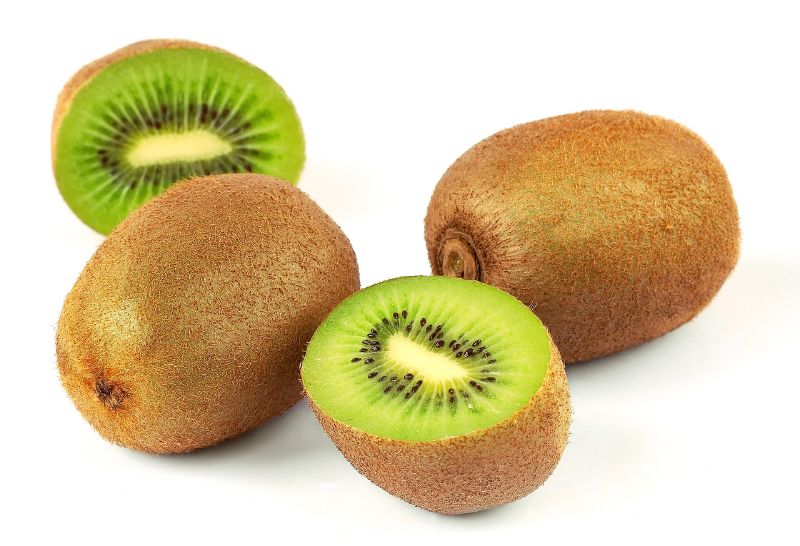
Yes, you can eat kiwi skin. Good Food treats it as an ordinary fact rather than a curiosity: the fuzzy brown coat is edible, and it is a growing habit rather than a strange one. The peel adds fibre, vitamin E and folate beyond what the green flesh gives you on its own. Two health cautions decide who should keep a peeler handy anyway.
more
The Guardian’s food-waste column calls the skin one of the biggest challenges its writer faced in learning to eat new foods, worse than any offal or funky ferment. She got there by trying it ten times. Ten kiwis later, she bites into the whole fruit like an apple and throws nothing away.
What the skin adds
Good Food’s registered nutritionist, Nicola Shubrook, writes that the skin, and the layer just beneath it, is where most of a kiwi’s antioxidant vitamins sit. It carries fibre, which supports a healthy gut, and is especially rich in vitamins C and E. A study on SunGold kiwi that she cites found that eating the whole fruit, skin included, raised fibre intake by 50%, vitamin E by 32% and folate by 34%, against eating the flesh alone.
The Guardian cites a different paper on kiwi’s health attributes, with a rougher set of numbers. Eating the skin can double the fruit’s fibre content, it says, and lift folate and vitamin levels by almost a third. The two pieces disagree on how much the skin adds, not on which way it moves. Cleveland Clinic ties a gram figure to the same 50% gain: a skin-on green kiwi carries about 3.5 grams of fibre, a skin-on gold kiwi about 3.
Cleveland Clinic says the skin holds three times more antioxidants than the fruit itself. About 30% of a kiwi’s polyphenols, which help fight inflammation, come from the skin.
Delish put the vitamin E point to Dr. Amy Lee, head of nutrition at Nucific. She calls the skin “particularly high” in vitamin E, an antioxidant she says promotes immunity.
Who should still peel it
Cleveland Clinic’s registered dietitian, Gillian Culbertson, tells anyone with a history of kidney stones to leave the skin off, because it is high in oxalates. Oxalates bind with calcium in the body, and that pairing is what forms the crystals behind a stone or an attack of gout. The American Urological Association recommends that anyone prone to stones avoid oxalate-rich foods.
Dr. Lee’s caution for everyone else is milder: add the extra fibre slowly if you are prone to digestive issues. The skin is also the part that faces whatever was sprayed on the plant, so her advice is the advice for any unpeeled fruit. Wash it well before you bite in.
Getting past the fuzz
The Guardian’s method is to scrub the fruit first to knock down the fur, then slice rather than bite, so the skin holds the flesh together without becoming the main event in the mouth. Delish offers a shortcut for anyone who would rather not meet the texture at all. Cook it down, the way a peach goes into a cobbler, or chop it into a salsa where the skin disappears into everything else.
Which kiwi to reach for
If the fur itself is the objection rather than the fibre, Cleveland Clinic points to the gold kiwi, whose skin carries none of the green kiwi’s coarse hairs. Of the roughly 60 species the kiwifruit genus runs to, green and gold are the two most shoppers will ever meet.
Buy gold if the fuzz is the only objection left. Green stays a job for the scrubbing brush, one bite at a time.