After Atlantic Records let her go, Chappell Roan went home to Willard, Missouri, and took a job at a drive-through coffee kiosk. She spent her shifts scheming about how to get back to Los Angeles. She told the Guardian she felt like “a failure”, while knowing deep down she was not one.
more
The label had dropped her in 2020, shortly after releasing a song it felt had underperformed. The song was “Pink Pony Club”.
Five years later, “Pink Pony Club” went to number one in the UK in March 2025. It stayed there a second week, ahead of Lady Gaga. NME reports total UK sales of 658,424. A month before, Roan had won best new artist at the Grammys. She used the speech to ask record labels for a livable wage and health care, and to describe being dropped.
Where did she start?
She was born Kayleigh Rose Amstutz in Willard, a very small Ozarks town, and raised a “God girl” who went to church three times a week. The pop of the late 2000s and early 2010s thrilled and scandalised her: Kesha, Lady Gaga and Katy Perry.
Roan told BBC Radio 1 that Gaga’s video for “Alejandro” started her on the route to the artist she is now. Watching it, she said, she felt she was sinning as a Christian. Then, she said, a fire lit in her, and she decided it was where she was meant to be.
She started writing songs in her early teens, partly because she was in love with an older student and felt she had to write the greatest love song ever. She also posted cover videos to YouTube.
How did a teenager get a major-label deal?
Those covers caught Atlantic’s attention. The AP dates the signing to 2015. The Guardian describes the act Atlantic signed as a downbeat songwriter, a long way from what came later.
She chose a stage name to honour her late grandfather, Dennis Chappell, and his favourite song, Marty Robbins’ “The Strawberry Roan”. Soon she was flying across the US to write and record.
At 17, she told the Guardian, she assumed a Grammy would follow. What followed instead was most of her late teens and early twenties spent hustling in development. Signing, she said, was when “the real work begins”.
What changed in Los Angeles?
In 2020 she started working in Los Angeles with the producer Dan Nigro, who would soon be famous for his work with Olivia Rodrigo. Big-city life startled her. She has described shaking in a Trader Joe’s at the sight of women buying groceries in sports bras, something unthinkable in Willard.
The bigger discovery was West Hollywood’s gay bars. She had grown up believing that being gay was “a sin”. One visit to a gay club, she said, felt like magic, the opposite of everything she had been taught.
She wrote “Pink Pony Club” straight after that first visit. The club was the Abbey, and its owner, Tristan Schukraft, said fans now visit to see the place behind the song. The bar even added a Pink Pony cocktail.
Why did Atlantic let her go?
The label felt the single had underperformed, and dropped her soon after its release. She went back to Missouri heartbroken.
The two Guardian pieces describe her job there differently. One calls it a drive-through coffee kiosk, the other a drive-through doughnut shop. The AP says she worked as a barista. On the main point all three agree: she was serving drinks in her home town while her music career stood still.
At the Grammys in 2025 she described what that period was like. The BBC reports that she described struggling to find work and being unable to pay for health insurance. Billboard’s account of the speech has her saying she was signed so young that she had zero job experience when she was dropped. She said it was devastating to feel so committed to her art and so betrayed by the system.
She saved enough to move west again and gave herself a deadline. She had 12 months, and if nothing happened by then, she would take it as a sign to go home for good.
Who backed her the second time?
Nigro did. Back in Los Angeles she resumed working with him and signed to Amusement, his own label at Island Records.
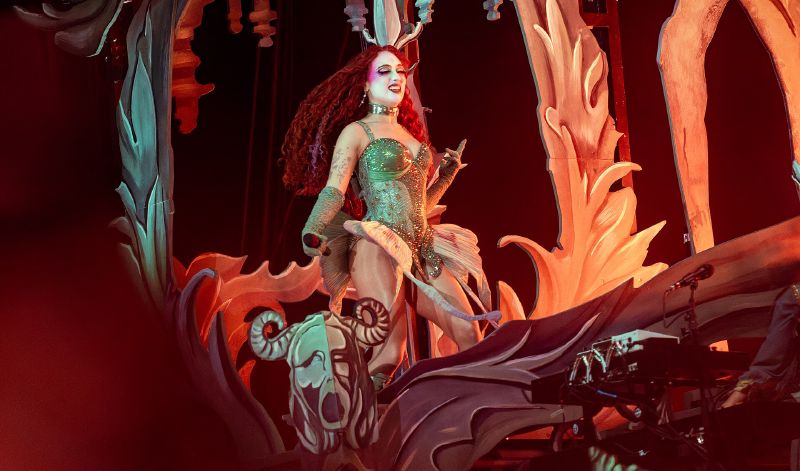
The Guardian wrote that being dropped pushed her towards something bolder. The experience, it said, led her to build a flamboyant persona that let a queer musician express what she had once repressed. She has said that a drag version of herself, otherwise an introverted video gamer, can be “whatever I want”.
The drag debt is explicit. She calls herself “your favourite artist’s favourite artist”, a play on the Drag Race winner Sasha Colby’s description of herself. She has told NME she wants people to think “drag queen” when they hear her name. At her headline shows she invites drag artists to open.
The sessions with Nigro became her debut album, The Rise and Fall of a Midwest Princess, released in September 2023. The Guardian called it one of the most over-the-top debuts in recent memory, and compared it at turns to Patsy Cline, 1980s Madonna and RuPaul. NME gave it four stars.
Why did it take a year to land?
The album built slowly, through fans rather than radio. NME reports that in December 2023 she sold out two headline shows at Heaven, the London LGBTQ+ club. She told NME she felt honoured to play where Freddie Mercury used to party. The AP says she first hit the mainstream as the opener for Olivia Rodrigo’s Guts tour.
Hazel Cills, a music editor at NPR, said in the Guardian that Roan worked several spaces at once. She served her core fans on TikTok, found new ones on the Rodrigo tour, and won others through television and festival sets.
The timing helped. The Guardian noted that a year earlier Billboard had asked why pop stars were not breaking through the way they used to, and that no one had seriously done so since Rodrigo in January 2021. Cills argued that young audiences wanted the theatrical pop they had been too young to see in the early 2010s.
Then came a single outside the album. “Good Luck, Babe!”, released in April 2024, is about loving a woman who would not come out. When it arrived, Roan had about a million monthly Spotify listeners. By that September she had 45 million.
How fast did it move?
Fast. At Lollapalooza in Chicago in August 2024, organisers estimated she drew the biggest crowd the festival had ever had. The same week, the album reached number one in the UK, almost a year after its release. By September she had six songs in the US Hot 100 and won best new artist at the MTV VMAs.
The speed was hard on her. At one show in June she told the crowd, in tears, that it was really hard to keep up. In August she shared a statement about invasive behaviour from fans. She told the Guardian she was not complaining about success but about being abused.
BBC Radio 1 named her its Sound of 2025. She has called herself, Sabrina Carpenter and Charli XCX the “Powerpuff Girls” of pop.
What did she say at the Grammys?
On February 2, 2025, Roan won best new artist, beating Carpenter, Benson Boone, Doechii, Khruangbin, Raye, Shaboozey and Teddy Swims. She had been nominated in five other categories as well, including album of the year. Grammy.com says Nigro won producer of the year earlier that day.
Billboard reports that she read her speech from a notebook and thanked her “papa Chappell”, the grandfather whose name she took. Then she asked the industry to offer artists a livable wage and health care, especially artists still developing. She finished with a line aimed at the executives in the room: “Labels, we got you, but do you got us?”
The speech drew criticism. The music executive Jeff Rabhan wrote in The Hollywood Reporter that labels are not charities, and called her “disingenuous”. Roan gave $25,000 to Backline, a US charity for musicians’ mental health, and challenged him to match it. The BBC says he has not responded. Backline’s director told the BBC that Charli XCX and Noah Kahan matched Roan’s donation and that Monday was the charity’s single biggest fundraising day.
Where did “Pink Pony Club” end up?
Back at the top. She wrote the song after one night at the Abbey. It reached UK number one in March 2025, five years after Atlantic first put it out. NME quotes her telling Official Charts that the UK had been there for her “since day one”.
NME says the debut album had sold more than 374,000 copies in the UK and gone platinum. It also reports that she dedicated her Brit award to trans artists, drag queens, fashion students, sex workers and Sinéad O’Connor.
Roan told the BBC that she, Carpenter and Charli XCX each made albums to blow their own minds rather than to change music.