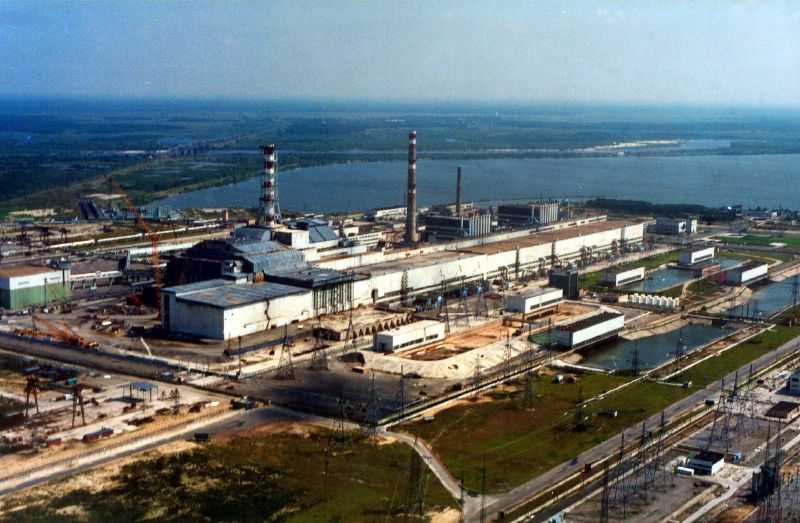
When Chernobyl’s reactor 4 exploded in 1986, it had no primary containment structure to hold the blast in. The steel arch that now covers the ruin, called the New Safe Confinement, is designed to keep its radioactive remains from leaking out.
more
What the reactor was missing
The RBMK-type reactor at Chernobyl was water-cooled and graphite-moderated, a Soviet design still in use in Russia in 2011. It had no steel-reinforced-concrete containment building around the core, and such a reactor would not have been licensed in the West. When a botched safety test on April 26, 1986 sent the reactor’s power surging out of control, hydrogen and steam explosions blew the 1,000-tonne reactor lid aside and tore a hole in the roof. Pieces of core and fuel landed on the roof. The wind carried radioactive smoke and dust across Europe.
The first, hurried fix
Workers buried the wrecked reactor within six months, under a steel and concrete structure built at speed and known as the sarcophagus. It was never meant to last. By 1997, engineers were already describing it as dangerously unstable. By 2011 it was weakening, and a collapse could have turned into a second catastrophe.
A tomb built to move
The New Safe Confinement replaced the sarcophagus rather than patching it. Engineers built the 36,000-tonne steel arch about 180 metres from the reactor, at 108 metres high and 270 metres wide, then slid the whole structure into place on tracks in December 2017. At the time it was the largest structure ever moved over land.
Its job is not just to sit there. Cranes and remote-controlled equipment mounted inside the arch let workers dismantle the old sarcophagus and the reactor debris beneath it without stepping into the radiation themselves. The Institution of Civil Engineers puts its design life at more than 100 years.
Who paid for it
More than 40 countries paid for the roughly €2.1 billion project, alongside the European Commission and the European Bank for Reconstruction and Development. Fulcieri Maltini, who led Chernobyl’s decommissioning programme in the 1990s, called the confinement one of the world’s largest and most complex engineering works.
The wider clean-up runs longer still. Dismantling the site’s other three reactors is expected to run until 2064, and full decontamination further still, because of how much radioactive material sits on the site and across the surrounding exclusion zone.