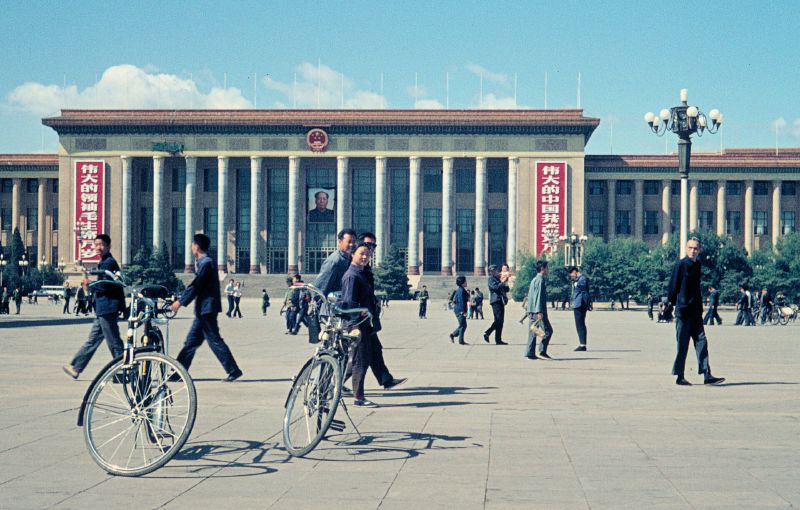
On the evening of 6 October 1976, four of China’s top leaders were told to come to an emergency meeting of the Politburo. The session was called for the Great Hall of the People in Beijing, and every member was expected to attend. Between 7:55 and 8:30 that night the four arrived, and soldiers seized each of them as they stepped through the doors into the lobby. Nobody fired a shot.
more
They were Jiang Qing, the widow of Mao Zedong, and her three allies Zhang Chunqiao, Yao Wenyuan, and Wang Hongwen. Their arrest came one month after Mao’s death, and it brought the Cultural Revolution to a close. Stefanie Lamb’s history of the Cultural Revolution, published by Stanford, dates the arrest to 6 October 1976 and says many treat that day as the end of the Cultural Revolution.
The man who gave the order was Hua Guofeng, a provincial official whom Mao had lifted to the top only that year. Fifty years on, the arrest is easy to read as the moment China turned towards reform. It did not look that way at the time, and the man who made it happen did not survive the turn.
The four and their posts
The group took its name from the arrests. Hua seized the four remaining leaders of the Cultural Revolution and labelled them the “Gang of Four”. Until that evening they had held some of the highest posts in the country.
Jiang Qing had been an actress before she became Mao’s third wife in 1939. She was the leading figure of the group, and she had sat on the Politburo since 1969. In the years before Mao died she had lived largely apart from him.
Zhang Chunqiao ranked second in the group. He had become Communist party secretary of Shanghai by 1966, the year Mao launched his campaign. He rose to vice premier in the early 1970s. Until shortly before his arrest he was also chief political commissar of the armed forces.
Yao Wenyuan wrote the essay that opened the attack. In November 1965 he published an attack on a play by Wu Han, a deputy mayor of Beijing, which he claimed was a coded criticism of Mao. The Guardian’s obituary of Yao says his pen launched the Cultural Revolution. By the mid-1970s he ran the party’s whole propaganda machine, including its journal Red Flag.
Wang Hongwen was the rising star. He had climbed to number three in the party by 1973, while still in his late thirties. He held less real power than the others.
What the Gang did
The Cultural Revolution ran from 1966 to 1976. Mao began it because he feared the party had grown too bureaucratic, and that its officials were abandoning the revolution. Jiang Qing and her allies were among its loudest voices.
From May 1966, Jiang’s allies purged figures in the cultural bureaucracy and went after writers seen as critical of Mao. Jiang handed out armbands to squads of students and declared them Red Guards. The Guardian’s account says the Gang persecuted thousands of people, as Red Guards ransacked homes and destroyed books, antiques, and religious objects.
The violence reached its peak in the summer of 1967. Intellectuals were beaten, and some killed themselves or died of their injuries. Thousands were imprisoned, and millions were sent to the countryside to labour among the peasants. Stanford’s account estimates that about 16 million urban young people were sent to work on the land over the whole period.
How Hua Guofeng came to lead
Hua was not an obvious leader. He was born in Shanxi province, lost his father at six, and joined the Communist party in 1938. He spent more than twenty years in Hunan, rising to party secretary in Shaoshan, Mao’s birthplace, and then of the whole province.
Mao noticed him. In 1971 Hua’s name was “marked” by Mao, the old practice of circling in ink the names chosen for promotion. He joined the Politburo in 1973. When Premier Zhou Enlai died in January 1976, Mao made Hua acting premier.
Then came a meeting that may never have happened. According to Hua, Mao summoned him in April 1976 with no one else in the room. Mao, by then barely able to speak, is said to have written him a six-character note: “With you in charge of business, I can relax”. The Guardian’s obituary of Hua says his account looked shaky. It still gave him a mandate. The Politburo accepted him as first vice-chairman of the party.
There was a logic to it. The army’s leaders held the balance of power, and they would not accept a takeover by the ultra-left. They saw Hua as a compromise who stood for the mainstream Maoists in the party.
The scramble after Mao died
Mao died on 9 September 1976, after 27 years as China’s supreme leader. A power struggle broke out at once. On one side stood the Gang. On the other stood an alliance led by Deng Xiaoping and Marshal Ye Jianying.
Both sides tried to win Hua over, or to force him to hand over power. The Gang pressed hardest. They controlled the state’s media and used it to keep denouncing Deng and his allies. They also had some hold over the military.
After nearly three weeks, Hua sided with Ye. He agreed to Ye’s proposal to arrest the Gang, and the two men drew up a detailed plan in secret. The Guardian’s obituary of Yao puts the outcome down to the army. The radicals had alienated every other faction in the party, the army included, and the army made sure of their arrest.
The night of the arrests
The plan was a summons. Each member of the Gang received word of the emergency Politburo session, with several important issues on the agenda. They walked in one at a time, and soldiers took them one at a time. Some of their associates were taken with them.
That same night, all of them went to Qincheng, a maximum-security prison in north-western Beijing. Hua’s group then met the rest of the Politburo and told them the Gang had been arrested.
Outside China, the story arrived in pieces. When the BBC reported the arrests, Chinese officials had still not confirmed them. Some reports said Jiang Qing was forging Mao’s will to name herself his successor when Hua’s personal bodyguards surrounded her. The Times called the arrests the strongest sign yet of a new political direction, according to the BBC.
Inside China, the public denunciations began soon after. In many cities, crowds gathered to celebrate.
Did Hua get the credit?
For a while he got more than credit. Posters of the April meeting with Mao went up across the country in their millions. Portraits of Mao and Hua of identical size hung in every school classroom. It was Hua who insisted on building Mao’s mausoleum in the middle of Tiananmen Square.
His policies held him back. Hua announced the Four Modernisations, a grand plan covering farming, industry, defence, and science and technology. He also announced the Two Whatevers: the party would uphold whatever Mao had decided and follow whatever Mao had instructed.
That left him open to Deng. Deng’s camp accused Hua of following the Maoist line slavishly. It also raised his role as Minister of Public Security in branding the April 1976 Tiananmen demonstration “counter-revolutionary”.
Deng came back to power in July 1977. Hua lost the premiership to Zhao Ziyang in September 1980. In June 1981 Deng’s protégé Hu Yaobang replaced him as head of the party and the armed forces. Deng later dismissed Hua’s time in office as “just a transition, not an epoch”.
The trial
The trial took four years to arrive. In September 1979 Ye Jianying called the Cultural Revolution “an appalling catastrophe”, and Deng proposed an open trial of the Gang at the same meeting. Deng wanted it to show the party correcting the mistakes of the Cultural Revolution, and to educate the public.
It opened on 20 November 1980. More than 880 “representatives of the masses” attended, along with more than 300 journalists. Ten defendants sat in the front row: the Gang and six associates.
The indictment ran to 20,000 words, so two prosecutors took turns to read it. The sources disagree on its central figure. Haiping Zheng’s account of the trial says it charged the Gang with persecuting 750,000 people, 34,375 of whom died. Man He’s review of Alexander C. Cook’s history of the trial gives 729,511 persecuted and 34,800 killed. Zheng doubts that ten people could have persecuted so many.
The four behaved very differently in court. Zhang refused to speak, and refused a lawyer, so nobody spoke for him. Yao accepted a lawyer and read out a defence he had written himself. At his trial he argued that he had made mistakes but committed no crimes.
Jiang fought. She called the trial a parody of justice and the chief judge a “fascist”. She was escorted out of the courtroom more than once, shouting “Revolution is no crime!” Under questioning about the persecution of the former head of state Liu Shaoqi, she cast herself as an assistant who had followed Mao’s orders.
Testimony ended on 29 December 1980, after 49 witnesses and more than 870 pieces of evidence. Sentence came on 25 January 1981. Jiang and Zhang received death sentences with a two-year reprieve, Wang life imprisonment, and Yao 20 years. There was no appeal. Jiang’s and Zhang’s sentences were later commuted to life.
Many in the West called it a show trial. Newspapers in China had declared the Gang guilty months before it began. Cook, as Man He reads him, treats it as an exercise in transitional justice, and one with inconclusive results.
What became of them
Jiang Qing died in captivity in 1991, reportedly by suicide. Wang Hongwen died in 1992. Yao was released in 1996. Zhang was released on medical parole in 1998 and died of cancer on 21 April 2005, at 88. Yao died on 23 December 2005.
Neither death made much noise in China. Xinhua gave Zhang a four-sentence obituary. Yao’s death was reported briefly, and only after a two-week delay. He had hoped to write his memoirs, but the propaganda apparatus he once ran stopped him.
Hua outlived them all. He died on 20 August 2008. In retirement he lived quietly in Beijing. His friends said that twice a year, on the anniversaries of Mao’s birth and death, he went to the mausoleum in Tiananmen Square and had his family bow three times to the chairman.