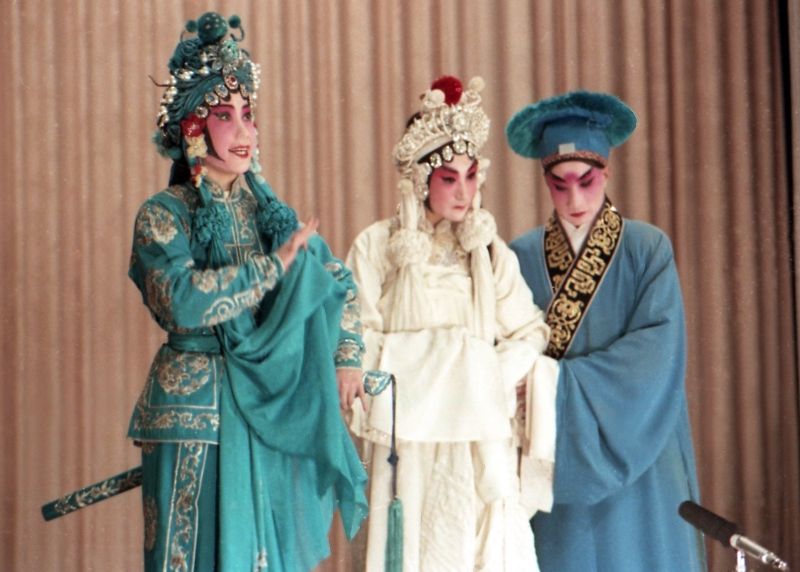
A Peking opera performance is built from a fixed cast of role types rather than from individual characters. BBC Bitesize names five of them: sheng, lao sheng, huadan, qingyi and hualian. Each performer spends a working life perfecting one of these types.
more
Chinese performers describe the form as “leading-role” theatre, the Guardian reported in 2015. The show exists to display the actor’s craft.
What the types look like on stage
The Guardian’s writer, visiting the National Peking Opera Company in Beijing, sketched the range. It runs from the strong warrior and the elderly scholar to the upright empress and the flirtatious courtesan. Each is rigidly defined, and a performer does not drift between them.
Some types are narrower still. Li Shengshu, who led the company’s production of The Warrior Women of Yang, plays the dao ma dan. That is the female general. She told the Guardian the part demands singing, acting and acrobatics together, and that “it begins with the breath”.
The singing stands apart too. The Guardian’s writer heard a female lead sing in a high, clear tone while boys somersaulted around her with wooden swords. To an ear raised on Verdi, the paper admitted, the singing can sound yelping and nasal.
Why a role takes a lifetime
Training starts young. Performers can begin at nine, working under a master who shapes both the voice and the fighting. Entry to Beijing’s Peking Opera School is highly competitive, and the course lasts six years. Students learn to sing, dance, act and tumble.
The stories suit a fixed cast. BBC Bitesize describes them as the romances, plots and adventures of scholars, emperors and warriors. The repertoire runs to more than 1,000 operas, with variants in every region. One of the best loved, Farewell My Concubine, can last four hours.
An old form with a newer shape
Chinese audiences call the form jingju, and “jing” means capital city. Its present form dates from 1790. Its roots go back nearly a thousand years, to song-and-dance shows at the imperial courts.
Audiences are sharp-eyed about all this. Shows often pause for applause. Shouts of “hao”, meaning bravo, can drown out the band.