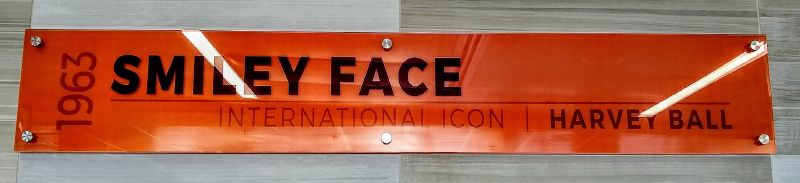
Harvey Ball, an ad-man from Worcester, Massachusetts, drew the smiley face in its most iconic form in 1963. It took him ten minutes, and he was paid $45 for it. He never trademarked the design.
more
Ball drew the icon for the State Mutual Life Assurance Company, which wanted an image to boost staff morale. The company produced pins with the face on them.
The badges sold in the millions over the rest of the decade. Ball collected his $45 fee and nothing more. He didn’t copyright the drawing, so no licence fee ever came back to him.
What made this version stick
Plenty of yellow smiling faces existed before Ball’s. A New York radio station, WMCA, had printed one on a promotional sweatshirt in 1961 to advertise a talk show, and gave away thousands of them. Ball’s drawing is the one that lasted.
Bill Wallace, who runs the Worcester Historical Museum, likens the uneven slant of the mouth to the Mona Lisa’s smile. The BBC has noted the same signature flaws in the “Worcester-made” original: a right eye drawn larger than the left, and a mouth with a particular thickness and angle.
Who made the money instead
Ball’s design travelled without him. In 1971, two brothers who ran Hallmark card shops in Philadelphia, Bernard and Murray Spain, copyrighted a version of the face paired with the words “Have a Happy Day”. They sold more than 50 million buttons in the first year alone.
A year later, a French journalist named Franklin Loufrani registered the smiley as a trademark in France, the first person to do so. He had been running a newspaper column in France-Soir called “Prenez le Temps de Sourire” (“Take the Time to Smile”), using a hand-drawn smiley to flag good-news stories. He began licensing the image to other papers, then to Mars and Levi’s. His son Nicolas now runs the Smiley Company, which sold $486m worth of licensed products in a single year and holds the trademark in more than 100 countries.