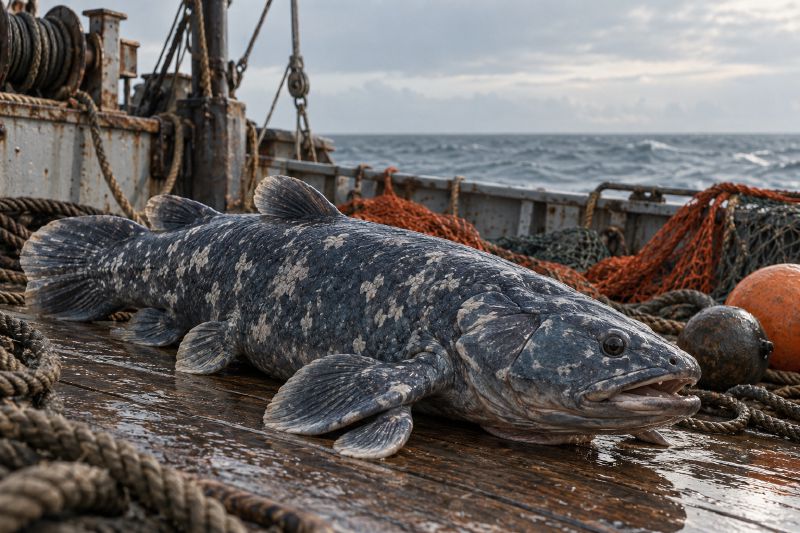
Science learned the coelacanth still lived because a museum curator looked closely at a fishing catch. In 1938 Marjorie Courtenay-Latimer, a curator in South Africa, found the fish on a local trawler working the country’s Indian Ocean coast. Scientists had assumed it died out tens of millions of years earlier.
Textbooks of the day said this line of lobe-finned fish vanished with the dinosaurs, some 70 million years ago. Its fossils go back to the Devonian period, about 360 million years ago. Finding one alive, Smithsonian Magazine noted, was about as likely as meeting a velociraptor in your garden.
Why nobody had seen one
Coelacanths live deep. They are rarely caught shallower than 300 feet. National Geographic puts their range down to 2,300 feet.
They also live in few places. One species is found off the Comoros Islands near east Africa, and a second off Sulawesi in Indonesia. The Indonesian fish became known to science only in 1997.
Specimens came slowly after the discovery, and about 300 now sit in collections worldwide.
What made the catch so striking
The living fish looks almost exactly like its fossil relatives from 300 million years ago. Its paired lobe fins stick out from the body and move in turn, like the legs of a trotting horse. Its armoured scales are a type otherwise seen only in extinct fish. NOAA describes a joint at the back of the skull that lets it open its upper and lower jaws together. At night it hunts slowly, drifting and feeding on squid, eels, cuttlefish and deepwater fish.
Those fins started a debate about how the fish fits into the evolution of land animals. Many scientists think the coelacanth shows an early step in the move from fish to four-legged land animals.
A long, slow life
Sources disagree on how long it lives. National Geographic and the Smithsonian give about 60 years. NOAA estimates about 100.
NOAA’s figures on breeding are the more striking. Males mature between 40 and 69, and females carry their young for about five years, the longest pregnancy of any animal with a backbone.
A life that slow leaves little room for losses. In 2016 NOAA listed an isolated Tanzanian population as threatened, with shark gillnets the main danger.