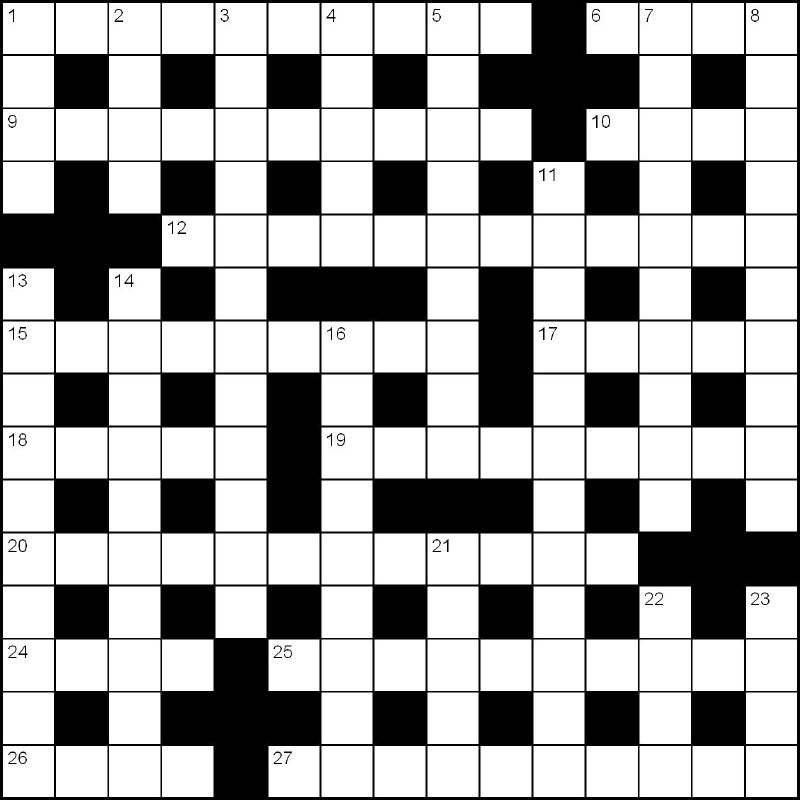
Crossword setters build their grids so the pattern of black squares survives a half turn. Rotate the page upside down and the blocks land where they started. No rule of nature demands it. The habit is a convention, and it is more than a century old.
more
Where the habit began
The modern crossword grew from a puzzle by Arthur Wynne, a Liverpool immigrant. It ran in The New York Sunday World on December 21, 1913, under the name Word-Cross. Readers took to it at once, and their suggestions shaped the basic rules. A symmetrical grid became a convention within months.
Newspapers then kept the habit. A Guardian reader who worked as a crossword compiler wrote that most papers hold around 30 grids for their setters to choose from. Every one of them is symmetrical.
What symmetry buys
Part of the answer is pleasure. The Wordplay blog on the New York Times site called it a joy to see a layout fall into balance. In one puzzle by Elizabeth C. Gorski, two number-based entries at 17 and 57 Across sat in mirrored positions and were anagrams of each other.
Part of it is checking. Rick Hosburn, puzzles editor at Take a Break, said symmetry helps proofreaders. They can fold the grid in half and hold it to the light to see whether the black squares line up. He added that the answer lengths in brackets follow a mirrored pattern too, so a checker can read the first half of the list against the second.
Another reader, Tim Cresswell of Leeds, was not convinced. He tried the folding test on that day’s Guardian Quick Crossword and found it failed, because that grid’s symmetry runs on a diagonal. He argued the real reason is that crosswords are symmetrical “because they are”.
Does it help the setter?
A pair of former compilers, John and Hazel Sweetman of Basingstoke, said it does. They filled black squares on alternate rows, and any of the four squares in the top left corner could hold the first one. Filling the rest symmetrically avoided tangles of letters and a surplus of two-letter words.
The cost is flexibility. The Wordplay blog noted that Joe Krozel had shown how dropping the rule could open up new themes and avoid awkward crossings. Even so, asymmetric puzzles stayed rare.
How rare is a broken grid?
By the blog’s count in July 2009, the New York Times had published seven truly asymmetric grids in the Will Shortz era. The first three looked accidental. The other four were deliberate, and two of them were Krozel’s.
Rotational symmetry is also not the only kind in use. The blog counted 18 Times puzzles with left-to-right mirror symmetry. Gorski made a third of them. One Saturday puzzle used diagonal symmetry to suit a maths theme.