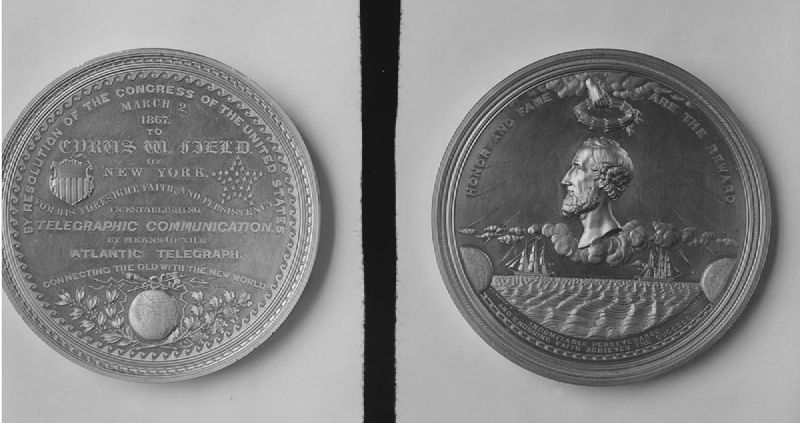
Cyrus Field’s team failed three times to lay a lasting transatlantic telegraph cable before one finally worked for good, in 1866, nine years after the first attempt.
more
Field, an American businessman, led the project with a team that included the physicist William Thomson, later Lord Kelvin, the telegraph’s inventor Samuel Morse, and the engineer Isambard Kingdom Brunel. The prize was speed: a ship crossing the Atlantic with news took ten days or more, and a cable could do it in hours.
The first three tries
Field’s ships first tried to lay a cable across the Atlantic in 1857, and the cable broke during installation. Counted by individual voyage rather than by year, that 1857 campaign alone failed twice before the crews gave up for the season.
The next attempt, in the summer of 1858, worked. On 16 August 1858, a short message travelled the roughly 3,000 kilometres from County Kerry to Newfoundland, opening with the words “Europe and America are united by telegraph” and closing with a line of scripture on peace and goodwill. By the more granular count, that success came only after three further failed attempts earlier that same summer.
The 1858 cable did not last. An unknown rupture ruined its conductivity, and within two months the line was dead. The American Civil War then made it harder to raise money for another attempt, and it was not until 1864 that work began on a new cable, stronger and better insulated.
In July 1865, the giant ship Great Eastern set out to lay that cable from Valentia, Ireland, to Newfoundland. After what the crew suspected was sabotage, the cable snapped and sank 1,200 miles into the crossing. A week of trying to grapple it back up failed, and the Great Eastern turned home empty-handed.
The fourth attempt
In July 1866, the Great Eastern tried again with an improved, galvanised cable and heavier lifting gear on board. The crossing went smoothly, and the ship reached Newfoundland after a fifteen-day passage. Then, rather than stop there, the crew spent weeks dragging the Atlantic floor for the cable lost the year before. They found it, spliced it to fresh cable, and landed a second working line at Heart’s Content, Newfoundland, in September 1866.
News of the connection set off celebrations on both sides of the ocean, with bells rung and front-page stories printed in North America and Britain. Field, despite the achievement, later lost his fortune and died poor.