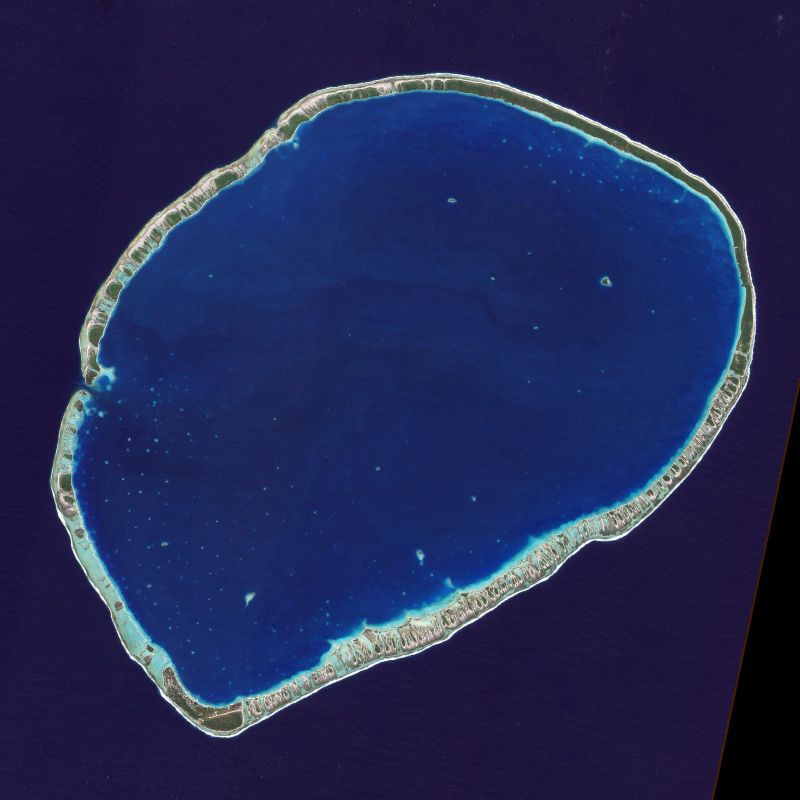
Charles Darwin explained an atoll as the last stage of a reef around a sinking volcano. A reef first grows on the edge of a volcanic island. As the dead volcano slowly subsides, the reef keeps building upward and ends up separated from the shore by a lagoon. When the island has sunk out of sight, only a ring of reef is left round a central lagoon. That ring is the atoll.
more
The theory tied three kinds of reef into one sequence. Darwin published it in 1842. Drilling has confirmed part of it, and two geologists want the rest out of the textbooks.
The view from Tahiti
The idea came into focus in November 1835. HMS Beagle had reached Tahiti in the South Pacific, and Darwin climbed its volcanic slopes. Across the water he could see the island of Moorea, ringed by a barrier reef.
His reasoning was spare. If that reef grew upward and stayed at sea level, the central island only had to sink for the barrier reef to become an atoll.
The Beagle gave him plenty to work with. The ship sailed round the world from 1831 to 1836. Its orders included recording the tides and ocean depths around a coral atoll. André Droxler, a marine geologist retired from Rice University, said the navy mapped reefs so closely because they wrecked ships.
Three types of reef
Darwin sorted every known reef into one of three classes.
- Fringing reefs are attached to land.
- Barrier reefs stand off the land, with a lagoon between.
- Atolls are rings of reef that enclose a lagoon with no land in it.
He noticed that fringing and barrier reefs both tended to surround volcanic islands. Subsidence let him read the three types as stages in one life. Geologists of his day already believed the ocean floor was slowly sinking, so the idea fitted the thinking of the time.
His map drew on the navy’s charts. Droxler called it “unbelievably accurate” against modern satellite images.
What the drills found
Drilling later bore out the sinking. Cores confirmed that atolls had subsided, as Darwin had said. Beneath the young reef lie hundreds of metres of older reef limestone, and at the bottom a volcanic base.
The same cores showed the story was messier. Atolls grew as stacks of reef layers, not in one steady climb. Each layer formed while the sea stood high. Between layers lie broad surfaces worn down while the sea stood low and the reef sat in the air. The youngest layer under a reef flat is often only 10 to 20 metres thick. It can sit on as many as five older layers of about the same depth.
For a long time nobody found a reef caught changing from one type to another. An early researcher, Vaughan, wrote that no such conversion “has yet been discovered”.
A study in Scientific Reports went back to Tahiti to look. Using cores from Integrated Ocean Drilling Program Expedition 310, the team traced a fringing reef that retreated upslope as the sea rose after the last ice age. It met an old reef platform, got stranded on its edge and formed a lagoon. Faster-growing corals then took over, the reef kept pace with the sea, and it became a barrier reef. The authors said this links Darwin’s reef types.
The case against the sinking island
Darwin assumed the sea stayed put. That assumption came under question once geologists discovered the ice ages. Droxler said Darwin had no idea that sea level could rise and fall. Glaciation was not common knowledge until the 1860s.
Droxler and Stéphan Jorry of the French marine institute IFREMER set out another model in the Annual Review of Marine Science. In their account, no volcano is needed.
It starts with flat-topped banks of carbonate rock. These built up between about 5 million and 2.5 million years ago, while the climate was warm and sea level steady. Then the ice ages began to swing the sea up and down roughly every 100,000 years. Smithsonian Magazine puts the swings at up to 135 metres. ScienceDaily reports them as 120 metres or more.
When the sea drops, rain pools on the exposed bank. Mildly acidic rainwater dissolves the rock most at the centre and leaves a hollow. When the sea returns, corals grow mainly on the raised rim, where they sit nearest the light. Over many cycles a ring of reef builds up around the hollow. Droxler dates today’s atolls to the last 500,000 years.
The pair drew heavily on the Maldives, which Droxler called “the Mecca of atolls”. Oil company boreholes, drilling expeditions and a sonar survey near the capital, Malé, supplied the data.
Why Darwin’s version lasts
Droxler knows why the older model survives. He called it so “beautiful” and “pleasing” that everybody still teaches it. He also called it “a fabulous model” given how little data Darwin had.
The question now matters beyond geology. Smithsonian Magazine notes that people live on hundreds of atoll islands, and rising seas threaten their low-lying homes.