Most of the Dead Sea Scrolls did not come out of the caves as scrolls. Searches of 11 caves near Qumran turned up around 900 texts, and most of them were fragments. Rebuilding them is slow. One scroll took two researchers a full year, and telling apart the scribes who wrote another needed a neural network.
more
The find began with a lost goat. In 1946 a Bedouin shepherd boy threw a rock into a cave above the Dead Sea and heard it strike a ceramic jar. Inside was an ancient manuscript, the first of the scrolls. Archaeology Magazine dates the find to 1946 or 1947, and says searches over the following decade produced the rest.
What the caves held
The texts date from the third century BC to the first century AD, by Archaeology Magazine’s count. The BBC’s In Our Time puts the range at around 250 BC to AD 68, and the total nearer a thousand texts. They include almost the whole Hebrew Bible, along with legal texts, community rules and literary writing.
National Geographic counts about 230 of the manuscripts as Biblical. The rest describe the beliefs and daily practice of the people who kept them. Most are in Hebrew on parchment, though some are on papyrus and one is on copper.
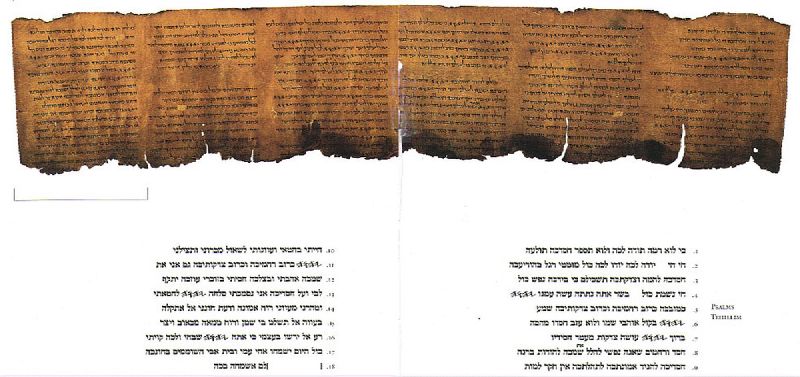
A few survived whole. The Great Isaiah Scroll, one of the seven original scrolls from the Qumran caves, was written around 125 BC. It is the largest and best preserved of the set, and it holds the entire Hebrew text of Isaiah in 27 columns.
A year for one scroll
The fragments are where the time goes. At the University of Haifa, Eshbal Ratson and Jonathan Ben-Dov spent a year fitting 60 fragments together into one scroll. Its text ran in a band of code on parchment.
The result described a 364-day calendar. Because 364 divides by both four and seven, Ratson and Ben-Dov explained, festivals fell on the same day every year. “The Qumran calendar is unchanging,” they said. The scroll also gave a name, Tekufah, to the celebrations marking the turn of each season. Other texts had described them without naming them.
When National Geographic reported the work, it said that only one more known scroll remained untranslated.
Two hands in one scroll
Even a complete scroll can hide questions. The Great Isaiah Scroll has a break halfway through its 27 columns: a gap of three lines where a second sheet was stitched to the first. The handwriting on each side looks identical, even to highly trained readers.
A team led by Mladen Popović, a Hebrew Bible scholar at the University of Groningen, tested it by computer. They trained a neural network to separate the ink from the leather beneath it. Lambert Schomaker, a co-author and artificial intelligence researcher there, said ink traces follow a person’s muscle movement, so they are specific to one writer.
The team then mapped every aleph and bet in the scroll. An averaged aleph from the first half looked different from one built from the second. Two scribes had shared the work, and the second took over at the halfway break. “It tells us they worked in teams,” Popović said.
Other tools keep adding text too. Smithsonian notes that multispectral imaging found writing on fragments once thought blank.
Blank parchment and fakes
New material still surfaces, and not all of it is real. Fragments said to come from the Qumran area have appeared on the antiquities market, and many are thought to be fakes. The Israel Antiquities Authority responded with Operation Scroll, a survey of several hundred caves in the area.
In February 2017 a team led by Oren Gutfeld of the Hebrew University and Randall Price of Liberty University announced a cave west of Qumran. It held broken storage jars, cloth for wrapping scrolls, leather straps and blank parchment, but no scrolls. Hidden between two rocks were a pair of pickaxes from the 1950s. To Gutfeld, they showed looters had emptied the cave 60 years earlier.
Robert Cargill of the University of Iowa was less sure. He thought the blank parchment mattered more, as evidence that people at Qumran could make scrolls. Lawrence Schiffman of New York University read the same parchment another way. Blank animal skin from antiquity, he said, is what a forger needs to make a fake that passes radiocarbon dating.
Popović called the handwriting study “just the first step” towards studying all the scribes behind the collection. “We will never know their names,” he said. After 70 years, though, he felt researchers could “shake hands with them through their handwriting.”