A diagrid moves a tall building’s structure from the middle to the skin. Instead of relying mostly on a central core, the tower carries its weight and wind load through a crisscross lattice of diagonal members on its outside. The payoff can be height. In London, the architects of one diagrid tower say a conventional core-led design would have had to be 30 per cent shorter.
more
Why the London tower needed one
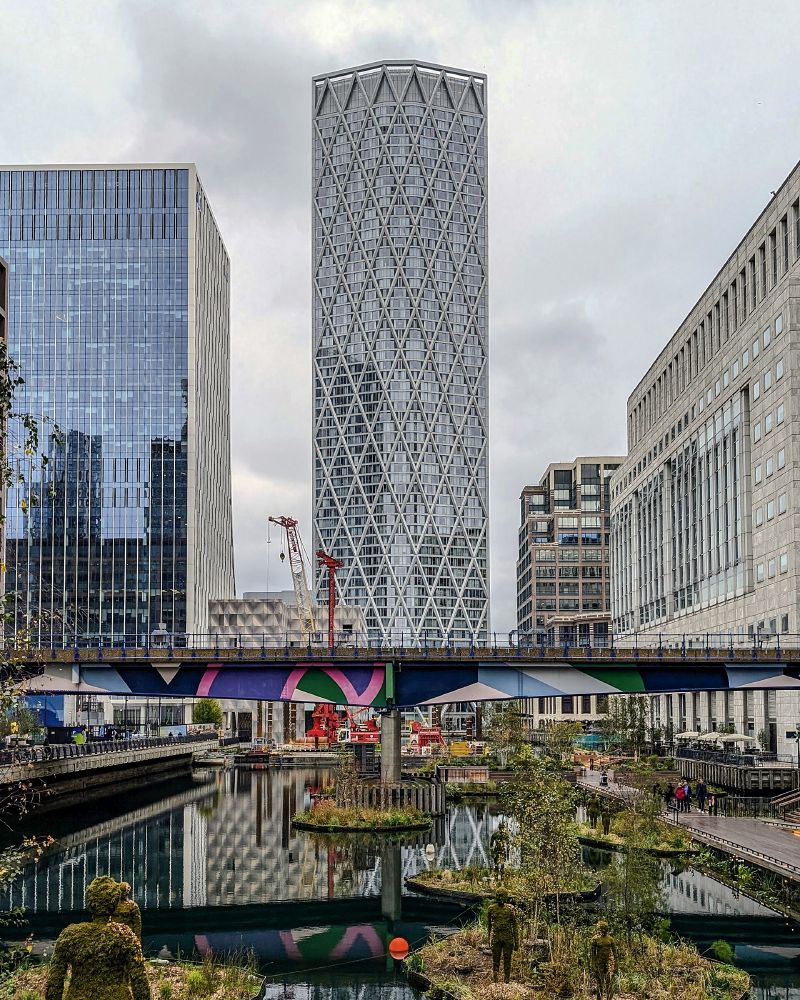
That tower is Newfoundland, a 225-metre, 58-storey residential block in Canary Wharf by the studio Horden Cherry Lee. It stands directly above an Underground train tunnel. The ground near a tunnel can bear only so much, so the building had to be fairly light and had to pass its loads down at a few chosen points around the tunnels.
Co-founder Billie Lee told Dezeen the team’s answer was an external diagrid, which he called naturally stable for such a slender building. It let the engineers steer forces away from the tunnels. That, in his account, is what let the tower reach almost to the aviation height limit.
The frame is on show. It is clad in silver aluminium, and the 72,248-square-metre building holds 636 rental flats. Dezeen reports it as the tallest build-to-rent project ever completed in the UK.
Does the diagrid work alone?
Not always. At Poly International Plaza in Beijing’s Wangjing district, Skidmore, Owings & Merrill paired a steel-and-concrete diagrid with a concrete core. Architectural Record says the two together form the primary load-resisting system.
The main tower there is 499 feet high, elliptical in plan, and nicknamed the Diamond Lantern. Its diagrid is clad in white aluminium, and lights set into the structural members make it glow at night. Mark Sarkisian, the SOM structural engineer who co-led the project, described a long process of working out with the client what the site meant.
The design also had to cope with Beijing’s seismic activity and extreme climate. Each floor plate gives about 21,200 square feet with no columns in it. SOM says the tower cuts carbon emissions by 18 per cent and energy use by 23 per cent.
The frame as the building’s face
In both towers the frame doubles as the building’s face. Lee called Newfoundland a sculpture for the city, with the diagrid giving it an identity readable from far off. In Beijing, the angled glass and white exoskeleton make the tower look like an origami lantern.
The two buildings answer different briefs. One needed to be light over a tunnel. The other needed to stand up to earthquakes beside a busy highway. Both put the diagonals where you can see them.