Göbekli Tepe suggests religion came before farming because hunter-gatherers seem to have built it. The carved stone rings on a hilltop in south-eastern Turkey are about 11,000 years old, older than pottery or metal tools. Klaus Schmidt, the German archaeologist who excavated the site, argued that the work of building them pushed people towards farming, rather than farming making the building possible.
That reversed the textbook order. Since Schmidt died in 2014, fresh digging has made the picture messier.
What the old timeline said
Archaeologists had long held that organised religion and monuments were luxuries. In that account, people first domesticated crops and animals, a shift known as the Neolithic. The food surplus then freed them to spend time on ritual.
The Guardian’s editorial on the site adds the usual explanation for the switch to farming. A slow warming at the end of the ice age was thought to have driven it.
What Schmidt found on Belly Hill
The site’s name means “belly hill” in Turkish. Anthropologists from the University of Chicago and Istanbul University visited in the 1960s and took the broken limestone for a medieval cemetery. Schmidt read their brief note in 1994, went to look, and began digging with five colleagues the following year.
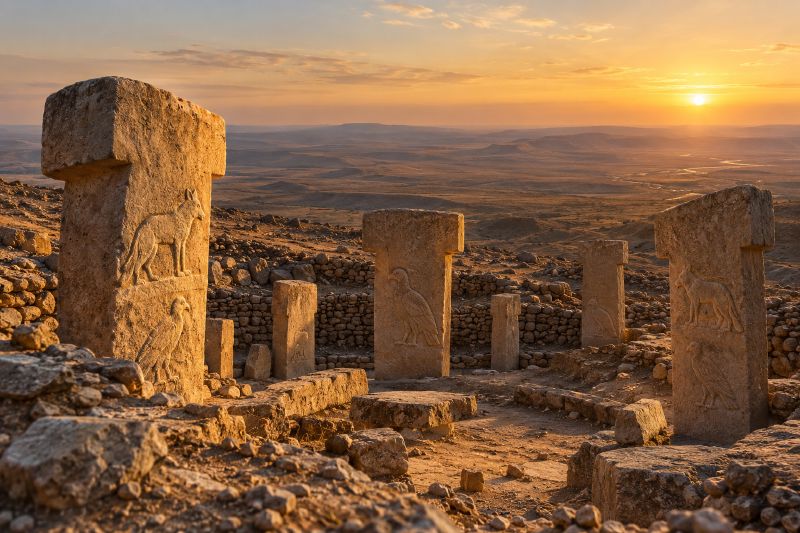
What they uncovered were rings of T-shaped pillars, with two large ones in the centre of each ring. Smithsonian reported that the tallest stood 16 feet. Some are carved with foxes, lions, scorpions and vultures. The BBC described the central pillars of the largest enclosure as 5.5m tall, carved as stylised human figures with folded hands and fox-pelt belts.
The sources disagree on the weight. Schmidt told Smithsonian the tallest weighed seven to ten tons, while National Geographic put the largest at more than 16 tons. The Guardian wrote of 20-tonne pillars.
Why Schmidt thought hunters built it
The evidence pointed away from farmers. The BBC reported that the tens of thousands of animal bones on the site came from wild species, with no sign of domesticated grain or plants. After more than 25 years of digging there was still no evidence of domesticated plants or animals.
Schmidt’s team also found no hearths, houses or rubbish pits. He concluded nobody lived there full time and called it a “cathedral on a hill”.
The dating rested on stone tools that matched others from nearby sites dated to about 9000 BC, backed by limited radiocarbon dating.
How a temple could lead to a farm
Schmidt pictured small nomadic bands gathering on the hilltop for bouts of building, holding large feasts, then scattering again. Carving and moving the pillars needed hundreds of people and enough food to feed them.
Over about 1,000 years, the BBC’s account runs, that demand pushed people to make food more dependable by domesticating plants and animals. National Geographic reported that Schmidt thought the labour force needed food, and perhaps drink, on a schedule.
The digs turned up evidence of feasting. The backfill inside the enclosures holds tens of thousands of broken bones from gazelles and aurochs, an extinct wild cow. It also holds stone vessels big enough for more than 40 gallons of liquid, perhaps early beer.
Jens Notroff of the German Archaeological Institute told National Geographic that feasting was “the easiest explanation” for drawing workers to the hill.
What the newer digs changed
Digs since Schmidt’s death cast doubt on the lonely temple. The Guardian reports that newer excavations revealed houses and signs of year-round living. That makes Göbekli Tepe look more like a thriving village with large special buildings at its heart.
Clare has offered a different reading. He suggests the site may have been a response by hunter-gatherers trying to hold on to their way of life while neighbouring groups took up farming.
Göbekli Tepe was not alone either. Smaller versions of its pillars and symbols have turned up in settlements up to 125 miles away. The Guardian notes that more of these “mini” Göbekli Tepes are being found across Turkey’s Harran plains.
The question still open
The builders buried their own monument. After each ring was finished, it was filled in with earth, and new structures rose on top of the backfill. The Guardian notes that no flood or earthquake did this. The burial was deliberate, perhaps by the people who built it.
Archaeologists can tell what the builders ate and hunted. What they believed is still a guess.