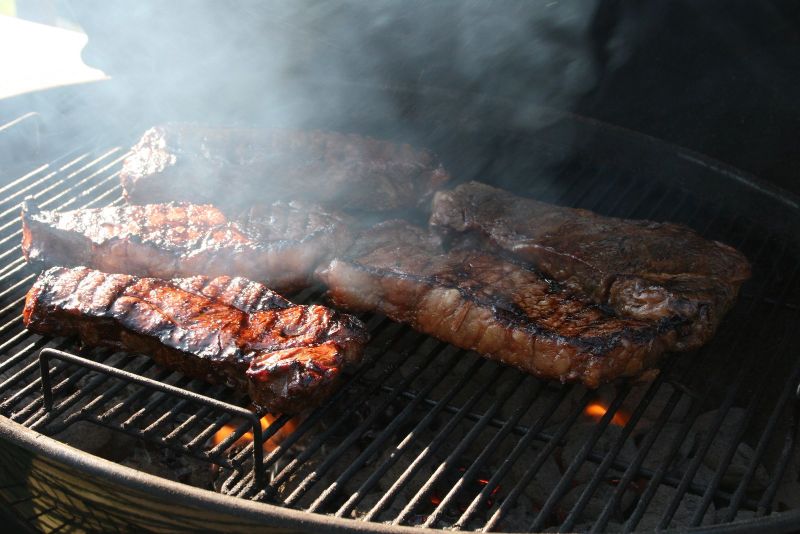
A seared steak browns because dry heat drives its surface past the point where amino acids and natural sugars in the meat start reacting and rebuilding themselves into new molecules. Chefs have a shorthand for the result: colour equals flavour. Chemists call the process the Maillard reaction, and it is what turns a pale, steamed-looking piece of meat into one with a mahogany crust and a smell that fills the kitchen.
more
Louis-Camille Maillard was not trying to explain a good sear when he wrote up the reaction in 1912. The French chemist was investigating how amino acids behave inside the body, and he noticed that heating them together with sugar produced strong-smelling brown compounds as a side effect.
Why a wet steak refuses to brown
Water gets in the way first. A wet surface cannot climb past 100°C, because the liquid sitting on it boils, and the steam that forms carries the extra heat off before the surface can heat any further. That is the entire reason recipes insist on drying a steak before it meets the pan.
Charlie Crote, who heads the kitchen at the Midland Grand in London, salts a steak only once it is ready for the heat. Salt too early, he told the Guardian, and the moisture it draws out leaves the steak carrying “a layer of moisture on the outside” by the time it meets the pan. It boils there instead of searing. Skye Gyngell, who runs the kitchen at Spring in London, makes the same point about a crowded pan. Overcrowd the pan, she says, and the meat stews instead of browning.
Searing in smaller batches works for the same reason. Less meat touching the metal at once means the pan holds its heat, and the water each piece releases has room to escape as steam rather than pooling underneath it.
What is actually happening in that crust
The colour change starts earlier than the crust does. At around 60°C, the pigment myoglobin that keeps red meat red begins to darken on its own, well before any real browning. The reaction that builds an actual crust needs far more heat than that: it barely runs at all until the surface has climbed well past 150°C.
Once the pan clears that mark, the amino acids and the small amount of natural sugar in the meat’s muscle fibres react and recombine, branching into dozens of pathways at once. Popular Science, working with Saveur, put the result at 3,000 to 4,000 separate compounds in a well-browned crust, and said the hotter the surface gets, the faster that crust forms. The first new compound to form is unstable, and it rearranges itself almost at once into something food chemists call an Amadori product. From there the chemistry fans out into the melanoidins that turn a crust brown, and into the smaller compounds that give it its smell.
Getting the technique right
Gyngell heats her pan on a high flame for a couple of minutes, waiting for a thin curl of smoke to rise from its centre, before oil goes anywhere near it. The meat should sizzle the moment it lands, and pieces need enough space between them that steam has somewhere to go instead of sitting on the surface.
Her other rule is patience. Leave the steak alone rather than turning or prodding it, because a crust that looks stuck to the pan lets go on its own once it has properly formed.
Does searing really lock in the juices?
One popular claim about searing does not hold up: it does not seal in the juices. It is about flavour, the Guardian’s own food writers note, and that particular idea is not true. Serious Eats found something closer to the opposite trade-off. The deeper the sear, the more moisture the meat loses: the browner the surface, the tougher and drier it turns.
Braising does not dodge that trade either. A piece of meat simmered in liquid loses almost as much moisture as one roasted dry in an oven. Its muscle fibres contract and squeeze out liquid as they heat, whatever medium is carrying that heat in.
What to do once the steak is out of the pan
Crote leaves the seared meat uncovered rather than under foil, because covered meat sweats rather than roasts. The browned bits left stuck to the pan are not waste, either: pour off the fat, add a splash of wine, and what lifts off the metal becomes the start of a sauce.