Where dubstep came from
more
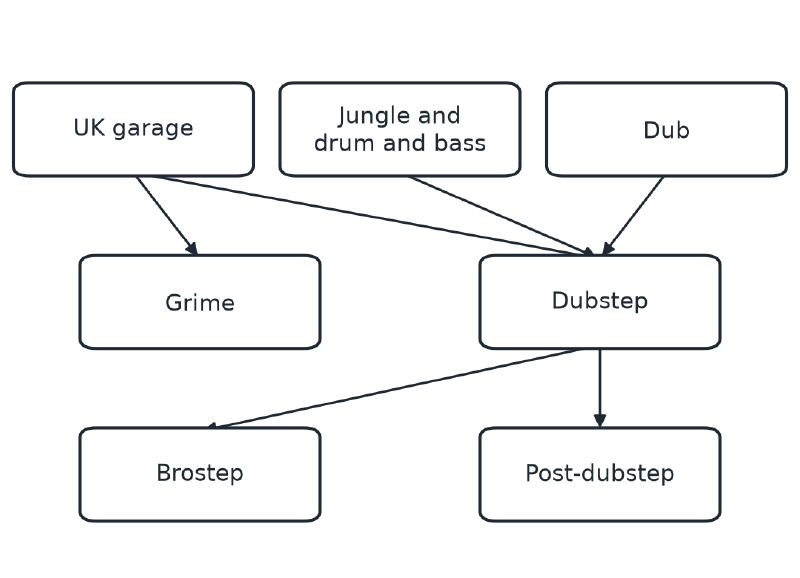
Dubstep began in south London around the turn of the millennium, when a handful of producers took UK garage and stripped it down to bass, drums and dub echo. Its roots lie in Big Apple Records, a shop and label in Croydon, where the people who would build the sound met to try out new, bass-heavy ideas. By 2011 it had travelled from evening radio to arenas across middle America.
more
The timing mattered. By 2000 jungle and drum’n’bass had run low on fresh ideas, and garage had swapped its moody underground roots for champagne and chart hits, as the music writer Lauren Martin puts it. Small groups in London, Croydon and Essex decided to take out the breakbeats and the cliques and keep what a sound system does best: bass, space and a sense of togetherness. Martin has collected that story in Aftershock: The Seismic Impact of Dubstep, an oral history told by 28 artists and people from the scene.
A record shop in Croydon
Clash traces the darker strain of garage to three studios: those of Menta, El-B and Horsepower Productions. DJs such as Hatcha played it at FWD», and Big Apple sold it on vinyl to hungry buyers. For about five years those producers refined the sound with little interference from the outside world.
Big Apple was more than a till. Skream’s older brother Hijack, a jungle DJ, worked there, and the producer Arthur Smith, known as Artwork and as Menta, had his studio above the shop. Skream would sit upstairs and listen to Smith’s tunes. He told Clash in 2006 that without the shop, he “might not even be making dubstep”. He added that it was the people, not the postcode, that counted.
Resident Advisor lists some of the regulars who gathered there: Coki, Mala, Kode9, N-Type and Loefah. At first the sound went by the clumsy name “forward music”. Resident Advisor describes it as a ruder, grittier kind of UK garage, shaped by the rhythms of dub and reggae.
When dubstep arrived
Pitchfork dates the split from UK garage to around 2002. Its review of The Roots of Dubstep, a compilation put together by the writer Martin Clark and his partner Ammunition, names Horsepower Productions’ album In Fine Style as the moment dubstep arrived. The reviewer calls the record epochal, and says Horsepower had perhaps the best bass sound of any records made this century. The dictionary agrees on the year: Merriam-Webster dates the word “dubstep” to 2002.
The people who made it came from jungle, or had grown up going to jungle clubs. El-B and his circle loved the deep sub-bass of the Metalheadz label and carried that intensity into garage. Kode9’s Hyperdub webzine chronicled garage’s descent into darkness, in the reviewer’s words. The compilation ends with Digital Mystikz’s “Pathwayz” from 2003: three heavy kicks, two snare cracks, a vocal chant and a sour synth line, looped.
Resident Advisor, reviewing Kode9 and the Spaceape’s album in 2007, remembered the same moment from another angle. Two-step garage, it said, was already turning into the early dubstep of Horsepower Productions and the Tempa label.
How it feels on a dancefloor
The tempo explains a lot. Joe Nice, a Baltimore DJ, was one of dubstep’s first champions in the US. He sets it against its neighbours: house runs at 120 to 130 beats a minute, and drum’n’bass at around 170. Dubstep runs at 140, he says, but it feels like 70. He compares it to the Earth spinning, fast and still at once, and says no other genre he plays gives a dancer so much freedom.
The first mixes and the first label
Before many records existed, the music spread on mix CDs. Mixmag calls Hatcha’s Dubstep Allstars Vol. 1, released in 2003, a kind of ground zero for the genre. Early in that mix sits “The Judgement”, the first record Skream and Benga released together, on Big Apple. Youngsta’s live mix from Plastic People, built mostly on music by Digital Mystikz and Loefah, carried the sound to a wider audience.
The Observer, reviewing the fifth Dubstep Allstars in 2007, noted how local the scene had been. The previous volume, mixed by Hatcha and Youngsta, featured just one artist from outside Croydon. By then the sound had begun to outgrow its home, and more than 60 people had travelled from Europe and America for one DMZ night.
Hyperdub’s story starts in a flat above a hair salon in Camberwell. Steve Goodman, the DJ and academic who records as Kode9, ran it as a webzine first. Its first record was his own “Sine of the Dub”, a sparse 10-inch released in 2004, when dubstep was still, in the Guardian’s words, a dark glint in UK garage’s eye.
The Croydon teenagers and the Brixton dance
Dubstep’s founders were young and local. Skream, born Oliver Jones, left school at 14 and drifted until record shops gave him somewhere to be. He was soon making about 13 tunes a week that nobody wanted to play. Then he met Benga, and the two began swapping tunes and working out the new sound between them.
more
The pirate DJs Hatcha and Artwork started playing what the pair made, and Skream and Benga won their own show on Rinse FM. By 17 Skream had listeners tuning in from Brazil, Korea and Indonesia.
Artwork kept doors open for others too. Loefah told Clash that Artwork ran the Big Apple label and took a chance on his first 12-inch, though the mixdowns on it were, by his own account, appalling. Loefah has since made a point of doing the same for new producers on his own labels.
DMZ: no VIPs, plenty of bass
The DMZ crew go back even further. The Observer reported in 2007 that Mala, Loefah, Coki and their MC Sgt Pokes first swapped mixtapes at Atwood Primary School in Croydon. Mala and Pokes played their first gig at 14, alongside the jungle DJ Kenny Ken, who told them to keep going.
Their club night began in March 2005 at 3rd Base, a room inside Mass in Brixton, and ran every two months after that. Coki remembers the space looking like a function hall, with red curtains, church glass in the roof and a little stage for a pastor and choir. He worked the door at the first night, aged 25, and let people in free.
The rules were Mala’s. He wrote as Digital Mystikz under the motto “meditate on bassweight”, and he wanted a dance with no segregation and no VIP area. The DJ who opened mattered as much as the one who closed. Crowds looked in record boxes and reloaded records, and Mala says almost nothing bad ever happened at the dances, right in the centre of Brixton.
When a new tune hit hard, someone pulled it back to the start. Loefah says some DJs played only 10 tunes in two hours because of all the rewinds, a habit the crew brought from jungle raves and dancehall. Joe Nice watched Coki’s “Haunted” get pulled up four times at that first DMZ before anyone let it play through. Coki stood in a corner smoking, watching the chaos his new tune had caused.
A sound against violence
The calm was deliberate. Loefah recalls people being shot and stabbed in clubs at the time, and says dubstep worked hard to stay apart from that. He says that is the point of Digital Mystikz’s “Anti War Dub”: a dance not uplifting so much as safer. Coki adds that garage and grime raves had become too violent, and the crew’s answer was to leave it.
The vocal on “Anti War Dub” came from Spen G, a friend of Coki’s cousin in Jamaica. Coki had written the beat as a reggae exercise, then handed it to Mala, who built the track. Mala also credits the dub sound system Jah Shaka, whose gentle way of presenting music let the audience simply be themselves.
Mala’s father, a painter and decorator all his life, once told a neighbour that if he could live again he would live as his son. Mala calls it probably the nicest thing anybody ever said to him.
The big night
DMZ’s first birthday, on 4 March 2006, showed how far it had come. Within an hour of opening, about 450 people were inside and another 500 queued outside. Loefah says every dance drew at least 10 or 15 visitors from abroad, and sometimes 40 or 50. DMZ ran a separate queue for them. In 2026, Mala and Coki played Fred Again’s residency at Alexandra Palace in London, in front of a new generation of fans.
Kode9, Martyn and the wider circle
Kode9’s “Sine of the Dub” reached further than Croydon. The Dutch producer Martyn told Pitchfork it was the record that made him notice dubstep, because it fitted the reggae-tinged techno he was hunting at the time. Pitchfork’s columnist added that many dubstep pioneers, from Kode9 to El-B, had drawn on Berlin’s Basic Channel. Joe Nice, meanwhile, spread the music on his monthly Gourmet Beats radio show.
Mala also runs Deep Medi, the label behind Silkie’s debut album, City Limits Volume 1. Silkie told Pitchfork he chose dubstep over grime because grime’s MCs crowded the frequencies, while in dubstep the beat could carry the whole tune.
Benga’s honesty
Benga, born Adegbenga Adejumo, joined Skream and Artwork in the trio Magnetic Man. In 2015 he spoke publicly about his mental health, after a diagnosis of bipolar disorder and schizophrenia the year before. He said speaking out was a way of moving forward, and he told the Guardian that at times he felt the happiest he had ever been.
The records that defined dubstep
Early dubstep lived on dubplates and tiny vinyl runs. At the start of 2005, Pitchfork’s Martin Clark wrote, the whole scene was a small London community with a handful of fans abroad. Horsepower and Goldspot’s “Sholay”, which he called a stone cold classic, was first pressed in a run of only 300 copies.
The tunes that moved the scene
Clark argued that dubstep grew by small steps rather than one revolution. He still named two tunes that shifted the sound: Groove Chronicles’ “1999” and Loefah’s “Horror Show”. He heard Loefah’s music as pure condensed anger, so dark and minimal that it seemed to be made of absent sound.
Through 2005, Skream’s “Midnight Request Line” crossed over into grime and microhouse sets. By late 2006 Clark was calling “Anti War Dub” and Mala’s “Bury the Bwoy” rhythmic landmarks. He also tracked a change that would matter more than anyone guessed. Skream and Loefah built basslines for bigger rooms, and Skream and Coki made their basslines wobble so much that they became part of the rhythm. Copycats followed, each trying to sound darker and wobblier than the last.
Coki’s “Spongebob”
One morning in 2007, Coki was playing with low-frequency oscillators in his studio in south London, trying to copy the trembling basslines of the French producer Mr Oizo. The loop he landed on became “Spongebob”, which Resident Advisor calls a dubstep classic. The name came from his son, who was watching the cartoon while he worked.
He gave it to Hatcha on a USB stick the night he made it. Mala, Benga and Skream soon played it at DMZ and FWD». Resident Advisor says it was one of the first dubstep tracks to make the bassline the hook. It inspired a generation of producers to chase the dirtiest drop, and bolder, jump-up dubstep became the norm.
Burial, the producer nobody could see
The albums that carried dubstep beyond the club came from Hyperdub. Kode9 admits he was worried about releasing Burial’s debut, because he doubted anyone would like what he called a weird take on garage. Burial came out in 2006 and dominated the year in Pitchfork’s dubstep column, winning listeners who had never cared for the sound. Clark tied its mournful melodies to early El-B and mid-1990s jungle. Pitchfork’s review of Untrue heard both albums as a tribute to two-step garage, the short-lived style that splintered into dubstep, grime and bassline house.
The Guardian’s list of 1,000 albums to hear before you die includes Burial, describing a concept album for a flooded south London of the near future. The paper’s 2006 roundup of critics’ lists placed it sixth, quoting Fact magazine calling it an instant classic. Its cover, Pitchfork’s Simon Reynolds writes, shows an aerial view of the south London borough of Wandsworth.
Untrue followed on Hyperdub on 5 November 2007. Burial had first made a whole darker album, then scrapped it when his mother disliked the tunes he played her. He started again around vocal samples and finished Untrue in a couple of weeks. The Mercury Prize nominated the record in 2008.
Kode9 says he was relieved when Elbow beat Burial, the bookmakers’ favourite, to that prize. He was protecting Will Bevan, the man behind Burial, who wanted to avoid the spotlight. The Sun’s gossip editor Gordon Smart had started a campaign to unmask him, which pushed Bevan to reveal his identity himself.
The critics have only grown warmer. The Observer called Untrue an essential album and placed it ninth in its best albums of 2007. Pitchfork placed it in its 200 best albums of the 2000s, praising the way Burial treats voices on tracks such as “Etched Headplate” and “Shell of Light”. Rolling Stone named it among the 30 greatest EDM albums and called Burial dubstep’s first real link from London to the outside world. In 2019 the Guardian ranked it 31st among the 100 best albums of the 21st century. Pitchfork went further in 2017, calling it the most important electronic album of the century so far.
Kode9 and the Spaceape
Burial shared the top of Pitchfork’s dubstep chart for 2006 with Memories of the Future, by Kode9 and the Spaceape. Clark heard in Kode9’s album a mournful, vocal side of dubstep that few others had explored. Kode9 calls Hyperdub itself “a mutation of British electronic music”, caught from Jamaican sound systems and passed down through dub, jungle and dubstep.
Loefah, looking back in 2013, told Clash that dubstep had taught him you cannot please everyone. He also promised that the 12-inch records on his label would always stay on vinyl.
How dubstep left London
Two events in one weekend of January 2006 broke dubstep open. Pitchfork called that month a landmark for a sound that was then six years old. On the Saturday, DMZ defied the old club rule against opening on the first weekend of the year, and filled its room. On the Monday, Mary Anne Hobbs handed her whole Radio 1 show, Breezeblock, to the scene for a showcase she called Dubstep Warz.
Clark watched the effect. Traffic on the dubstep forum jumped, and FWD» opened in January for the first time in its history, with Hobbs herself in the crowd. Producers known for London reserve were, days later, bubbling with excitement and even giggling. He still warned against hype, because a sound built for meditating on bass weight might not carry to arenas.
2006, the year it broke
By the end of 2006 the change was hard to miss. Leeds and Bristol held large, regular raves with their own DJs and producers. Digital Mystikz and Loefah were playing across Europe, Skream and Kode9 were in New York and Australia, and Pinch, Vex’d and Distance had reached the US. Vinyl runs rose into the thousands, and a new Dubstep Forum signed up more than 4,500 members. Even a major film used dubstep on its soundtrack.
New listeners brought a new problem. Many of them, Clark wrote, behaved as if the sound had begun with Dubstep Warz, though its roots lay in the two-step garage of 2000. He wondered how producers who had never seen London’s decaying streets would make music about them, and hoped Bay Area or Brazilian producers might bring in their own local sounds.
Bristol, Berlin and the wobble
In 2007 Pitchfork followed a conversation between Bristol and Berlin. On the British side were Appleblim and Shackleton of the Skull Disco label, with Pinch and Peverelist. On the German side was the Basic Channel circle and the Hardwax record shop, which began to champion dubstep. The same column worried that mainstream dubstep sets in 2007 were losing the old balance between low male bass and high female vocals.
That was the wobble taking over. By late 2009 Pitchfork reported that the wobble side, now renamed “brostep”, had become the default dubstep for many British fans. After “Spongebob” spread across London, Resident Advisor says, it reached dancefloors around the country. Its peak came in 2008, while Coki was still working full-time as a civil servant and raising his son. Friends told him the tune was even being played abroad. He did not leave his office job until 2011, the year dubstep exploded.
America takes the drop
From there the louder strain grew in the US. Resident Advisor describes producers such as Skrillex and Flux Pavilion pushing Coki’s midrange further, making harder hits. The style picked up the scornful name “brostep” after the crowds it drew, and filled stadiums and festival fields. A$AP Rocky rapped over a Skrillex bassline on “Wild for the Night”, and Britney Spears put a brostep breakdown into “Hold It Against Me” in 2011.
Hatcha, the DJ Coki first handed “Spongebob” to, later told Fact magazine that the media and the public only wanted the noisy stuff. By 2012, Resident Advisor says, the bubble had begun to burst.
The quieter strain survived
Underneath the boom, a slower, deeper dubstep kept going. The blog OneFortyDeep, writing for the Guardian in 2014, set out to promote the sound that had survived a commercial boom which had warped what people thought dubstep was. Its picks came from far beyond Croydon, from the Istanbul producer Gantz to the Japanese veteran Goth-Trad. Mixmag adds that labels such as Innamind Recordings, Uprise Audio and Gourmet Beats have kept the raw sound alive with a modern touch.
From the charts to the comeback
At its commercial height, dubstep belonged to the charts. At the start of 2011 Skream had four songs on the Radio 1 playlist, a feat the Guardian said only David Guetta had matched. He was producing for Katy B and Example, playing to crowds of 8,000 on a US tour, and headlining festivals as one third of Magnetic Man. His 2009 remix of La Roux’s “In for the Kill” had arrived as dubstep rose, and he was credited with carrying it into the mainstream.
The Guardian’s diary of that year shows how wide the sound had spread. James Blake came second on the BBC’s Sound of 2011 list. Nero played a dubstep symphony with the BBC Philharmonic. FWD», the club that had nursed the genre, turned 10 with a 10-hour night, one DJ for each year.
Skrillex and the backlash
The face of the American boom was Sonny Moore, a Los Angeles producer who had once sung in the screamo band From First to Last. As Skrillex he became, in the Guardian’s words in 2011, the figurehead for electronic dance music’s explosion into middle America. He played more than 300 shows that year, and on the Beatport store he was searched for about 50 times more than any other producer. One Coachella forum thread attacking him ran to 1,485 posts.
Moore shrugged it off. He told the Guardian he did not even try to make dubstep, and saw it as one more tempo that made crowds go wild. Skream defended him against the purists. He said Skrillex had done to dubstep almost what he and Benga had done to garage.
Skream felt the backlash too. He told the Guardian he hated that fans who had followed him from 2002 to 2006 now thought he had lost it. A meme on the dubstep forums set a photo of men in winter coats watching a mixer against one of American teenagers in glowstick glasses.
The colour comes in
Some of dubstep’s founders had already moved on. Kode9 told the Guardian in 2009 that by about 2007 the greyness of dubstep had left him cold. Hyperdub turned to synthesisers and colour, with new acts such as Darkstar and Ikonika, and Kode9 likened the result to hearing circuitry cry. Money from Burial’s album paid for that shift. Kode9’s own “Black Sun” was, the Guardian wrote, the sound of an auteur trying on house music for the first time.
Simon Reynolds, looking back on the decade for the Guardian, saw the same turn. He wrote that dubstep had swung from dread and darkness towards a cartoon brightness, and named the Bristol micro-genre “purple”, built by Joker, Guido and others. He also credited Burial as the genre’s great ambassador, the producer who made dubstep an album form for people who never went to the clubs.
By 2011 Pitchfork was refereeing an argument over what to call the music that came next: post-dubstep, bass music, or 130bpm. It listed James Blake, Mount Kimbie and Darkstar among the acts, along with labels from Hyperdub to Hessle Audio.
Burial’s mood travelled furthest. The Guardian hears his first two albums in the songcraft of the xx and James Blake, and in a whole generation of ambient producers. Reynolds, writing for Pitchfork, adds Jamie Woon, Darkstar, Andy Stott and Raime to that list. He notes that a loose genre of lonely, cinematic music came to be called “Night Bus”, after Burial’s track.
The wobble comes home
In 2024 Resident Advisor found wobble back in favour in the underground. Skream and Benga had come out of retirement for a world tour and an official remix for Charli xcx. Fred again.., Flowdan and Skrillex had won a Grammy with “Rumble”, a track Resident Advisor says carried the DNA of “Spongebob” to millions.
Coki still regrets the split that the boom left behind. He told Resident Advisor that it was a shame dubstep could never unify, leaving some artists eating big and others eating small. Abroad, though, fans keep telling him they grew up on his music and now make dubstep of their own. And “Spongebob”, the record blamed for so much, still goes off in the rave.
Starter guide
Hear these nine records first. Each one has two trusted publications behind it.
- Midnight Request Line (Skream, 2005). Mixmag counts it among the 13 best mid-2000s dubstep tracks, and Rolling Stone among the 200 greatest dance songs of all time.
- Anti War Dub (Digital Mystikz). 12th Planet’s picks for Billboard’s 30 best dubstep songs ever include it, and Pitchfork’s dubstep column called it a rhythmic landmark.
- Untrue (Burial, 2007). The Guardian ranks it among the 100 best albums of the 21st century, and Pitchfork among the 200 best albums of the 2000s.
- Archangel (Burial, 2007). 12th Planet’s picks for Billboard’s 30 best dubstep songs ever include it, and the Guardian picks it among Burial’s 10 best.
- In for the Kill (Skream’s Let’s Get Ravey Remix) (La Roux and Skream, 2009). 12th Planet’s picks for Billboard’s 30 best dubstep songs ever include it, and Rolling Stone puts it among the 200 greatest dance songs of all time.
- Aidy’s Girl Is a Computer (Darkstar, 2009). The Guardian names it among five essential Hyperdub records, and Pitchfork lists it among 2009’s essential dubstep and post-dubstep releases.
- Black Sun (Kode9, 2009). The Guardian names it among three essential Hyperdub tracks, the one that led dubstep fans towards house, and Pitchfork lists it among 2009’s essential funky releases.
- Hyph Mngo (Joy Orbison, 2009). Rolling Stone puts it among the 200 greatest dance songs of all time, and 12th Planet’s picks for Billboard’s 30 best dubstep songs ever include it.
- Scary Monsters and Nice Sprites (Skrillex, 2010). Rolling Stone puts it among the 200 greatest dance songs of all time, and 12th Planet’s picks for Billboard’s 30 best dubstep songs ever include it.