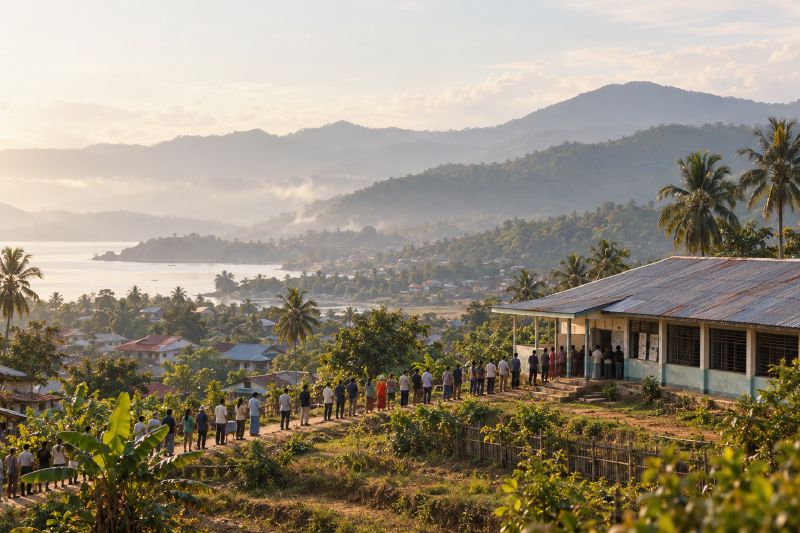
East Timor’s 1999 ballot never put independence to voters. It asked voters about special autonomy inside Indonesia, but everyone understood it as an independence vote. On 30 August 1999 the people of East Timor used it to vote for independence. After three years under a United Nations mission, the country became formally independent in 2002.
Twenty-four years of occupation
Indonesia had occupied the territory since 1975, after Portugal’s colonial rule ended. An estimated 180,000 Timorese died during the occupation, according to the Lowy Institute, an Australian think tank.
Indonesia controlled most of the territory by the early 1980s but never pacified it. Guerrillas fought on, helped by secret civilian networks, while Timorese abroad lobbied foreign governments.
The Santa Cruz massacre in 1991 changed how the outside world saw it. Indonesian forces killed or wounded hundreds of unarmed civilians, and international condemnation gave the resistance new momentum.
Why Indonesia allowed a vote
Jakarta did not want a referendum. It agreed under heavy international pressure, including from Australia, and the UN supervised the ballot. In Dili, a bridge now carries the name of B.J. Habibie, the Indonesian president who played a central part in the events that led to independence.
The violence around the ballot
Intimidation and violence marred the run-up to the vote. After the result, in September 1999, Human Rights Watch reported that the Indonesian army and local militias murdered, burned homes and drove people out.
An estimated 1,000 to 2,000 civilians were killed in the months before the vote and the days just after it. About 500,000 people were driven from their homes or fled. Human Rights Watch concluded the violence was planned by elements of the Indonesian government and army, to stop a free vote and to punish the result.
Justice was slow. In the first twelve verdicts of a special court in Jakarta, all nine military and police defendants were acquitted, and the only two people convicted were East Timorese.
The country now called Timor-Leste marked the vote’s twentieth anniversary on 30 August 2019.