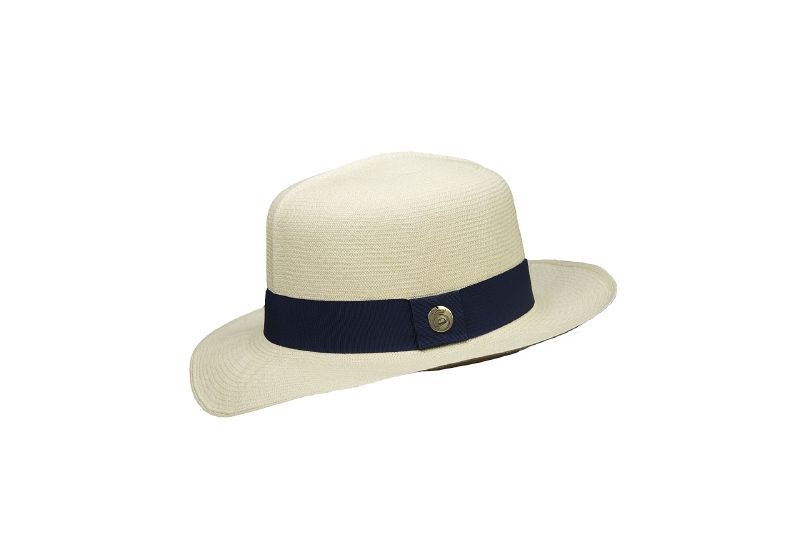
The Panama hat is named after where people bought it, not where it was made. Weavers in Ecuador make it from toquilla straw, and the hats reached the wider world through Panama. Buyers named them after the country of sale, and the label stuck. Roads & Kingdoms says its more correct name is the Montecristi hat, after the town where the hats are finished and sold.
more
When the name took hold
The sources agree on the route but not on the moment. Rough Guides dates it to the mid-19th century, when Ecuadorian straw hats traded in Panama became popular with gold prospectors. The Paris World Fair of 1855 then showed the hat to Europe as the “Panama hat”.
Smithsonian Magazine points to the canal instead. Workers building the Panama Canal wore the hats against the sun. In 1906 President Theodore Roosevelt inspected the works in a white linen suit and one of the hats. The photographs started a fashion. Wanderlust puts the number sent to canal workers in the 1900s at hundreds of thousands.
BBC Mundo gives a third version. In the first half of the 20th century, it reports, most of the hats were sold through the Panama Canal. Roads & Kingdoms records a legend that Roosevelt’s hat was a loan from Eloy Alfaro, Ecuador’s president.
Where the hat comes from
The straw grows from Panama to Bolivia, according to Rough Guides. Only Ecuador’s Manabí and Guayas provinces grow it well enough for hats. Weavers split, boil, dry and bleach the leaves before cutting them into straw.
The craft is old. Valdivian figurines from as early as 4000 BC appear to wear pointed straw hats. Spanish conquistadors called the local hats toquillas, from toca, a Spanish word for a wimple. In the 1940s the hat briefly became Ecuador’s top export.
Pile, a village of about 1,000 people in Manabí, claims the finest weaving of all. One weaver there, Simón Espinel, now makes two hats a year. One of his hats can sell for more than $25,000 in the United States. A superfino Montecristi takes three months to weave. Heat breaks the straw, so weavers work only early and late in the day.
Why Ecuador still minds
UNESCO listed the Montecristi hat as Intangible Cultural Heritage in 2012. Hats now carry the stamp “Genuine Panama Hat Made in Ecuador”.
The money rarely reaches the weaver. Roads & Kingdoms reported that a weaver earns $700 to $1,200 for a superfino hat. Cheap paper hats from China have cut prices and demand.
Panama has a straw hat of its own. The pinta’o, from the province of Coclé, carries dark woven patterns that look painted. Panama’s Artisan Registry lists 341 pinta’o makers.