Ecuador pushed out the Galápagos reserve’s boundary to protect the sea route its sharks, whales and turtles swim to Costa Rica. President Guillermo Lasso announced the 60,000 square kilometre addition at the COP26 climate summit in Glasgow in November 2021. Conservationists hoped it would protect the paths endangered whale sharks travel, and leave the reserve more resilient as the climate warms.
The old reserve was already large. Ecuador set it up in 1998, covering about 130,000 square kilometres of ocean, and UNESCO listed it as a World Heritage Site the same year.
Where the new line runs
The addition is two blocks of about 30,000 square kilometres each. One, between Ecuador and Costa Rica, bans all fishing. The other, north-west of the existing reserve, bans longline fishing.
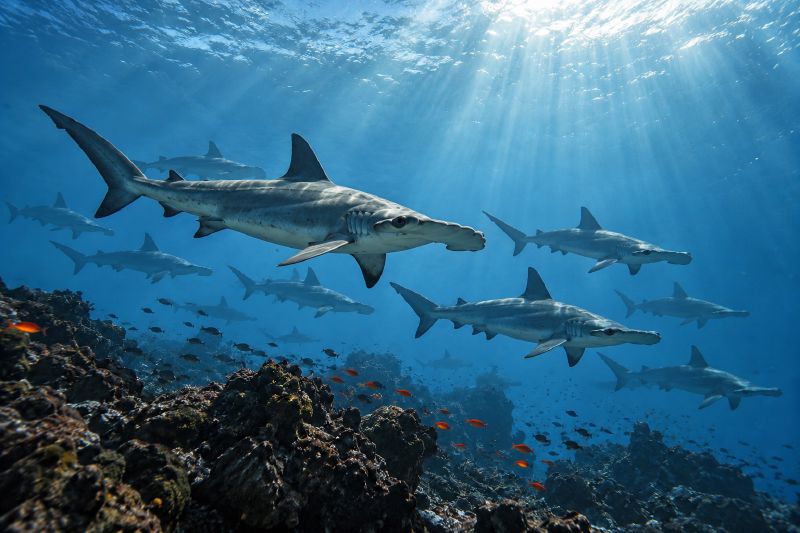
The no-take block covers part of the Cocos Ridge, a feeding and migration area for hammerhead sharks, whales, manta rays and sea turtles, according to Oceanographic. Divers now know the area as the Hermandad Marine Reserve, created in 2022 to protect what DAN World calls the Galápagos–Cocos Swimway.
A highway years in the planning
The corridor idea is older than the reserve. In 2004 Ecuador, Costa Rica, Panama and Colombia set up the Eastern Tropical Pacific Marine Corridor to link their marine reserves into one network.
In September 2016 the presidents of Ecuador, Colombia and Costa Rica met in the Galápagos and agreed to widen protection in their waters. National Geographic reported that Ecuador and Costa Rica swapped nautical charts that day to fix their maritime border, a step towards protecting the underwater highways used by migrating sharks and turtles. Earlier that year Ecuador had made the waters around Wolf and Darwin islands a sanctuary, closing about a third of the Galápagos waters to fishing.
Those waters are crowded with fish. Enric Sala, a National Geographic explorer, measured fish biomass around Wolf and Darwin at an average 17.5 tonnes a hectare, twice that of the next richest site known.
The fleet at the edge
Fishing pressure sits just outside the line. In 2020 more than 300 foreign fishing vessels, almost all Chinese, waited in international waters around the islands, reportedly for squid. Their presence there was lawful. Galápagos residents still remembered a Chinese vessel caught inside the reserve in 2017 with thousands of sharks on board.
Lasso denied that the fleet drove the decision. He told the BBC the expansion was an autonomous decision of the Ecuadorean government. Oceana later counted 510 Chinese vessels fishing more than 134,000 hours near Ecuador’s waters between January 2021 and August 2023, DAN World reported.
Who pays for the patrols
A line on a chart needs boats. Sharon Johnson, chief executive of the Galapagos Conservation Trust, told the BBC that resources had to follow to protect the enlarged reserve.
Lasso’s answer was a debt-for-conservation swap. DAN World reports that it turned $1.6 billion of commercial debt into a $656 million bond-financed loan, freeing $450 million for the Galápagos over 20 years. One early condition puts observers aboard at least 70% of the purse seiners by late 2024.