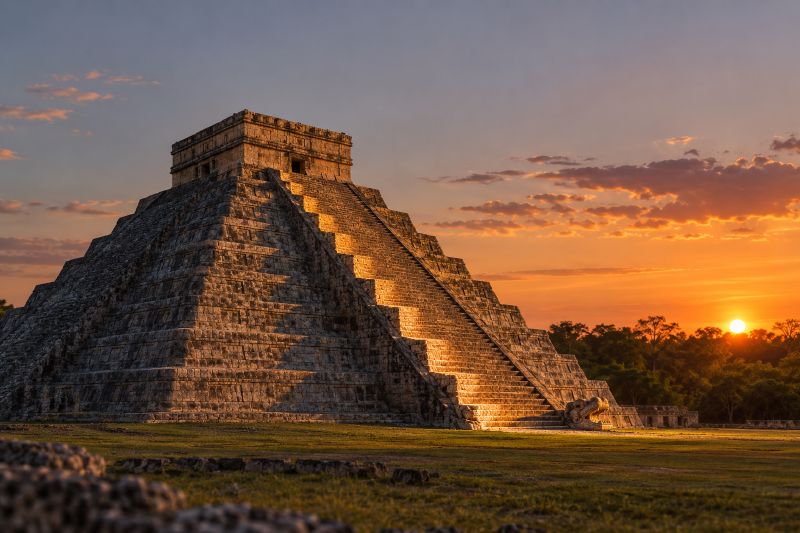
El Castillo has 365 steps because its builders made the pyramid count the days of the year. Each of its four staircases has 91 steps, and the platform at the top adds the last one. The Smithsonian’s National Museum of the American Indian gives the same sum: 91 on each side, plus the temple at the summit, makes 365.
The pyramid, also called the Temple of Kukulkan, stands at Chichén Itzá on Mexico’s Yucatán Peninsula. National Geographic calls a 365-day calendar one feat among many in Maya science.
A building that watches the sun
The steps are only part of the design. On the spring and autumn equinoxes, the setting sun throws a shadow down the pyramid’s north staircase in the shape of a serpent. The museum explains how it forms. The shadows of the pyramid’s nine platforms trace seven triangles of light on the side of the stairway. With the lit stone serpent head at the foot of the stairs, they read as a snake coming down from the sky.
Local Maya say that Kukulkan, the feathered serpent, is the cord that ties Earth to the sky, according to the museum.
Why the solar year mattered here
Chichén Itzá sits in the tropics, where the sun passes directly overhead at noon twice a year. At the site that happens on May 22 and July 19, when shadows of upright columns vanish. The museum says that careful watching of these zenith passages over centuries let the ancient Maya calculate the length of the solar year precisely.
El Castillo is not the only building tuned to the sky. The museum names El Caracol, the observatory, alongside it as a structure with astronomical meaning. National Geographic adds that Maya astronomers could predict solar eclipses.
When the city flourished
The sources differ on the dates. The museum says Chichén Itzá prospered from 950 to 1200 AD. National Geographic puts it as a sacred and urban centre from 750 to 1200. National Geographic also links the pyramid to Toltec influence after an invasion around 1000.
The site is large, with more than 20 groups of buildings joined by 75 causeways. UNESCO made it a World Heritage site in 1988. Ceremonies there continued into the 1550s, the museum notes, after the city had emptied.