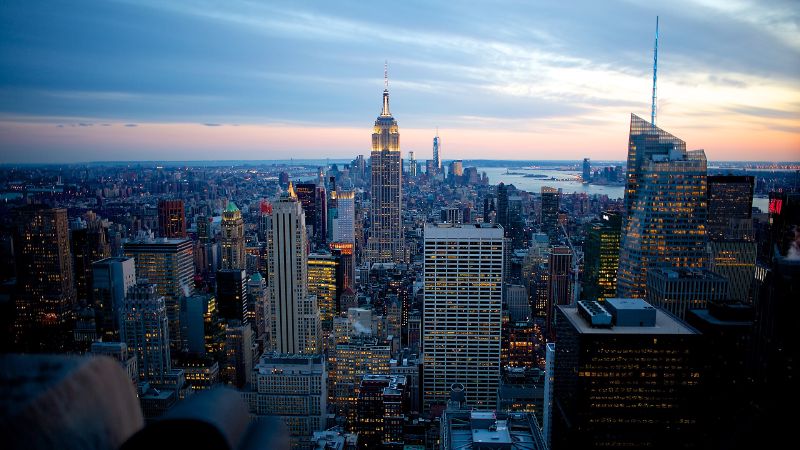
The Empire State Building went up in about 13 months, between the spring of 1930 and the spring of 1931, and it opened as the tallest building in the world. Its builders ran the site like a factory line. Parts were made elsewhere to a standard pattern, then brought to the site and put together.
more
The dates show how tight it was. Foundation work started on March 17, 1930, and by September 19 the steel frame had topped out at 1,048 feet, 23 weeks later. President Herbert Hoover opened the finished building on May 1, 1931, by pressing a button in Washington.
Who was it racing?
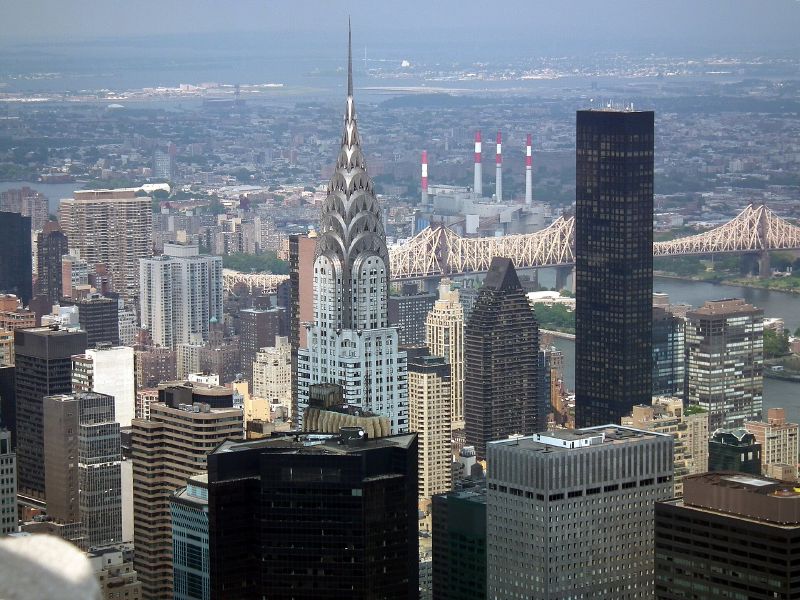
For 15 years nobody in New York built higher than the Woolworth Building. Its tower, finished in 1913, stood 792 feet tall. Then, in 1929, two towers went after the title at once. One was 40 Wall Street, in the financial district. The other was the Chrysler Building, first planned at 808 feet. Each side kept raising its figure. The owners of 40 Wall Street went to 927 feet, and the Chrysler’s architect, William Van Alen, answered with a 125-foot spire.
more
more
A 1930 report in The Builder, now reprinted by Building Design, said the cold reasoning of advertising value was stretched “to impossible proportions” by the craze. The Chrysler took the record when it topped out in October 1929.
It held the record for about a year. In August 1929 Empire State Inc. had announced its own plan for a 1,050-foot building. To make sure of the lead, it then added a 200-foot metal crown, which took the roof to 1,250 feet. The design changed fifteen times before its owners were sure it would be the tallest. When it was done, the Empire State Building stood 204 feet above the Chrysler and held more than twice its office space.
The money, and the hotel it replaced
The money came from a small group. John Jakob Raskob, a former General Motors executive, formed Empire State Inc. with Coleman du Pont, Pierre S. du Pont, Louis G. Kaufman, and Ellis P. Earle. They put Alfred E. Smith, a former Governor of New York, at its head. Smith had also just lost a race for the presidency as the Democratic candidate.
ArchDaily recounts that Smith and Raskob gathered wealthy financiers less than a month before the 1929 stock market crash. By the end of that meeting they had money to buy the old Waldorf-Astoria Hotel. The hotel sat on land the Astor family had held for more than a century. William B. Astor bought it as part of a farm in 1827. The Waldorf opened there in 1893, and in 1897 the Astoria joined it next door, according to the city’s Landmarks Preservation Commission. With 1,300 rooms, it was the largest hotel in the world by the time the wreckers came.
Demolition began on October 1, 1929. The owners had hired the architect William F. Lamb, of Shreve, Lamb and Harmon, the month before. They wanted tenants in by May 1, 1931, so design and construction ran side by side. The steel drawings were not finished until the middle of January 1930. Digging for the foundations began on January 22, with two 12-hour shifts of 300 workers each going round the clock.
How the steel rose so fast
Delivery was the hard part. The site had no room to store steel, so the contractor ordered it two floors at a time and had it arrive as needed. Two Pennsylvania firms, American Bridge Co. and McClintic-Marshall Co., made the members. They went by rail to a yard on the New Jersey waterfront, by barge to an East River pier, and by truck for the last stretch.
The quantity was huge for its day. The frame used 57,000 tons of structural steel, against 21,000 tons in the Chrysler Building. Thirty-eight riveting gangs joined beams and columns. Each gang had two riveters and a heater, plus a bucker-up and a helper or two. Every day, trucks brought 16,000 partition tiles and 5,000 bags of cement. Carts on a small railway took materials from basement stores to the elevators, and more track on the upper floors carried them on to the crews.
The general contractor, Starrett Brothers and Eken, was run by William A. Starrett. He had written a 1928 book on skyscrapers, which compared putting one up to waging war in peacetime. The building’s owners say the tower rose at about four and a half storeys a week. ArchDaily puts the peak at a little over one storey a day.
Hard times helped as well as hurt. Gothamist reports that the Depression cut the expected cost by more than half, and that crews worked Saturdays and every public holiday. ArchDaily says the job finished 45 days early and $5 million under budget.
One part of the plan never worked. Above the crown sat a 222-foot mast for mooring airships. The idea was soon given up as too dangerous.
Who were the men on the beams?
More than 3,000 workers were employed on the building, at a time of mass unemployment. The ironworkers who raised the frame went first, with carpenters, glaziers, tilers and stonemasons coming up behind them. Many of the ironworkers were Scandinavian, Irish-American, or Kahnawà:ke Mohawk.
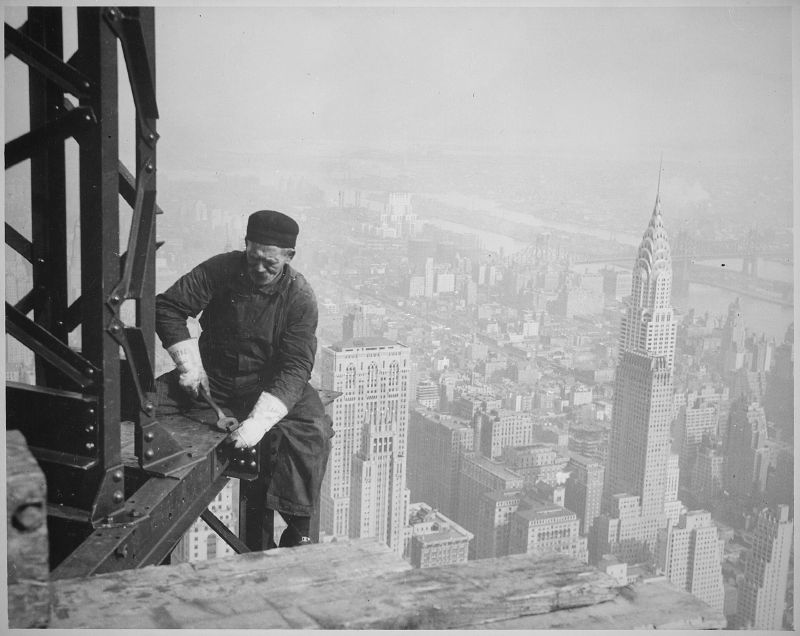
The Empire State Corporation hired Lewis Hine to photograph them as part of its publicity. Hine was 56 by then. He had spent a decade photographing for the National Child Labor Committee, and those pictures helped end child labour in the United States. Columbia University Libraries, which holds the building’s archive, says the Depression pushed him into this advertising job. The pictures still came out as close, often heroic studies of working men. Macmillan published them in 1932 as Men at Work.
Hine called the ironworkers his “Sky Boys”. One print, which he titled “Icarus”, shows an unnamed young ironworker gripping a hoisting cable, his head level with the clouds over New Jersey. The New York Public Library holds 42 of Hine’s photographs of the building going up. In another of his images, The Sky Boy, a man tightens a bolt so high that a fall would take about 11 seconds, by the Guardian’s reckoning.
The writer Glenn Kurtz has set out to name some of the men in his own book, also called Men at Work. A lobby plaque listing 32 workers given craftsmanship awards first drew him in. One of them was Victor “Frenchy” Gosselin, a connector, whose job was to catch a swinging beam and guide it into place. Hine’s shot of him astride a hoisting ball appeared on a US stamp in 2013.
Nobody agrees on how many died. The official count is five, according to both Gothamist and the Guardian. Kurtz puts it at eight or more. His figure includes seven construction workers and Elizabeth Eager, a passer-by struck by a falling plank. The BBC, marking the building’s 75th birthday, gave a higher figure of 14 immigrant workers killed.
The years as the tallest
The building did not pay at first. Because of the Depression and then the Second World War, its owners made no profit until the early 1950s. The observation deck was a draw from the start. The building’s owners say its telescopes took more than $3,000 in coins in six months. In 1933 King Kong put the tower in front of cinema audiences.
It stayed the world’s tallest building until the North Tower of the World Trade Center topped out in 1970. The Landmarks Preservation Commission’s report records that the Sears Building in Chicago then took the world title. After the attacks of September 11, 2001, it was once again the tallest building in New York. One World Trade Center passed it in 2012. The commission held its hearings on making the building a city landmark in 1979, and no speaker opposed it.
What happened when a bomber hit it?
On July 28, 1945, a US Army B-25 bomber flew into the building in fog. The pilot, Captain William F. Smith, was ferrying servicemen from Massachusetts to LaGuardia Airport. The control tower had advised him not to land because he could barely see.
Smith turned over midtown Manhattan. When the cloud broke, he found himself among skyscrapers, according to Arthur Weingarten, who wrote a book on the crash. The plane hit the 79th floor. Fourteen people died: Smith, the two others aboard, and 11 people working in the building.
Parts of an engine cut the cables of two elevators, which fell to the subbasement. A 19-year-old operator, Betty Lou Oliver, was inside one. She broke her pelvis, back and neck, and she lived.
The energy retrofit
A large energy retrofit ran from 2009 to 2011. It made the Empire State Building the tallest building in the United States with LEED certification. President Bill Clinton, Mayor Michael Bloomberg, and Anthony E. Malkin announced the programme. The building’s owners also list the replacement of 6,514 windows.
Engineering models forecast a 38 percent cut in energy use, worth $4.4 million a year. Lucas Davis, an economist at the University of California, Berkeley, looked at the metered results. Electricity use fell 29 percent in winter months, and by more in summer. He called for more years of data to refine the estimates, and for a closer look at which parts of the work saved the most.