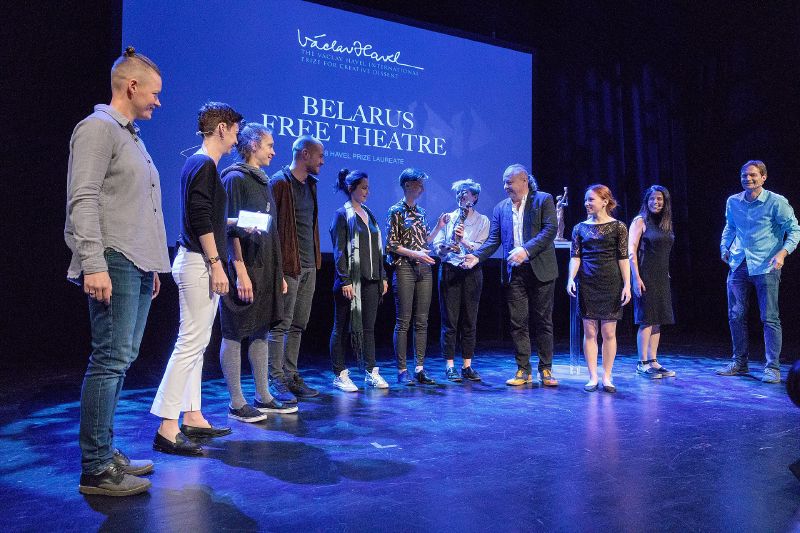
Belarus Free Theatre does not stop making theatre because a government banned it. It moved its actors, its director and whatever text it was rehearsing to a country that would have them, and carried on from there.
more
The company is the only one in Europe prohibited on political grounds, and for sixteen years it staged underground performances in Minsk from whatever space it could find. In October 2021, with reprisals against its members judged too likely, it moved its people out of the country instead.
Why the company left when it did
The trigger was the crackdown that followed Belarus’s disputed 2020 election. Several members of the company were imprisoned amid the protests that followed president Alexander Lukashenko’s declared victory. The theatre’s managing director, Svetlana Sugako, was one of them: held for five days, along with 35 others, in a cell built for four.
Sixteen members of the ensemble and nine family members left Minsk in October 2021, some smuggled out, carrying only clothing and small personal items. They arrived in London on six-month artists’ visas, timed to run alongside a production of Dogs of Europe at the Barbican. Co-founder Natalia Kaliada called the position “limbo”: the visas would expire when the run ended, and the company’s next base, considered to be Poland or another eastern European country, had not been settled.
What the company did before it left
Exile was not new to Belarus Free Theatre’s leadership. Kaliada and her co-founder Nikolai Khalezin had already been living in London since being forced into exile in 2011. The company’s associate director, Vladimir Shcherban, also lives in London. Shcherban has described his last performance in Minsk in person: a clandestine staging of Kathy Acker’s New York ‘79 for an audience of people who had come despite the risk, watched for the police at the door, and ended without an arrest. He has spoken to Belarusian audiences by video link ever since.
That pattern, performing for a home audience without being in the country, continued after the wider company left too. Belarus Free Theatre has streamed productions to viewers inside Belarus and performed clandestinely in courtyards, warehouses and garages in Minsk even while its senior members worked from abroad.
Other exiled artists, other hosts
Belarus is not the only source of exiled theatre-makers, and London is not the only destination. The Russian director Dimitry Krymov was blacklisted by the Russian government after publicly rebuking its invasion of Ukraine. He has stayed in the United States for safety reasons. The Off-Off-Broadway company La MaMa gave him an emergency residency in New York, where he staged two workshop productions with American casts in December, one of them adapted from Alexander Pushkin’s Onegin.
The common thread is an existing theatre institution abroad willing to absorb an artist or a company on short notice, ahead of any settled plan for what comes next. For Belarus Free Theatre, that meant the Barbican and a temporary visa. For Krymov, it meant La MaMa and a two-week workshop slot, running from 9 to 22 December, with performances open to the public but closed to reviewers. Neither arrangement answered where the work would go once the run ended.
Money moves alongside the work, when the destination allows it. Proceeds from the opening weekend of Krymov’s residency went to Cash for Refugees, a group supporting people displaced by the war he had spoken out against.
Vlad Kobets of the Belarusian Solidarity Centre in Warsaw, a group connected to the company, has said the exodus exposed something about the government the artists left behind. “You can’t build a country on nightsticks alone,” he said.