Alfred Nobel built his fortune on explosives, and his will gave most of it away to fund five prizes, one of them for peace. The usual explanation is a newspaper’s mistake: in 1888 a French paper wrongly reported Nobel dead and printed an obituary calling him a merchant of death. Smithsonian Magazine traced that story to its source and could not find the newspaper anywhere except attached to the tale itself. History Today points instead to the self-loathing that came with a family fortune built on instruments of destruction.
more
Where the merchant-of-death story comes from
In 1888, Nobel’s brother Ludvig died. A French newspaper confused the two men and ran Alfred’s obituary instead. Its headline translates as “the merchant of death is dead.” The text went further: it claimed he had grown rich by inventing quicker ways to kill people than the world had known before. By most tellings, Nobel saw it and did not like it.
How solid is the evidence?
Less solid than the story’s popularity suggests. Smithsonian Magazine’s Colin Schultz searched for the French paper named in every retelling and found that it barely exists outside the tale. Every version of the anecdote repeats the same two lines, translated the same way, with nothing new turning up in digitised newspaper archives or book scans. The Nobel Foundation does not tell this story on its own account, though Al Gore repeated it when he accepted his own Peace Prize in 2007. Annika Pontikis of the Nobel Foundation was asked directly about the story. She said Nobel had seen the obituary and been unhappy with it, but called it “probably not the only factor” behind the peace prize.
The Economist’s Oliver Morton has a phrase for what may have happened instead: “printing the legend.”
What actually built the fortune
Nobel was born in Stockholm on 21 October 1833, the son of an engineer and inventor. In 1842 the family moved to Russia, where his father ran a firm supplying the Tsar’s army. In 1850 he was sent abroad to study chemical engineering, and over two years he moved between Sweden, Germany, France and the United States. The family firm went bankrupt, and Nobel returned to Sweden with his father in 1863 to work on a substance he had grown fascinated by: nitroglycerine.
The chemical was violently unpredictable, and the cost of that showed early. A nitroglycerine explosion killed Nobel’s brother Emil in 1864. Nobel’s answer was to mix nitroglycerine into an inert silica, which made it safer and easier to handle. He patented the result as dynamite in 1867. Dynamite made Nobel famous, and builders were soon using it for tunnels, canals, railways and roads around the world. Through the 1870s and 1880s he built a network of explosives factories across Europe, and in 1894 he bought an ironworks at Bofors, Sweden, that grew into the Bofors arms works. He kept inventing to the end. By his death he held 355 patents.
What Nobel believed about his own work
History Today’s account of Nobel’s death points to a different root for the peace prize: a family fortune built on “instruments of destruction,” and the “self-loathing” that came with it. His father had made explosives and torpedoes for the Russian military. Nobel’s own dynamite found some of its earliest uses in the Fenian bombing campaign in Ireland, decades before the movements that became the IRA. He added to that fortune by investing in the oilfields of southern Russia, and bitter litigation over his patents left him with what History Today calls a sour view of human nature. Nobel came to believe that only a weapon terrible enough to make war unthinkable could ever stop one. He described humanity as “tailless apes running about on an aimless projectile in space.”
What the 1895 will set up
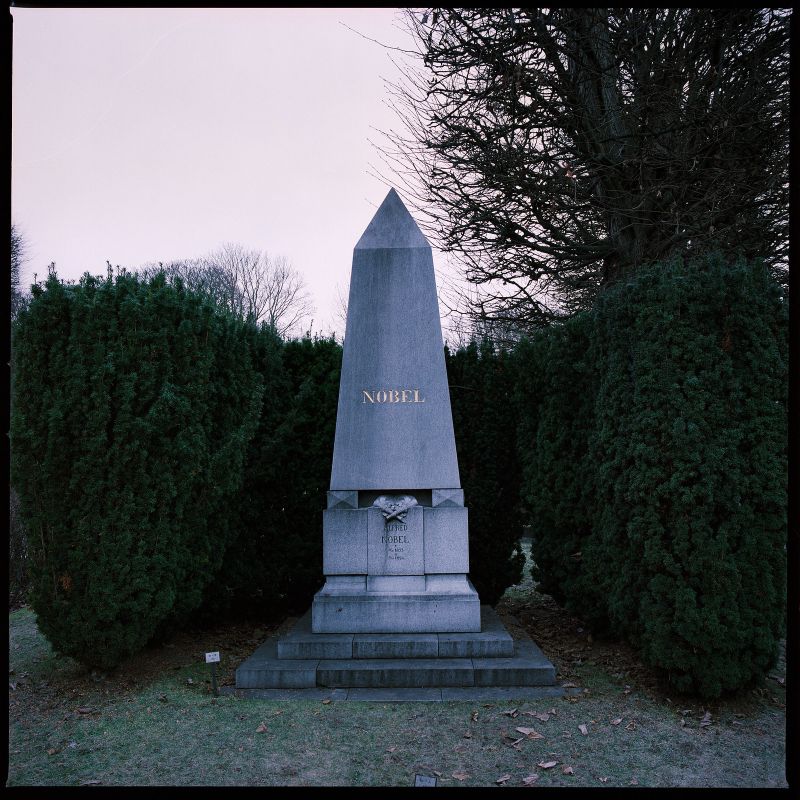
Accounts differ slightly on the date. The BBC’s history unit puts the signing of Nobel’s final will in November 1895. Smithsonian Magazine dates the decisive revision, made without his family’s knowledge, to that September. Either way, the will left more than 90 percent of his fortune to the prizes, a sum Smithsonian Magazine puts at roughly $250 million in today’s money. It set up annual prizes in physics, chemistry, physiology or medicine, and literature, alongside a fifth prize for “the cause of universal peace.” A sixth prize, in economics, was added later. Nobel died at San Remo, in Italy, on 10 December 1896, at the age of 63, and was buried in Stockholm. The first prizes were awarded in 1901.
The peace prize has since gone to figures such as Anwar Sadat and Menachem Begin for the Middle East peace process, and to F. W. de Klerk and Nelson Mandela for South Africa’s transition away from apartheid. Richard Cavendish, writing in History Today, closed his account of Nobel’s death by wondering what the inventor would have made of the atomic bomb.