Where Southern Gothic came from
Southern Gothic grew from an English novel about a haunted castle, transplanted to the American South and turned on the region’s own history. The gothic half of the name goes back to 1764. That year Horace Walpole, then the Whig member of parliament for King’s Lynn, wrote The Castle of Otranto. Walpole first passed the book off as a translation of a manuscript from 1529, and he only owned up to writing it in the second edition. Imitators followed fast. Clara Reeve published The Old English Baron in 1778, and MG Lewis published The Monk in 1796.
Walpole lived his taste before he wrote it. In 1749 he began a mock gothic castle at Twickenham, Strawberry Hill House, which became one of the first buildings of the gothic revival. The BBC traces a line from his novel to Edgar Allan Poe, whose “The Masque of the Red Death” drew directly on Otranto. That line matters here, because Publishers Weekly names Poe, with Nathaniel Hawthorne, as the genre’s foundation.
The castle, the curse and the family secret crossed the Atlantic. What the South added was a setting that already felt haunted. Jamie Kornegay, a bookseller in Greenwood, Mississippi, describes the genre as dark, mysterious stories set in an old, mannered South that has gone sour. In his telling, the mansions are grey, the residents are not quite right, and the righteous behave badly. God and the Devil turn up too, in the same muddy river.
The name itself began as a put-down. The novelist Ellen Glasgow coined it dismissively, according to a Southern Gothic writer from Richmond writing for Reactor. The same writer notes that functional families have been rare in the genre ever since.
Why the South, and why from the inside
The Louisiana novelist MO Walsh argues in The Guardian that the genre runs on authenticity. He points out that the writers he calls its “gods” came from Mississippi, Georgia, Alabama and Florida. In his view, a Southern Gothic novel by someone from outside the South is usually a bad one, because the form has to come from the culture rather than look down on it. He also credits an oral tradition of front porch storytelling for the genre’s delight in sentences.
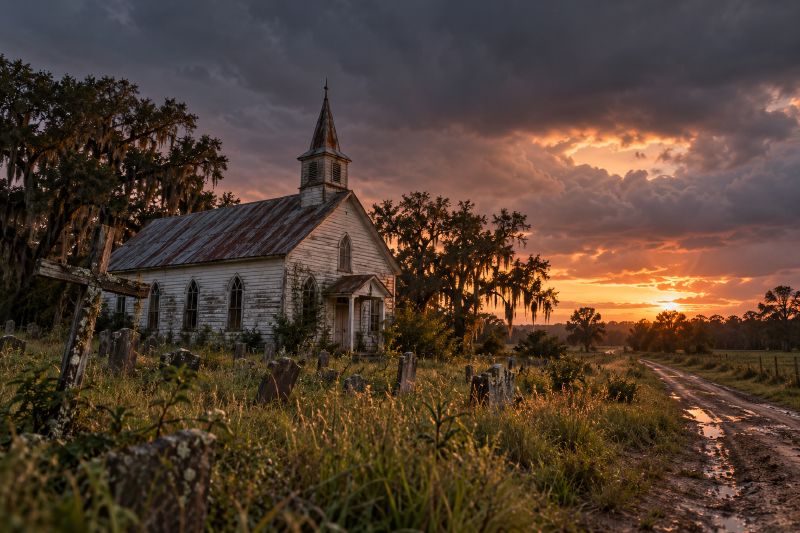
Landscape is the other half of his case. Walsh lists what a reader meets first in these books: Spanish moss, dusty gravel roads and stubble in the cotton fields. He argues that the land counts as gothic because it presses so hard on the people living in it. Even Scout Finch, the plain-spoken narrator of To Kill a Mockingbird, turns poet when she describes her sagging courthouse town.
The Mississippi Encyclopedia gives a clear picture of how that inside view formed in its central figure. William Faulkner was born in New Albany in 1897 and moved to Oxford in 1902. His great-grandfather, William C. Falkner, had been a lawyer, planter, Civil War officer, politician, railroad builder and novelist. The encyclopedia says his career seemed to leave his descendants with a sense of inevitable decline. Decline is the gothic’s native weather.
Faulkner also looked outward. From 1914 an Oxford lawyer, Phil Stone, ran a reading tutorial for him that lasted more than a decade, covering the French Symbolists, Joyce, Pound and Eliot. In 1925 Faulkner spent six months in the French Quarter of New Orleans, among writers including Sherwood Anderson. The critic Allen Tate described the Southern Renaissance generation as having a “double focus”. The encyclopedia reads it as a look back to the Civil War and forward to modernism.
After six months in Europe, much of it in Paris, Faulkner came home in 1926. He married his high school sweetheart, Estelle Oldham Franklin, in 1929 and settled in Oxford for good. Apart from spells in Hollywood writing screenplays for money, he lived and wrote there for the rest of his life. Southern Gothic sits in exactly that tension: old ghosts, new forms.
The grotesque gets a name
A related term is the Southern grotesque. The Paris Review counts Flannery O’Connor, and Carson McCullers before her, as practitioners of it, with O’Connor adding stories of faith and religion. O’Connor took an odd road there. At Georgia State College for Women she drew cartoons seriously and hoped to match James Thurber’s success at The New Yorker. She went instead to the University of Iowa, first for journalism and then for the Writers’ Workshop.
The Library of America’s James Gibbons says “A Good Man Is Hard to Find” opens like a southern-fried James Thurber, a lightly satiric family comedy, before it turns terrifying.
The writers who built it
The foundations are older than the South’s own writers. Writing for Publishers Weekly, the novelist behind a list of 10 books argues that Nathaniel Hawthorne and Edgar Allan Poe laid the base. On that view, mid-century writers such as Faulkner, O’Connor and McCullers set the posts and beams.
more
Eudora Welty and the post office
Eudora Welty made her debut in 1941 with A Curtain of Green, a story collection. Her story “Why I Live at the P.O.” follows a young postmistress who walks out on her squabbling family and moves into the post office. Kirkus contributing editor Gregory McNamee calls it a prime piece of Southern Gothic with loopy plot turns. He also rates the collection’s title story, in which a widow weighs killing a man with a hoe, as a rival to Faulkner’s “A Rose for Emily”.
McNamee met Welty at a reading in New Orleans and told her he liked teaching “Why I Live at the P.O.”. She answered that she was not sure she could teach it herself, and was glad he could. Her sense of racial fairness ran through her work too. Toni Morrison said Welty wrote about Black people “the way they should be written about”. An early email program, Eudora, took its name from her, because post offices kept turning up in her stories.
Flannery O’Connor and the theology of the back road
O’Connor gathered “A Good Man Is Hard to Find” into a 1955 collection of the same name. Gibbons notes that the killings happen at the edges of the story, which gives it the restraint of classical tragedy. At its core, he writes, the Misfit and the grandmother are having a theological discussion despite their plain speech.
Lit Hub’s Gothic canon picks her second and last novel, The Violent Bear It Away, in which a boy tries to escape a prophecy that he will become a prophet. The essay argues that O’Connor rebuilds the old Gothic ruins, violence and death to jolt the reader into transcendence.
She did not have long. When O’Connor died at 39, she had published two novels, 31 short stories and a slim body of criticism. Milton Glaser drew the sooty portrait on the 1967 Farrar, Straus and Giroux jacket of Wise Blood, her first novel. The Paris Review reports that the designers who redrew all five of her books still kept that cover in mind.
Kornegay puts that first novel on his list. Its anti-hero, Hazel Motes, arrives in town angry and turns the anger into a street ministry for atheism. Kornegay finds him darker and stranger than Ignatius J. Reilly, the hero of A Confederacy of Dunces.
Who sits at the table
MO Walsh, when critics called his own novel Southern Gothic, pictured himself at a party with Faulkner, O’Connor, Harper Lee, Barry Hannah and Zora Neale Hurston. Kornegay reports that readers in the South regard Hannah as the saviour of modern Southern literature. He names Cormac McCarthy as the face of modern Southern Gothic, from the years before McCarthy moved west. Kornegay notes that McCarthy described the heinous and unholy in formal, poetic language.
The crime novelist SA Cosby puts the tradition in three words. He told The Guardian that race, class and sex are “the holy trinity of southern fiction”. He cites Faulkner’s Light in August and O’Connor’s Wise Blood as the great books built on them.
The Paris Review’s Mississippian
Elizabeth Spencer, another Mississippian, shows how wide the circle ran. The Paris Review notes that most critics place her in the Southern tradition, though she lived for years in Italy and Canada. Her first two novels won her a citation from the American Academy and the National Institute of Arts and Letters in 1952. She taught creative writing at the University of Mississippi before she moved abroad.
The books that set the rules
In his novels up to Go Down, Moses in 1942, Faulkner widened a Southern drama into a study of broader social conditions. The Mississippi Encyclopedia lists the people who move through them. They include Addie Bundren in As I Lay Dying (1930) and Temple Drake in Sanctuary (1931). Lena Grove walks through Light in August (1932). Quentin Compson haunts Absalom, Absalom! (1936). All of it happens in Yoknapatawpha County, a fictional place modelled partly on Oxford, where Faulkner stayed while most American modernists left home.
more
Race drives the best of it. The encyclopedia calls race the great moral issue of Faulkner’s time and place, and the force behind his greatest fiction. Light in August and Absalom, Absalom! both turn on the murder of a man made Black by the society around him: Joe Christmas and Charles Bon.
Sex runs through the same books as a test. The encyclopedia traces it to Caddy Compson’s rebellion in The Sound and the Fury, which both appals and fascinates her brother Quentin. In its reading, Faulkner’s women chase experience while his men retreat from it in fear of contamination. In Light in August, the encyclopedia argues, Faulkner treats racial difference as cultural rather than biological.
One story that teaches the whole genre
O’Connor’s “A Good Man Is Hard to Find” shows the machinery at work in a few pages. A family drives off the highway to find a plantation house rumoured to hold a cache of silver that Sherman’s armies passed over. Gibbons reads that as a romantic, old-fashioned gothic fantasy. Then the car turns down a dirt road, and the old gothic gives way to a modern one that is bare, malevolent and terrifying.
Along the way O’Connor holds the sentimental myths of the old South up to scrutiny through the grandmother’s silly clichés, including her thought of Gone With the Wind at a plantation graveyard. In her essay “The Grotesque in Southern Fiction”, O’Connor described storytelling as a kind of reparation, a chance for what has fallen to be restored.
After the masters
Cormac McCarthy published Child of God in 1973. Its subject, Lester Ballard, is a destitute and violent man in Sevier County, Tennessee, who drifts out of human society into murder and necrophilia. The Publishers Weekly writer argues that McCarthy makes Ballard the product of his community rather than an exception to it.
Toni Morrison’s Beloved won the Pulitzer Prize in 1988. It follows Sethe, a woman who escaped slavery to Ohio, when a young woman named Beloved arrives at her door. The same list praises it as the best book about trauma that cannot be escaped. It still shapes new writers. Yah Yah Scholfield, whose Southern Gothic debut came out in January 2026, names Beloved among their gothic references.
Not every book on this ground is a novel. The Alabama folklorist Kathryn Tucker Windham published 13 Alabama Ghosts and Jeffrey in 1969. The Paris Review notes that the book is required reading in many of the state’s elementary schools. One of its stories tells of the steamboat Eliza Battle, which burned on the Tombigbee River in 1854 and killed half its passengers.
The Paris Review argues that Welty, O’Connor and Harper Lee are too often cast as reclusive Southern spinsters. Welty’s own reach was wider. After the crime novelist Ross Macdonald sent her his first fan letter in 1970, praising Losing Battles, the two wrote to each other until his death in 1983. They exchanged some 345 letters.
Windham’s book carries the same weight in a darker register. In one tale the face of a lynched man appears in a courthouse window after the mob has gone, and stays there. The Paris Review calls that streaked pane a Rorschach test for the Southern conscience.
How it travelled
The genre left the South through crime and horror, and through readers abroad. In 2015, as Harper Lee’s Go Set a Watchman came out, Walsh asked in The Guardian why Southern Gothic sells around the world. His answer was the underdog. In To Kill a Mockingbird, he notes, almost everyone in the courtroom believes they are doing right against the odds.
Grit lit
McCarthy’s early books set off a movement of their own. Kornegay credits them with inspiring grit lit and names its major talents.
- Larry Brown, for Father and Son
- Daniel Woodrell, for Winter’s Bone
- Ron Rash, for One Foot in Eden
Out of the Deep South
Later the genre moved north and west, and into other genres. The Publishers Weekly list tracks the shift.
- Gillian Flynn’s Sharp Objects (2006) sends a scarred journalist back to her home town of Wind Gap, Missouri, to cover two murders.
- Matt Ruff’s Lovecraft Country (2016) mixes pulp science fiction with Southern Gothic, and makes Jim Crow the true villain.
- John Hornor Jacobs’s 2019 novella “My Heart Struck Sorrow” follows a Library of Congress archivist collecting field recordings in the 1930s South.
- Sylvia Moreno-Garcia’s Mexican Gothic (2020) moves the old mansion and depraved family to the Mexican countryside.
Publishers Weekly reports that the place-bound gothic has gone global since then. Kylie Lee Baker’s Japanese Gothic, out in April 2026, sets its haunting in a house in rural Japan.
Into horror
Reactor argues that the genre’s tension comes from America’s history of slavery, violence, injustice and class inequality. On that reading, a writer barely has to tinker with the ingredients to tip a book into full horror. Reactor calls Cherie Priest perhaps the premier living writer of Southern Gothic horror. Her novel The Toll sends something out of a swamp every thirteen years to collect its due.
Karen Russell’s Swamplandia! takes the same humidity somewhere stranger. A family’s alligator-wrestling park in Florida is falling apart, and the middle daughter is engaged to a ghost.
The parent genre keeps growing too
The Southern strain is one branch of a much larger tree. Lit Hub traces the mystery, the detective story and the horror novel to a common root in 18th-century Gothic fiction, such as Walpole’s and Ann Radcliffe’s novels. Publishers Weekly notes that gothic novels have always been bound to their places, from Otranto onward. For a 2026 novel, Vincent Tirado set a family horror in an old house after watching an adaptation of Poe’s “The Fall of the House of Usher”. Leila Siddiqui went back to the gothic’s own birthplace. Her novel The Glowing Hours imagines the Villa Diodati in Switzerland as haunted, during the June 1816 house party where Mary Shelley began Frankenstein.
Kornegay’s own picks show the genre’s range at home. Barry Hannah’s last novel, Yonder Stands Your Orphan, sets a casino pimp called Man Mortimer loose on a lake community near Vicksburg. Brad Watson’s The Heaven of Mercury, a love story in a small Mississippi town, has been called Southern magical realism. Kornegay argues that its ghosts and dark comedy earn it the gothic label.
Where Southern Gothic stands now
Electric Literature argues that the genre was long dominated by men, and that 21st-century books by women are shifting it. The newer books care less about the region’s place in history and more about the private lives of ordinary people. It says no account of the new Southern Gothic can leave out Lauren Groff, whose story collection Florida is among its picks.
The genre still sells and wins prizes. SA Cosby’s Blacktop Wasteland, a heist thriller set in Virginia, topped Amazon’s mystery and thriller chart. It was also a New York Times notable book of the year. In 2021 he told The Guardian that his next book was a Southern Gothic murder mystery, tentatively titled All the Sinners Bleed. It follows the first Black sheriff of a small Southern town in 2017.
His route there was not smooth. Before the breakthrough he worked 60 hours a week managing a hardware store, and drove round bookshops with a boot full of his first crime novel. An agent, Josh Getzler, signed him after a Florida crime convention panel on Southern fiction. His follow-up, Razorblade Tears, is a revenge thriller about homophobia across communities in the Deep South.
Cosby writes from inside the history Walsh describes. He went to Lee-Jackson Elementary, named after two Confederate generals, and he lives in a town with a Confederate statue outside its courthouse.
The old masters, reissued
The anniversaries keep coming. The Library of America marked O’Connor’s centenary in 2025 with an essay on “A Good Man Is Hard to Find”. Kirkus marked 80 years of Welty’s A Curtain of Green in 2021, calling it a hallmark of Southern and American literature. The Paris Review has revived a stranger case. The British actor Irene Handl wrote what it calls a high-camp Southern Gothic, first published in Britain in September 1965.
Where the newer books go
Some of the strongest new work moves the South forward in time. Joe R. Lansdale’s Moon Lake opens in 1968, when a grieving father drives himself and his son off a bridge in East Texas. The father dies, the boy survives, and a Black family takes him in. Years later a sheriff calls with new information, and the grown man goes back to the scene. Lansdale has written more than 30 novels, and the list calls him a master of the form. The Publishers Weekly writer says anyone curious about the genre’s future should read John Hornor Jacobs.
Kornegay was not sure the genre could work in a modern setting until he read John Brandon’s Citrus County. That novel, set in rural Florida, sees an eighth-grade boy commit a terrible act and lets it simmer. Kornegay calls the result New South Gothic.
The oldest picks still hold their place. Kornegay puts Faulkner’s Sanctuary first on his list. It caused a scandal on publication in 1931, and he finds it more sinister than modern crime novels. He leaves out To Kill a Mockingbird, which he finds too honourable to be properly gothic.
Walsh argued in 2015 that the genre has to come from inside the culture. Cosby, a Black writer who went to a school named for Confederate generals, is one answer to who gets to write it now.
Starter guide
Every book here has two independent publications behind it.
- The Sound and the Fury (William Faulkner, 1929). The Guardian puts it 57th in its 2026 list of the 100 best novels, as voted for by authors, critics and academics. The New York Review of Books refers to it, with As I Lay Dying, as one of Faulkner’s early “modernist masterpieces”. It notes that the mainstream critical tradition focused on them.
- As I Lay Dying (William Faulkner, 1930). The Guardian ranks it No 55 in its series on the 100 best novels. Smithsonian lists it among Faulkner’s “classics”.
- Light in August (William Faulkner, 1932). In the London Review of Books, Sean O’Faolain calls it Faulkner’s “indubitable masterpiece”. A New York Review of Books essay calls it “one of his greatest novels”.
- Absalom, Absalom! (William Faulkner, 1936). The New York Review of Books says some critics think it Faulkner’s greatest novel. Smithsonian lists it among Faulkner’s “classics”.
- The Heart Is a Lonely Hunter (Carson McCullers, 1940). The Guardian calls it her “classic novel”. Her biographer Mary V. Dearborn tells the Library of America it is what she considers McCullers’s best book. Electric Literature calls it her “masterpiece”.
- Wise Blood (Flannery O’Connor, 1952). The Guardian includes it in its 2003 list of the 100 greatest novels of all time. Publishers Weekly places it second in its “10 Best Southern Gothic Books”.
- A Good Man Is Hard to Find (Flannery O’Connor, 1955). Smithsonian calls the 1955 collection one of her “seminal collections”. The Library of America calls the title story one of O’Connor’s greatest. Britannica says the collection holds several stories “generally considered masterpieces of the form”, the title story among them.
- Beloved (Toni Morrison, 1987). The Paris Review calls it the book “widely regarded as her masterpiece”. Smithsonian calls it a “seminal text”.